

europium
-
What is europium?
Europium (Eu) is a chemical element, a rare-earth metal in the lanthanide series of the periodic table. It is the least dense, softest, and most volatile member of the lanthanides.
Europium was discovered in 1901 by French chemist Eugène-Anatole Demarçay and named for Europe. It is one of the least abundant rare earth elements, with its concentration in Earth’s crust being nearly the same as bromine’s. It occurs in minute amounts in rare-earth minerals like monazite and bastnasite, and also in nuclear fission products.
Key properties:
- Atomic number: 63
- Atomic weight: 151.965
- Melting point: 822 °C (1,512 °F)
- Boiling point: 1,527 °C (2,781 °F)
- Oxidation states: +2, +3
Europium is primarily used in red phosphors in optical displays and TV screens using cathode-ray tubes, and in glass for fluorescent lamps. It is also used in scintillators for X-ray tomography and as a blue color source in light-emitting diodes (LEDs).
2 Britannica SourcesCreated from Britannica articles using AI. AI can make mistakes, so verify using Britannica articles. -
Where is europium found on the periodic table?
Europium (Eu) is a chemical element and a rare-earth metal belonging to the lanthanide series of the periodic table. It has an atomic number of 63 and an atomic weight of 151.965. This element is known for being the least dense, softest, and most volatile among the lanthanides.
1 Britannica SourceCreated from Britannica articles using AI. AI can make mistakes, so verify using Britannica articles. -
What are the main physical properties of europium?
Europium (Eu) is a rare-earth metal in the lanthanide series. It is the least dense, softest, and most volatile lanthanide.
Key properties of europium:
* Silver-colored, but quickly oxidizes and dulls in air
* Reacts rapidly with water and diluted acids
* Very strong paramagnet above 90 K (-183 °C), and antiferromagnetic below that temperature, forming a spiral structure
* Exists in a single allotropic (structural) form
* Body-centered cubic structure with ( a = 4.5827 ) Å at room temperature
* Melting point of 822 °C (1,512 °F) and boiling point of 1,527 °C (2,781 °F)
* Specific gravity of 5.244 at 25 °C
* Oxidation states of +2 and +32 Britannica SourcesCreated from Britannica articles using AI. AI can make mistakes, so verify using Britannica articles. -
How was europium discovered and who discovered it?
Eugène-Anatole Demarçay, a French chemist, discovered europium (Eu) in 1901 and named it after Europe. This rare-earth metal is part of the lanthanide series in the periodic table.
Europium is one of the least abundant rare earth elements, with its concentration in Earth's crust nearly the same as bromine. It is found in trace amounts in minerals like monazite and bastnasite, as well as in nuclear fission products.
1 Britannica SourceCreated from Britannica articles using AI. AI can make mistakes, so verify using Britannica articles. -
What are some common uses of europium?
Europium (Eu) is a chemical element of the lanthanide series. It is used in red phosphors in optical displays and TV screens using cathode-ray tubes and in glass for fluorescent lamps. It is also used in X-ray tomography scintillators and as a blue color source in light-emitting diodes (LEDs). Europium and dysprosium are used in control rods because they absorb a high number of neutrons.
3 Britannica SourcesCreated from Britannica articles using AI. AI can make mistakes, so verify using Britannica articles. -
Why is europium important in modern technology, like TVs and energy-efficient lights?
Europium (Eu) is a rare-earth metal that is important in modern technology due to its unique properties. It is used as a red phosphor in optical displays and TV screens that use cathode-ray tubes. Europium is also used in fluorescent lamps and as a source of blue color in light-emitting diodes (LEDs).
4 Britannica SourcesCreated from Britannica articles using AI. AI can make mistakes, so verify using Britannica articles.
europium (Eu), chemical element, a rare-earth metal of the lanthanide series of the periodic table. Europium is the least dense, the softest, and the most volatile member of the lanthanide series.
The pure metal is silvery, but after even a short exposure to air it becomes dull, because it readily oxidizes in air to form Eu(OH)2 ∙ H2O. Europium quickly reacts with water and diluted acids—except hydrofluoric acid (HF), in which it is protected by a layer of EuF3. Europium is a very strong paramagnet above about 90 K (−183 °C, or −298 °F); below that temperature the metal orders antiferromagnetically, forming a spiral structure.
The element was discovered in 1901 by French chemist Eugène-Anatole Demarçay and named for Europe. One of the least abundant rare earths (its concentration in Earth’s crust is nearly the same as bromine’s), it occurs in minute amounts in many rare-earth minerals such as monazite and bastnasite and also in the products of nuclear fission.



 " height="20" alt="HEW Logo">
Both of its naturally occurring isotopes are stable: europium-151 (47.81 percent) and europium-153 (52.19 percent). A total of 34 (excluding nuclear isomers) radioactive isotopes, varying in mass from 130 to 165 and having half-lives as short as 0.9 millisecond (europium-130) and as long as 36.9 years (europium-150), have been characterized.
Europium is usually separated from the other rare earths by reducing it to the +2 oxidation state and precipitating it with sulfate ions. The metal has been prepared by electrolysis of the fused halides and by reduction of its oxide by lanthanum metal followed by distillation of the europium metal. Europium exists in a single allotropic (structural) form. It is body-centred cubic with a = 4.5827 Å at room temperature. The primary use of europium is in red phosphors in optical displays and TV screens that use cathode-ray tubes and in glass for fluorescent lamps. It is also used in scintillators for X-ray tomography and as a source of blue color in light-emitting diodes (LEDs).
In its predominant oxidation state of +3, europium behaves as a typical rare earth, forming a series of generally pale pink salts. The Eu3+ ion is paramagnetic because of the presence of unpaired electrons. Europium possesses the most easily produced and stablest +2 oxidation state of the rare earths. Europium(+3) solutions can be reduced by zinc metal and hydrochloric acid to give Eu2+ in solution; the ion is stable in dilute hydrochloric acid if oxygen from the air is excluded. A series of white to pale yellow or green europium(+2) salts are known, such as europium(II) sulfate, chloride, hydroxide, and carbonate. The halides may be prepared by hydrogen reduction of the anhydrous trivalent halides.
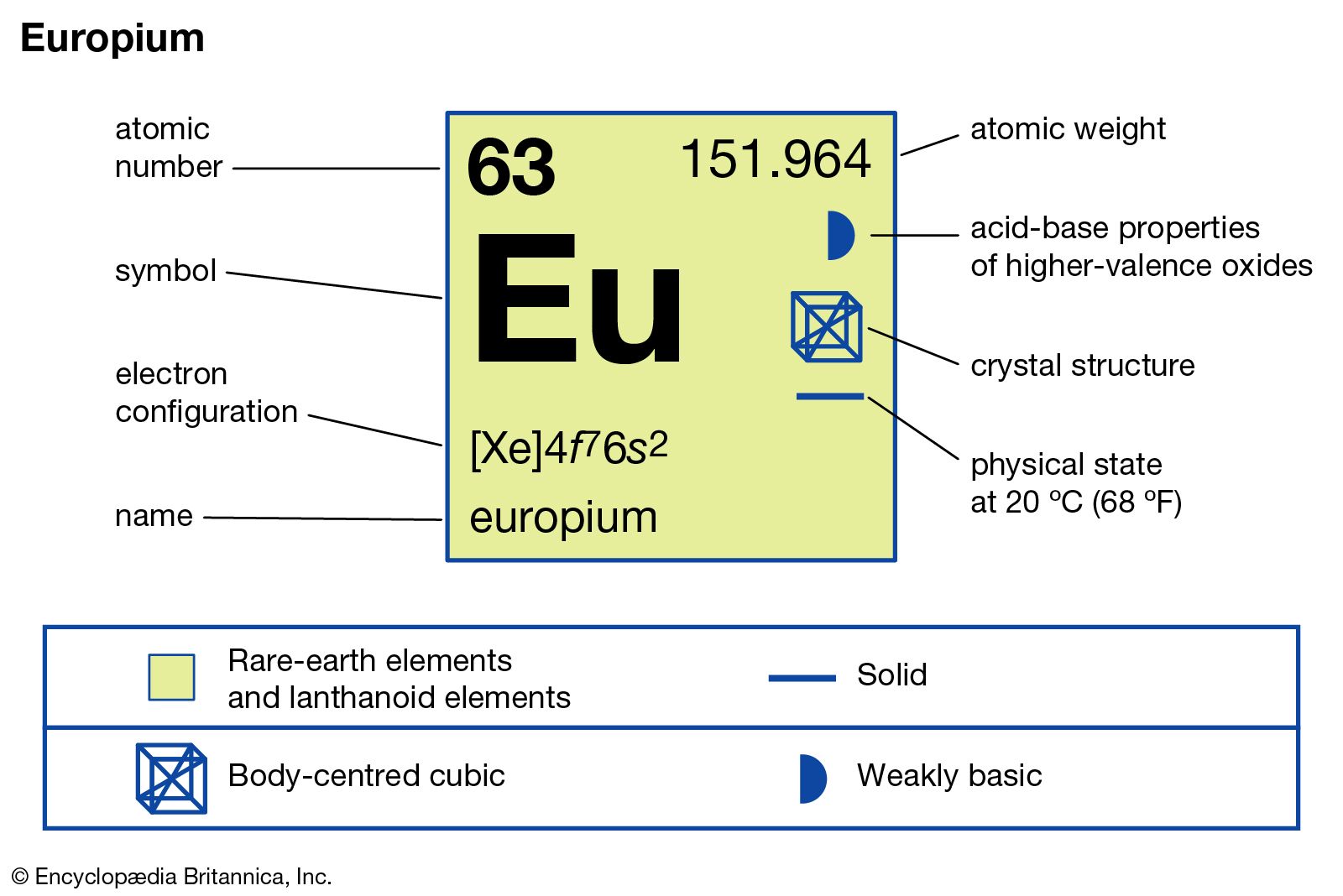
| atomic number | 63 |
|---|---|
| atomic weight | 151.965 |
| melting point | 822 °C (1,512 °F) |
| boiling point | 1,527 °C (2,781 °F) |
| specific gravity | 5.244 (25 °C) |
| oxidation states | +2, +3 |
| electron configuration | [Xe]4f 76s2 |