

equilibrant
Quick Summary

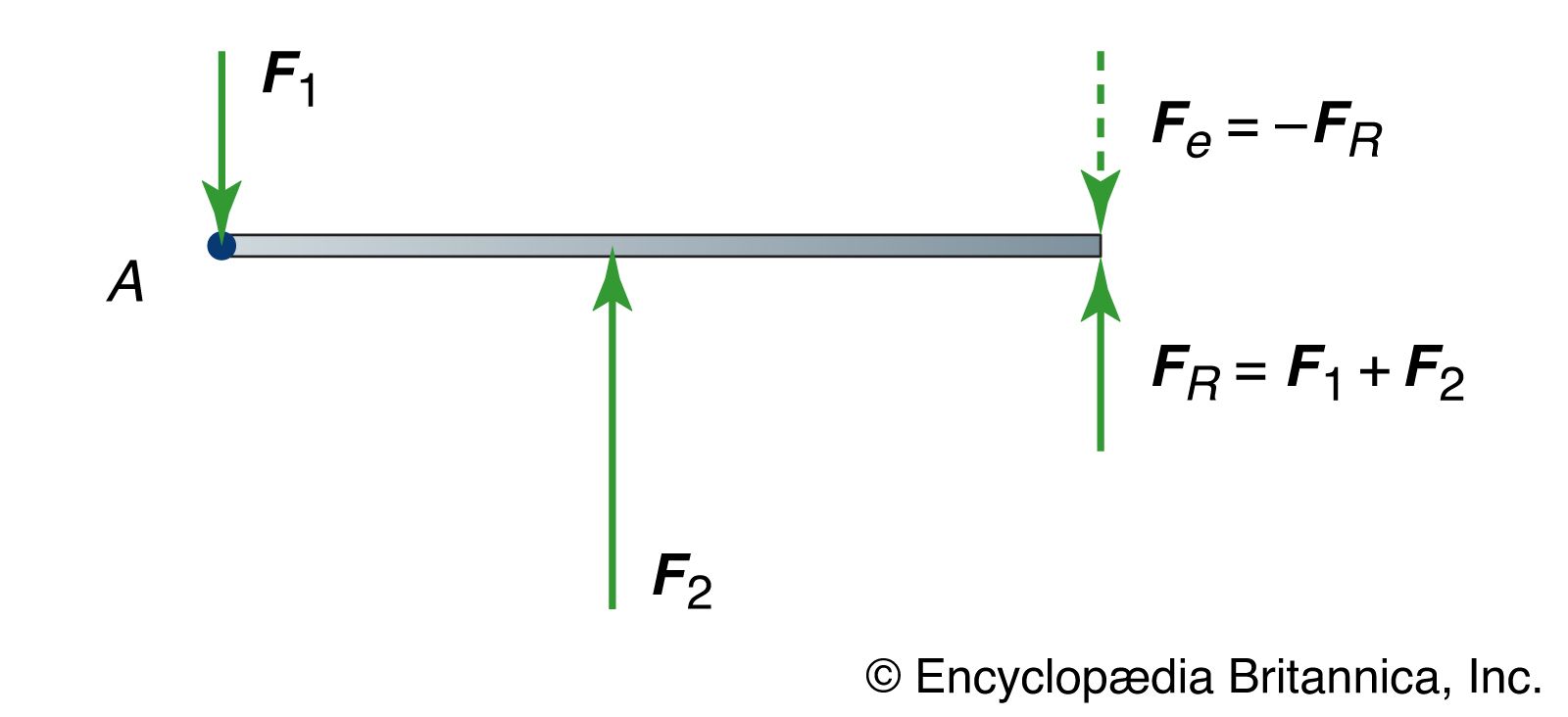
In mechanics, an equilibrant is a force that balances one or more unbalanced forces, bringing a system into a state of equilibrium. Equilibrium occurs when a system's state of motion and internal energy do not change over time. For a single particle, equilibrium is achieved when the vector sum of all forces acting on it is zero. A rigid body is in equilibrium if the sum of forces and the sum of torques acting on it are both zero, meaning its linear and rotational motion remain constant.12
Newton's laws of motion are fundamental to understanding equilibrium. The first law states that an object will remain at rest or in uniform motion unless acted upon by an external force. The second law relates force, mass, and acceleration ((F=ma)). The third law states that for every action, there is an equal and opposite reaction. When forces acting on an object are balanced, it is in equilibrium and does not accelerate.3
Ask Britannica AI about this topic
Britannica doesn't have a full article on this topic, so we've curated a list of our relevant coverage.
