

endosurgery
Quick Summary
Endosurgery, a form of minimally invasive surgery, utilizes specialized instruments and endoscopes inserted through small incisions to perform procedures inside the body. This approach allows for internal video imaging, enabling surgeons to operate on various organs and joints such as the gallbladder, appendix, uterus, fallopian tubes, shoulders, and knee joints. While offering advantages over traditional open surgery, endosurgery can sometimes be more expensive and may have higher complication rates. Robotic surgery, a related advancement, uses machines guided by doctors to enhance precision and dexterity, often facilitating minimally invasive procedures.12
Ask Britannica AI about this topic
Britannica doesn't have a full article on this topic, so we've curated a list of our relevant coverage.

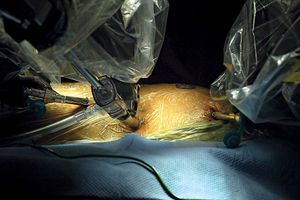 robotic surgery
…operations to take place through minimally invasive incisions, to eliminate unwanted motion and improve surgical dexterity, and to allow remote surgery. Those applications have been viewed variously as compelling and controversial. In the early 21st century, even as scientists reported on the benefits of robotic surgery—which included decreased complication and…
Read More…operations to take place through minimally invasive incisions, to eliminate unwanted motion and improve surgical dexterity, and to allow remote surgery. Those applications have been viewed variously as compelling and controversial. In the early 21st century, even as scientists reported on the benefits of robotic surgery—which included decreased complication and…
Read More- robotic surgeryHistorical developments
…approach represented a type of minimally invasive surgery. Some surgeons sought to develop surgical robots that could aid in minimally invasive procedures. By the late 1990s three systems designed for minimally invasive surgery had been tested: the da Vinci Surgical System, developed by California-based Intuitive Surgical, Inc., and the AESOP…
Read More…approach represented a type of minimally invasive surgery. Some surgeons sought to develop surgical robots that could aid in minimally invasive procedures. By the late 1990s three systems designed for minimally invasive surgery had been tested: the da Vinci Surgical System, developed by California-based Intuitive Surgical, Inc., and the AESOP…
Read More - robotic surgeryHistorical developments
…1990s three systems designed for minimally invasive surgery had been tested: the da Vinci Surgical System, developed by California-based Intuitive Surgical, Inc., and the AESOP and Zeus Robotic Surgical systems, both developed by Computer Motion, Inc., another California company. Many novel robotic surgeries were carried out by the Zeus system…
Read More…1990s three systems designed for minimally invasive surgery had been tested: the da Vinci Surgical System, developed by California-based Intuitive Surgical, Inc., and the AESOP and Zeus Robotic Surgical systems, both developed by Computer Motion, Inc., another California company. Many novel robotic surgeries were carried out by the Zeus system…
Read More - robotic surgeryCoupling with imaging guidance
…systems offers the possibility of minimally invasive surgery in areas in which visualization traditionally has been difficult. Such robotic systems include those that function within operating rooms equipped with magnetic resonance imaging (MRI) scanners and that interact with optical and electromagnetic navigation systems. Systems capable of using infrared or ultraviolet…
Read More…systems offers the possibility of minimally invasive surgery in areas in which visualization traditionally has been difficult. Such robotic systems include those that function within operating rooms equipped with magnetic resonance imaging (MRI) scanners and that interact with optical and electromagnetic navigation systems. Systems capable of using infrared or ultraviolet…
Read More