

- Key People:
- Paul-Émile Lecoq de Boisbaudran
- Related Topics:
- chemical element
- rare-earth element

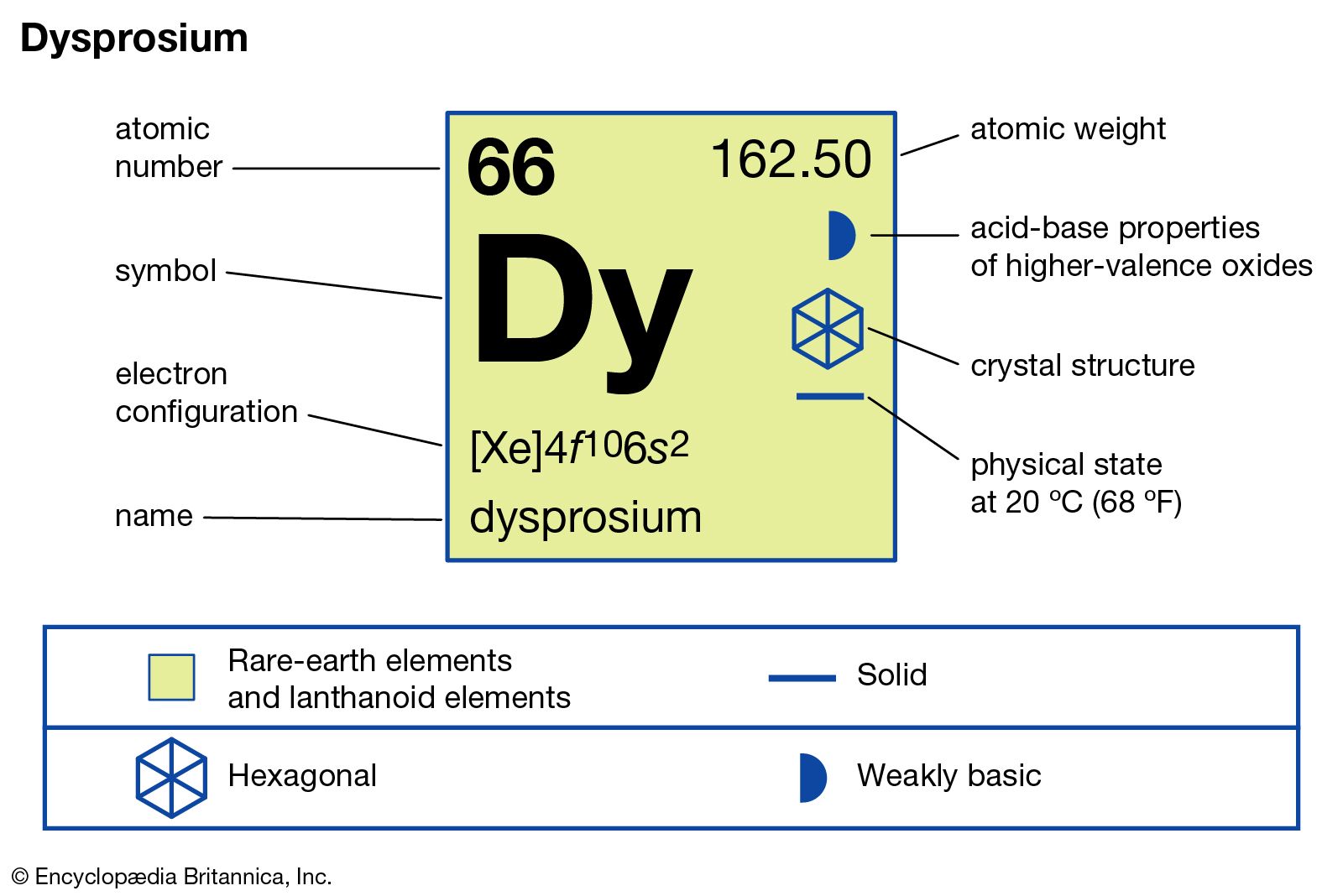
dysprosium
-
What is dysprosium?
Dysprosium (Dy) is a chemical element, a rare-earth metal in the lanthanide series of the periodic table. In its pure form, dysprosium is a relatively hard, silvery-white metal that remains shiny in air at room temperature. However, dysprosium turnings ignite and burn white-hot easily, and the metal slowly reacts with water and quickly dissolves in diluted acids.
Dysprosium is a strong paramagnet above approximately −93 °C; it is antiferromagnetic between about −183 °C and −93 °C and ferromagnetic below −183 °C. The naturally occurring isotopes of dysprosium are all stable and have mass numbers of 164, 162, 163, 161, 160, 158, and 156.
Dysprosium is mainly used as an addition to Nd2Fe14B permanent magnet materials and is also a component of Terfenol D. Due to its high neutron-absorption cross-section, dysprosium is used in control rods for nuclear reactors. Its compounds are used in laser materials, phosphor activators, and metal halide lamps.
1 Britannica SourceCreated from Britannica articles using AI. AI can make mistakes, so verify using Britannica articles. -
Where is dysprosium found on the periodic table?
Dysprosium (Dy) is a chemical element and a rare-earth metal in the lanthanide series of the periodic table. The lanthanides are a series of 15 consecutive elements, with atomic numbers 57–71. They are also called the lanthanoid elements; however, lanthanide remains the more widely used term. Dysprosium has an atomic number of 66.
3 Britannica SourcesCreated from Britannica articles using AI. AI can make mistakes, so verify using Britannica articles. -
What are the main physical properties of dysprosium?
Dysprosium (Dy) is a rare-earth metal in the lanthanide series of the periodic table. In its pure form, it is a relatively hard, silvery-white metal that remains shiny in air at room temperature.
Its key physical properties include:
- Atomic Number: 66
- Atomic Weight: 162.5
- Melting Point: 1,412 °C (2,574 °F)
- Boiling Point: 2,567 °C (4,653 °F)
- Density: 8.551 g/cm3 (at 24 °C, or 75 °F)
Dysprosium is a strong paramagnet above roughly 180 K (-93 °C, or -136 °F), becomes antiferromagnetic between approximately 90 K and 180 K, and ferromagnetic below 90 K.
1 Britannica SourceCreated from Britannica articles using AI. AI can make mistakes, so verify using Britannica articles. -
How is dysprosium mined or obtained?
Dysprosium (Dy), a rare-earth metal, was first identified in 1886 by Paul-\u00c9mile Lecoq de Boisbaudran, with a reasonably pure fraction prepared in 1906 by Georges Urbain. Dysprosium is sourced from minerals like laterite ionic clays, xenotime, fergusonite, gadolinite, euxenite, polycrase, and blomstrandine. It is also present in nuclear fission products.
Commercial separation involves liquid-liquid extraction or ion-exchange. The metal is obtained through metallothermic reduction of anhydrous halides using alkali or alkaline-earth metals, followed by purification via vacuum distillation.
2 Britannica SourcesCreated from Britannica articles using AI. AI can make mistakes, so verify using Britannica articles. -
What are some common uses of dysprosium?
Dysprosium (Dy) is a rare-earth metal and a member of the lanthanide series of the periodic table.
Common uses of dysprosium:
* Alloying addition to Nd_2Fe_14B permanent magnet materials to increase the Curie point and coercivity, which improves the alloy's high-temperature performance
* Component of magnetostrictive Terfenol D (Tb_0.3Dy_0.7Fe_2)
* Control rods for nuclear reactors due to its high neutron-absorption cross-section
* Making laser materials and phosphor activators
* Metal halide lamps2 Britannica SourcesCreated from Britannica articles using AI. AI can make mistakes, so verify using Britannica articles. -
Why is dysprosium important for modern technologies, like magnets and electronics?
Dysprosium (Dy) is a rare-earth metal with significant applications in modern technology due to its unique magnetic properties. As an alloying addition to neodymium-iron-boron (NdFeB) permanent magnets , dysprosium enhances the Curie point and coercivity, which improves the alloy's performance at high temperatures. It is also a component of Terfenol-D, a magnetostrictive material. Moreover, dysprosium is used in control rods for nuclear reactors because of its high neutron-absorption cross section. Dysprosium compounds are used in laser materials, phosphor activators and metal halide lamps.
2 Britannica SourcesCreated from Britannica articles using AI. AI can make mistakes, so verify using Britannica articles.
dysprosium (Dy), chemical element, a rare-earth metal of the lanthanide series of the periodic table.
Dysprosium is a relatively hard metal and is silvery white in its pure form. It is quite stable in air, remaining shiny at room temperature. Dysprosium turnings ignite easily and burn white-hot. The metal slowly reacts with water and quickly dissolves in diluted acids—except hydrofluoric acid (HF), in which it forms a protective layer of insoluble DyF3. The metal is a very strong paramagnet above approximately 180 K (−93 °C, or −136 °F); it is antiferromagnetic between about 90 (−183 °C, or −298 °F) and 180 K and ferromagnetic below 90 K.
French chemist Paul-Émile Lecoq de Boisbaudran first found this element (1886) associated with holmium and other heavy lanthanides; French chemist Georges Urbain later (1906) was able to prepare a reasonably pure fraction. Some important mineral sources of dysprosium are laterite ionic clays, xenotime, fergusonite, gadolinite, euxenite, polycrase, and blomstrandine. It also occurs in the products of nuclear fission.



 " height="20" alt="HEW Logo">
The naturally occurring isotopes are all stable and have mass numbers 164 (natural abundance 28.3 percent), 162 (25.5 percent), 163 (24.9 percent), 161 (18.9 percent), 160 (2.33 percent), 158 (0.10 percent), and 156 (0.06 percent). Excluding nuclear isomers, a total of 29 radioactive isotopes of dysprosium are known. They range in mass from 138 to 173. The least stable is dysprosium-139 (half-life 0.6 second), and the most stable is dysprosium-154 (half-life 3.0 × 10⁶ years).
Commercial separation is performed by liquid-liquid extraction or ion-exchange methods. The metal has been prepared by metallothermic reduction of the anhydrous halides with alkali or alkaline-earth metals. The metal is further purified by vacuum distillation. Dysprosium exists in three allotropic (structural) forms. The α-phase is close-packed hexagonal with a = 3.5915 Å and c = 5.6501 Å at room temperature. When cooled below ~90 K, the ferromagnetic ordering is accompanied by an orthorhombic distortion, β-Dy, of the hexagonal close-packed lattice. The β-phase has a = 3.595 Å, b = 6.184 Å, and c = 5.678 Å at 86 K (−187 °C, or −305 °F). The γ-phase is body-centred cubic with a = 4.03 Å at 1,381 °C (2,518 °F).
The major use of dysprosium is as an alloying addition to Nd2Fe14B permanent magnet materials (in which some of the neodymium is substituted with dysprosium) to increase both the Curie point and especially the coercivity and, therefore, improve the high-temperature performance of the alloy. The metal is also a component of magnetostrictive Terfenol D (Tb0.3Dy0.7Fe2). Dysprosium is used in control rods for nuclear reactors because of its relatively high neutron-absorption cross section; its compounds have been used for making laser materials and phosphor activators, and in metal halide lamps.
Chemically, dysprosium behaves as a typical trivalent rare earth and forms a series of pale yellow compounds in which its oxidation state is +3.
The trusted destination for professionals, college students, and lifelong learners.
SUBSCRIBE


| atomic number | 66 |
|---|---|
| atomic weight | 162.5 |
| melting point | 1,412 °C (2,574 °F) |
| boiling point | 2,567 °C (4,653 °F) |
| density | 8.551 gram/cm3 (24 °C, or 75 °F) |
| oxidation state | +3 |
| electron configuration | [Xe]4f 106s2 |