diffusion equation
Quick Summary
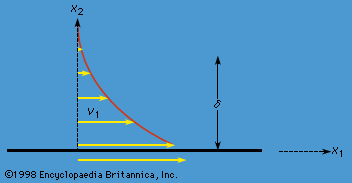
The diffusion equation is a mathematical model that describes the net flow of matter from an area of high concentration to an area of low concentration due to the random motion of molecules. This process is also known as diffusion. The rate of this flow is proportional to the concentration gradient, represented by the equation (j = -D(dc/dx)), where (j) is the flux, (D) is the diffusivity, and (dc/dx) is the concentration gradient.1
Parabolic equations, such as (u_{xx} = u_t), are a class of partial differential equations that arise in the mathematical analysis of diffusion phenomena, like heat distribution in a rod. These equations require initial and boundary conditions to find complete solutions. Diffusivity, a key property in diffusion, quantifies the rate at which molecules move through a mixture and is influenced by factors like temperature and intermolecular forces.23
Ask Britannica AI about this topic
Britannica doesn't have a full article on this topic, so we've curated a list of our relevant coverage.