
centripetal force
Quick Summary

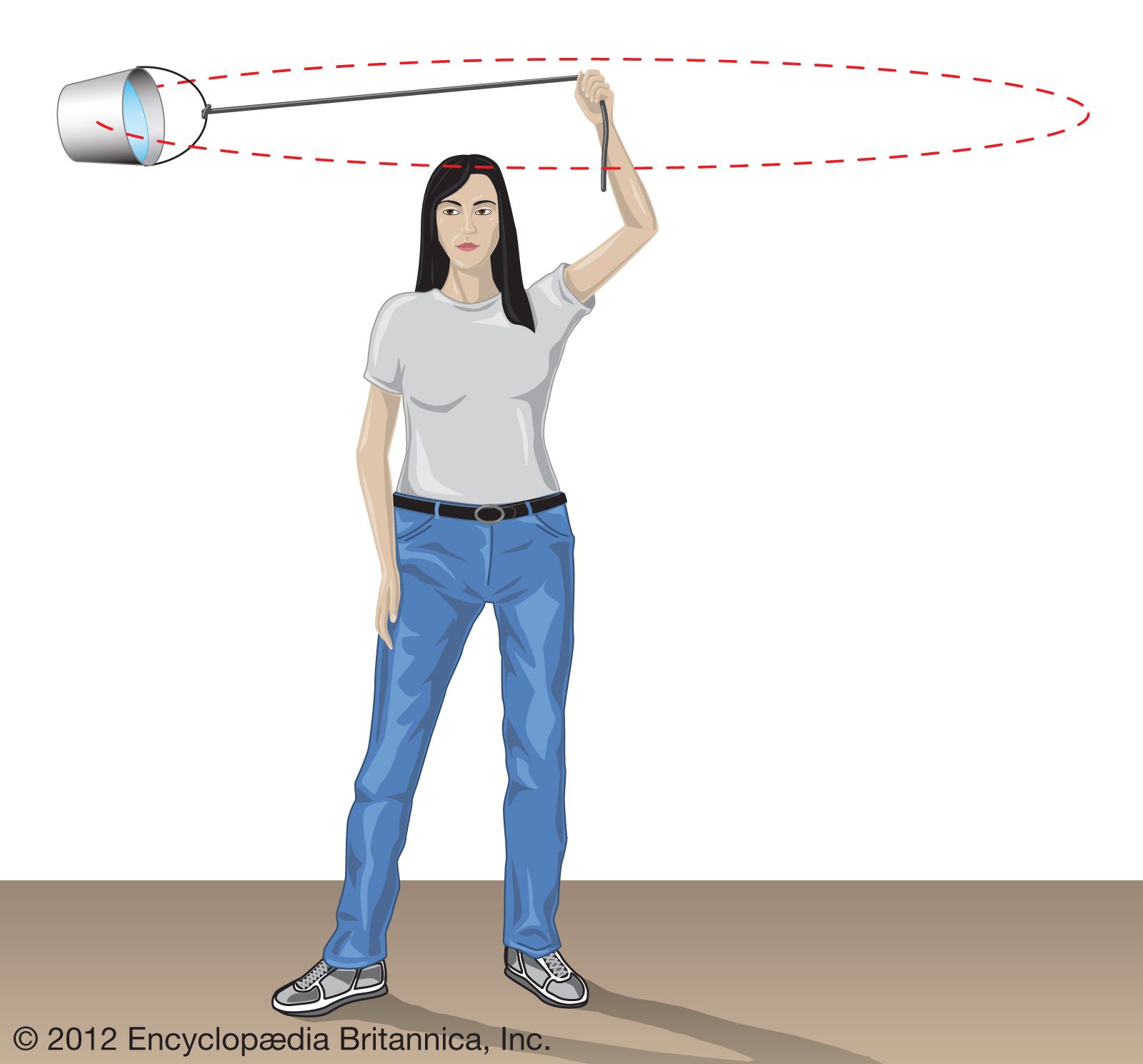
Centripetal force is the force required to keep an object moving in a curved path. This force is directed inward, toward the center of rotation. For example, when a stone is whirled on a string, the string exerts centripetal force on the stone.1
This inward force causes centripetal acceleration, which is the acceleration of a body moving in a circular path. Because velocity is a vector quantity (having both magnitude and direction), a changing direction means a changing velocity, thus producing acceleration. This acceleration is directed radially toward the center of the circle. The magnitude of centripetal acceleration is calculated as the square of the object's speed divided by the distance from the center of the circle to the object (ac = v2/r).2
It is important to distinguish centripetal force from centrifugal force, which is an apparent outward force felt by an object moving in a curved path.3
Ask Britannica AI about this topic
Britannica doesn't have a full article on this topic, so we've curated a list of our relevant coverage.