

basal placentation
Quick Summary
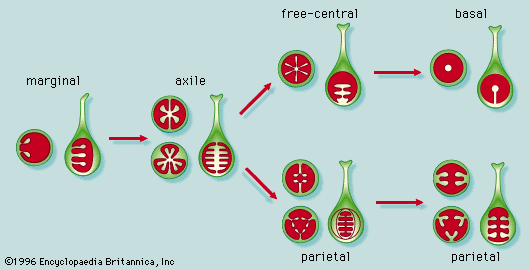
In botany, the placenta is the part of the carpel (a modified leaf) where ovules (which develop into seeds) are attached. The arrangement of these ovules within the ovary is called placentation, and it's often important for classifying plants.1
Basal placentation specifically refers to a type of placentation where the ovules are located on a small column at the very base of the ovary. This is one of several types of placentation, including parietal, axile, free central, and laminar, each describing a different arrangement of ovules within the ovary.1
Ask Britannica AI about this topic
Britannica doesn't have a full article on this topic, so we've curated a list of our relevant coverage.
- placenta
…central column bearing the ovules; basal, with ovules positioned on a low column at the base of the ovary; or laminar, with ovules scattered over the inner surfaces of carpels.
Read More…central column bearing the ovules; basal, with ovules positioned on a low column at the base of the ovary; or laminar, with ovules scattered over the inner surfaces of carpels.
Read More  angiospermSeeds
In basal placentation ovules are attached to the base of the ovary, and in parietal placentation the placentae are located directly on the ovary wall or on its extensions.
Read MoreIn basal placentation ovules are attached to the base of the ovary, and in parietal placentation the placentae are located directly on the ovary wall or on its extensions.
Read More