

axile placentation
Quick Summary
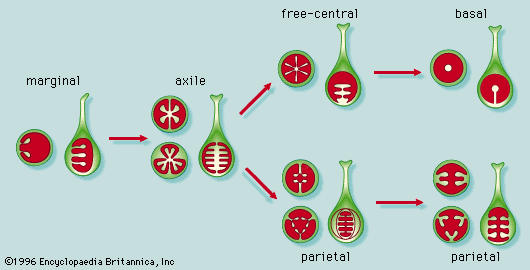
In botany, axile placentation is a type of placentation where ovules are arranged along the central axis of the ovary. This occurs when carpels, the leaf-like structures that form the female reproductive part of a flower, fold inward. The placenta is the part of the carpel to which the ovules attach. In axile placentation, these placentae are located on a central column within the ovary. Partitions can form from this central column to the ovary wall, creating chambers called locules that separate the placentae and attached ovules. This arrangement is a key characteristic used in plant classification.12
Ask Britannica AI about this topic
Britannica doesn't have a full article on this topic, so we've curated a list of our relevant coverage.
- placenta
…along the inner ovary walls; axile, with carpels folded inward and the ovules along the central axis of the ovary; free central, derived from the axile, with a central column bearing the ovules; basal, with ovules positioned on a low column at the base of the ovary; or laminar, with…
Read More…along the inner ovary walls; axile, with carpels folded inward and the ovules along the central axis of the ovary; free central, derived from the axile, with a central column bearing the ovules; basal, with ovules positioned on a low column at the base of the ovary; or laminar, with…
Read More  angiospermSeeds
In axile placentation the placentae are located on a central column; partitions from the central column to the ovary wall create chambers (locules) that separate the placentae and attached ovaries from each other. Free-central placentation resembles axile placentation; however, the column is not connected by partitions…
Read MoreIn axile placentation the placentae are located on a central column; partitions from the central column to the ovary wall create chambers (locules) that separate the placentae and attached ovaries from each other. Free-central placentation resembles axile placentation; however, the column is not connected by partitions…
Read More