ascending node
astronomy
Quick Summary
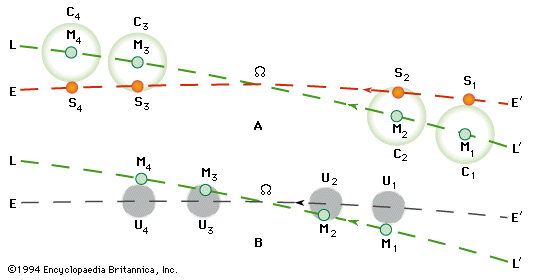
graph depicting the ascending node of the Moon's orbit as seen from an observer on Earth
Ascending node of the Moon's orbit as seen from an observer on Earth (the centre of the celestial sphere). Conditions necessary for a solar eclipse (top) and a lunar eclipse (bottom) are shown. (See the text.)
In astronomy, a node is where the orbit of a celestial body, like the Moon or a planet, intersects the plane of the ecliptic (the Sun's apparent path). The ascending node is specifically the point where the body crosses from south to north of the ecliptic. The descending node is the opposite intersection. Eclipses can only occur when the Moon is near a node. The longitude of the ascending node is one of the six orbital elements that define an orbit's plane.123
Summary created from Britannica articles
using AI.
AI can make mistakes, so verify using Britannica articles.
3 Britannica Sources
Ask Britannica AI about this topic
Britannica doesn't have a full article on this topic, so we've curated a list of our relevant coverage.