

Newton’s iterative method
Quick Summary
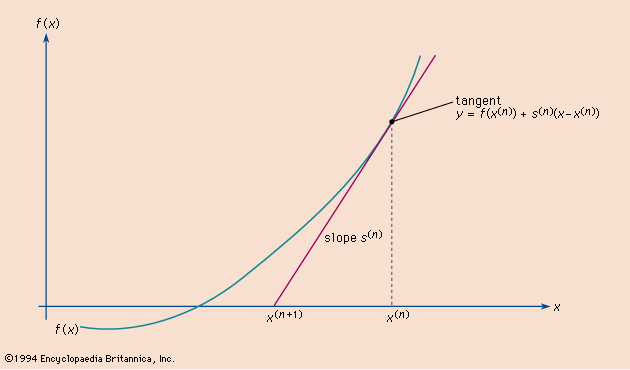
Newton's method is a mathematical technique used to find approximate solutions to equations where a polynomial expression equals zero, meaning f(x) = 0. It was developed by Isaac Newton in 1669 and later simplified by Joseph Raphson.1
The method begins with an initial guess, x0. A tangent line is drawn to the graph of the function at this point, and where this line intersects the x-axis provides a new, improved guess, x1. This is calculated using the formula:
x1 = x0 - f(x0) / f'(x0)
Here, f'(x0) represents the derivative, or slope, of the function at x0. This iterative process is repeated, using the new guess to find the next, until the desired level of accuracy is achieved. A general formula for this process is:1
xn + 1 = xn - f(xn) / f'(xn).1
For example, to find the square root of 5 (solving x2 - 5 = 0), with an initial guess of 2, the method quickly converges to a highly accurate approximation.1
Ask Britannica AI about this topic
Britannica doesn't have a full article on this topic, so we've curated a list of our relevant coverage.