

- Key People:
- Pierre-Simon, marquis de Laplace
- Related Topics:
- harmonic function
- Laplace operator
- second-order differential equation
- On the Web:
- Matematics LibreTexts - The Laplace Equation (Nov. 02, 2026)

Laplace’s equation
Laplace’s equation, second-order partial differential equation widely useful in physics because its solutions R (known as harmonic functions) occur in problems of electrical, magnetic, and gravitational potentials, of steady-state temperatures, and of hydrodynamics. The equation was discovered by the French mathematician and astronomer Pierre-Simon Laplace (1749–1827).
Laplace’s equation states that the sum of the second-order partial derivatives of R, the unknown function, with respect to the Cartesian coordinates, equals zero: 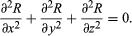
The sum on the left often is represented by the expression ∇2R or ΔR, in which the symbols ∇2and Δ are called the Laplacian or the Laplace operator. Laplace’s equation is a special case of Poisson’s equation ∇2R = f, in which the function f is equal to zero.

Many physical systems are more conveniently described by the use of spherical or cylindrical coordinate systems. Laplace’s equation can be recast in these coordinates; for example, in cylindrical coordinates, Laplace’s equation is 



 " height="20" alt="HEW Logo">