Kelvin wedge
Quick Summary
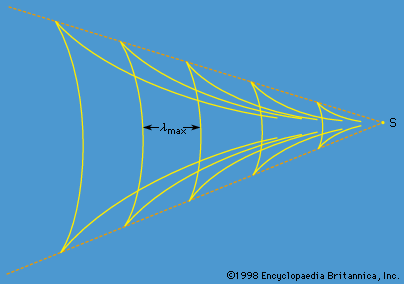
The term "Kelvin wedge" refers to the V-shaped pattern of waves created behind a moving ship. This phenomenon was first explained by Lord Kelvin and is a result of the dispersive nature of waves on deep water. The angle of this V-shaped wave pattern is fixed at approximately 39 degrees, regardless of the ship's speed. Ships lose energy to these waves, which contributes to their resistance. This resistance can be particularly high when the waves generated by the bow and stern reinforce each other.1
A Kelvin wave, in oceanography, is a long ocean wave that travels eastward towards the coast of South America. It causes a thickening of warm surface water and a rise in sea level. These waves are often associated with the development of El Niño events and are spawned by eastward wind reversals in the equatorial Pacific.2
Ask Britannica AI about this topic
Britannica doesn't have a full article on this topic, so we've curated a list of our relevant coverage.