
Britannica
Sources used in this answer
How does chromatography separate the components of a mixture?
Created from Britannica articles
using AI.
AI can make mistakes, so verify using Britannica articles.
sample preparation
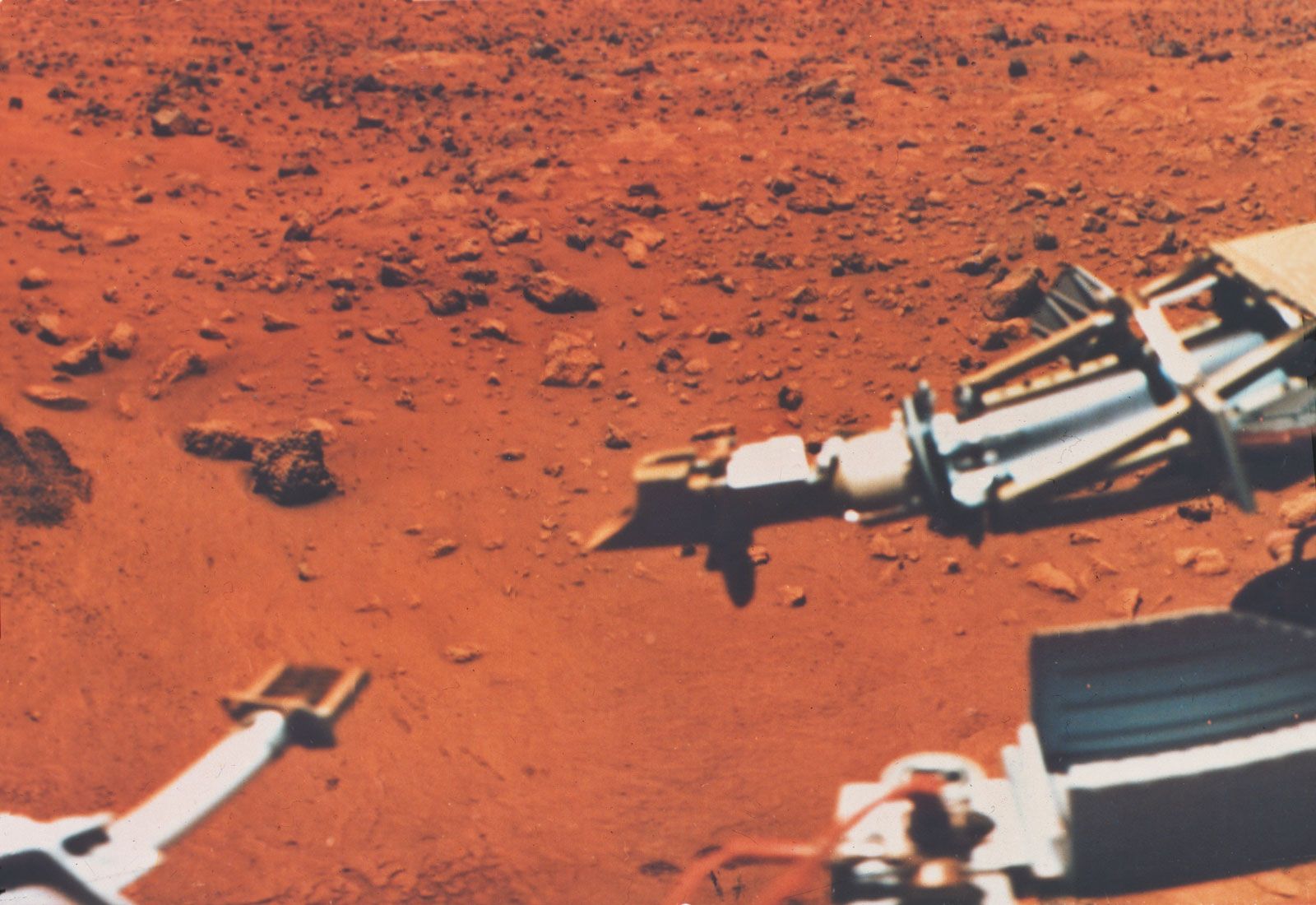
Viking 1's sample scoop, poised to extract material from the surface of Mars.
In analytical chemistry, chromatography separates the components of a mixture through the differential migration of solutes between two phases: a mobile phase (a moving fluid) and a stationary phase (a solid or liquid).12
The process works as follows:
- Distribution: As the mobile phase transports the mixture through the system, individual components distribute themselves between the two phases based on their relative affinity for each.13
- Selective Interaction: Components that are more strongly attracted to the stationary phase are held back, while those with a higher affinity for the mobile phase migrate more rapidly.14
- Differential Migration: Because different substances have unique partition coefficients—the ratio of their concentrations in the two phases—they travel through the column or across a plane at different rates.23
- Separation: This difference in migration speed results in the components becoming spatially or temporally separated as they exit the system or reach different positions on the stationary medium.13
This method is highly versatile, allowing for the separation of diverse substances ranging from small molecules to large biological structures.23