

Higgs mechanism
Quick Summary
The Higgs mechanism is a theoretical concept in particle physics that explains how elementary particles acquire mass. It involves the Higgs field, which permeates all of space. When other subatomic particles interact with this field, they gain mass. The Higgs boson is the particle associated with this field and is the carrier of its force.
This mechanism is crucial for the electroweak theory, which unifies the electromagnetic and weak forces. It explains why the W and Z particles, carriers of the weak force, are massive, while the photon, carrier of the electromagnetic force, is massless. The existence of the Higgs boson was confirmed in 2012 at the Large Hadron Collider.12
Ask Britannica AI about this topic
Britannica doesn't have a full article on this topic, so we've curated a list of our relevant coverage.
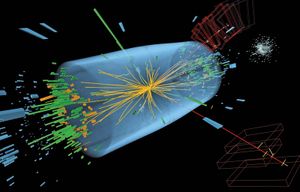 Higgs boson
The Higgs mechanism has a key role in the electroweak theory, which unifies interactions via the weak force and the electromagnetic force. It explains why the carriers of the weak force, the W particles and the Z particles, are heavy while the carrier of the electromagnetic…
Read MoreThe Higgs mechanism has a key role in the electroweak theory, which unifies interactions via the weak force and the electromagnetic force. It explains why the carriers of the weak force, the W particles and the Z particles, are heavy while the carrier of the electromagnetic…
Read More subatomic particleHidden symmetry
Higgs’s mechanism for symmetry breaking provided Salam and Weinberg with a means of explaining the masses of the carriers of the weak force. Their theory, however, also predicted the existence of one or more new “Higgs” bosons, which would carry additional fields needed for the…
Read MoreHiggs’s mechanism for symmetry breaking provided Salam and Weinberg with a means of explaining the masses of the carriers of the weak force. Their theory, however, also predicted the existence of one or more new “Higgs” bosons, which would carry additional fields needed for the…
Read More
