


Euler’s formula
What are the two main theorems associated with Euler’s formula?
How can Euler’s exponential formula be visualized?
How does Euler’s polyhedron formula relate to topology?
Euler’s formula, either of two important mathematical theorems discovered by the Swiss mathematician Leonhard Euler.

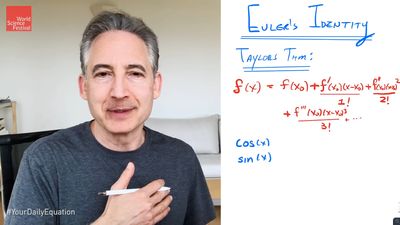
The more well-known of the two Euler formulas is eiθ = cos θ + i sin θ, where e is the exponential function; i is the imaginary unit, the square root of -1; cos and sin are the trigonometric functions cosine and sine, respectively, and θ is the value of an angle. This formula is sometimes called Euler’s identity.
When θ = π, the Euler formula becomeseiπ = cos π + i sin π = -1.This last result can be rewritten as eiπ + 1 = 0,which relates five important mathematical constants—0, 1, e, i, and π—in a single equation.
The second formula is a numerical relationship between the faces F, edges E, and vertices V of a polyhedron (a solid shape with polygons as its faces):V - E + F = 2.This result is also called Euler’s polyhedral formula.
For example, a cube has 6 faces, 12 edges, and 8 vertices; that is,8 - 12 +6 = 2.The left-hand side of the formula is more generally known as the Euler characteristic in topology.



 " height="20" alt="HEW Logo">