


- Related Topics:
- Cycas
- Encephalartos
- Zamiaceae
- Stangeriaceae
- Cycadaceae


cycad
-
What are cycads?
Cycads are an ancient group of palmlike gymnosperms with approximately 300 extant species across three families. They are characterized by crowns of large pinnately compound leaves and large cones.
Cycads are dioecious, with individual plants producing either male or female cones. They are typically short and squat, but some, like the Australian cycad Macrozamia hopei, can reach up to 19 meters in height.
These plants are found in subtropical habitats, including rainforests, savannas, and scrublands. Due to their attractive foliage and sometimes colorful cones, cycads are popular in gardens; however, overharvesting has led to some species becoming endangered.
4 Britannica SourcesCreated from Britannica articles using AI. AI can make mistakes, so verify using Britannica articles. -
Where are cycads commonly found?
Cycads, an ancient group of palmlike gymnosperms with approximately 300 extant species, thrive in subtropical habitats, occupying diverse ecological niches from rainforests to near-desert scrublands.
Though not abundant, they can be found in:
* Australia, with three endemic genera: Macrozamia, Lepidozamia, and Bowenia
* The Americas and Caribbean, including genera such as Microcycas, Zamia, Ceratozamia, and Dioon
* Africa, where Encephalartos and Stangeria are native
* The genus Cycas, the most wide-ranging, extends from eastern Australia across the Pacific and Indian oceans to Madagascar and the east coast of South AfricaCycads' desirability as ornamental plants has led to overharvesting, endangering some species.
3 Britannica SourcesCreated from Britannica articles using AI. AI can make mistakes, so verify using Britannica articles. -
How do cycads differ from other plants?
Cycads, mostly palmlike cone-bearing plants of low stature, differ from other plants in several ways. Unlike angiosperms, cycads have naked seeds not enclosed in an ovary. They are dioecious, with separate male and female plants.
Cycads have less secondary vascular tissue than conifers, resulting in less dense wood. Unique to cycads is their reliance on flagellated motile male gametes for reproduction, a trait linking them to ferns and other vascular cryptogams. They also host cyanobacteria in their roots, which fix atmospheric nitrogen. These features highlight the unique evolutionary and reproductive strategies of cycads.
3 Britannica SourcesCreated from Britannica articles using AI. AI can make mistakes, so verify using Britannica articles. -
What do the leaves and cones of cycads look like?
Cycads, as gymnosperms, feature distinctive characteristics in their leaves and cones.
Leaves: Cycad leaves are typically large and pinnately compound, forming crowns at the end of the trunk. However, the Bowenia genus displays bipinnate, fernlike leaves. Stangeria leaves also resemble ferns. Most cycad pinnae are thick and sclerophyllous with sunken stomata. Leaf size varies, with Zamia pygmaea having leaves of about 20–30 cm, while some Macrozamia, Lepidozamia, Ceratozamia, and Cycas species have leaves reaching three meters.
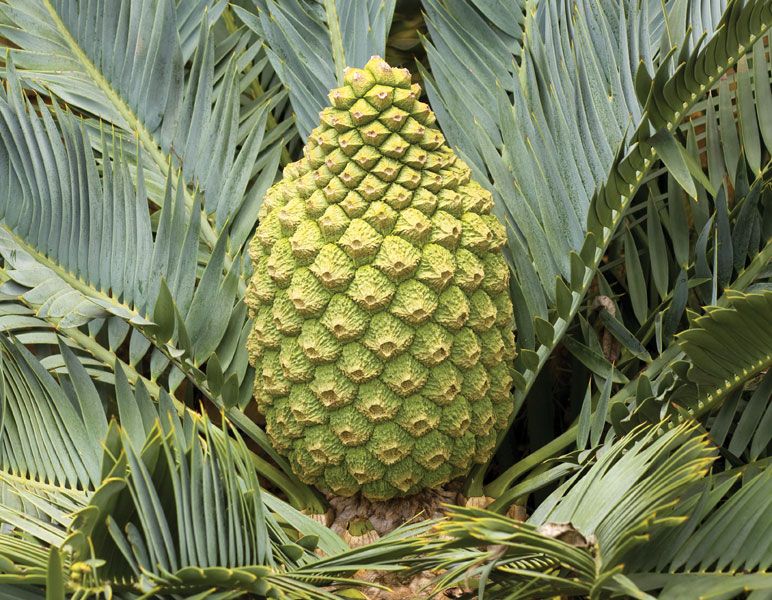
Cones: Cycads bear cones, typically at the trunk's end, in the center of whorled branches. Male cones produce pollen, which the wind carries to female cones on separate plants for fertilization.
3 Britannica SourcesCreated from Britannica articles using AI. AI can make mistakes, so verify using Britannica articles. -
Why are cycads sometimes called 'living fossils'?
Cycads are called "living fossils" because they are an ancient group of palmlike gymnosperms that have remained essentially unchanged from earlier geologic times. Their close relatives are usually extinct. Undisputed cycad fossils date back to the Triassic Period (251.9 to 201.3 million years ago). Fossil cycads have been discovered in regions where they are now extinct, such as Greenland, Antarctica, and Alaska, indicating milder climates in these areas in the past. Today, there are approximately 300 extant species across three families.
5 Britannica SourcesCreated from Britannica articles using AI. AI can make mistakes, so verify using Britannica articles. -
What threats do cycads face and why are they important for ecosystems?
Cycads, found in subtropical habitats, face threats such as overharvesting for ornamental use, which has led to some species becoming endangered or critically endangered. They are also affected by habitat loss.
Cycads are important because they offer insights into plant evolution and reproduction, particularly the origins of insect pollination. They also support various species as a food resource. Though not abundant, studying cycads provides valuable information, making their conservation crucial.
3 Britannica SourcesCreated from Britannica articles using AI. AI can make mistakes, so verify using Britannica articles.
cycad, (order Cycadales), any of the palmlike woody gymnospermous plants that constitute the order Cycadales. The order consists of three extant (not extinct) families—Cycadaceae, Stangeriaceae, and Zamiaceae—which contain 10–11 genera and about 310 species. Some authorities use the term cycad to refer to all members of the division Cycadophyta. Plants of this division are known to have existed in the Mesozoic Era (251.9 million to 66 million years ago).
Physical description
Cycads are gymnosperms distinguished by crowns of large pinnately compound leaves and by cones, which are typically borne at the end of the trunk in the centre of whorled branches. Some cycads have tall unbranched trunks with an armourlike appearance; others have partially buried stems with swollen (tuberous) trunks. The stem has a large pith surrounded by a narrow zone of soft woody tissue. Male cones produce pollen, which is carried by wind to female cones (borne on separate plants), where fertilization occurs. For a detailed discussion of cycad anatomy, see cycadophyte.
Major species and uses
Slow-growing cycads are used as ornamental conservatory plants, but some survive outdoors in temperate regions. The popular sago palm (Cycas revoluta) is grown as a houseplant and outdoor ornamental, and its leaves are widely used as ceremonial “palms” in floriculture. The pithy stems of this and other species are a source of sago, a food starch. The cardboard palm (Zamia furfuracea) and giant dioon (Dioon spinulosum) are also common ornamental species.



 " height="20" alt="HEW Logo">
A number of cycad species—among them the Australian nut palm (Cycas media), C. circinalis, and chestnut dioon (Dioon edule)—bear edible seeds. Starch from the roots of some cycads, including the coontie (Zamia integrifolia) of the southeastern United States and the West Indies, is edible after an alkaloid is removed by thorough cooking. The young leaves and seeds of other species also are edible.
The desirability of cycads as specimen and ornamental plants in gardens and greenhouses has led to the overharvesting of many species from the wild. As a result, some species are nearly extinct in nature, and a number are endangered or critically endangered. Most cycads are protected by conservation laws in their native countries. International trade in cycads is controlled by the Convention on International Trade in Endangered Species of Wild Fauna and Flora.
Annotated classification
The following is a classification of extant (not extinct) cycads.
- Order Cycadales
- Late Paleozoic? to present; woody coniferous plants with compound leaves, simple cones; flagellate motile male gametes; stout fleshy stems; 3 families currently recognized.
- Family Cycadaceae
- Generally restricted to species of Cycas; foliar multiovulate megasporophylls arranged in an indeterminate strobilus; pinnae with a single midrib but lacking lateral, branch veins; about 115 species defined.
- Family Stangeriaceae
- Fernlike leaves bearing pinnae with a prominent midrib and numerous dichotomously branching lateral veins; simple cones; female cones with biovulate megasporophylls; Stangeria includes only Stangeria paradoxa, a southern African cycad; Bowenia has 2 species, which have bicompound leaves.
- Family Zamiaceae
- Singly pinnate compound leaves bearing leaflets with parallel dichotomously branching veins (Chigua, if included, would be an exception); simple cones; female cones with biovulate megasporophylls; about 190 species, including Macrozamia, Lepidozamia, Ceratozamia, Encephalartos, Zamia, Microcycas, and Dioon.