
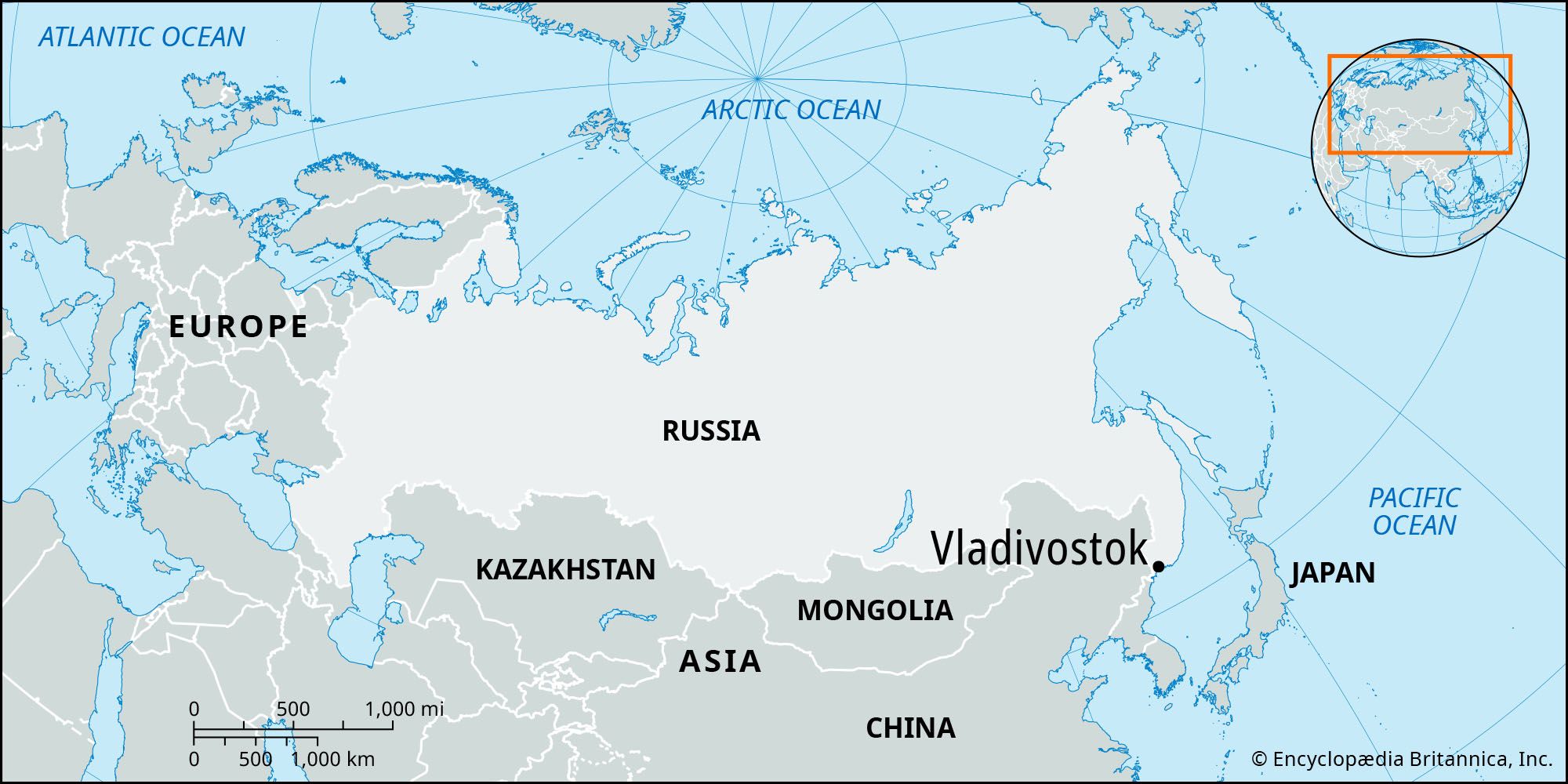





Vladivostok
-
Where is Vladivostok located in Russia?
Vladivostok is a seaport and the administrative center of Primorsky kray (territory), located in the extreme southeastern part of Russia. It lies on the western side of a peninsula surrounding Zolotoy Rog (Golden Horn Bay), which separates the Amur and Ussuri bays on the Sea of Japan (East Sea).
Founded in 1860 as a Russian military outpost, Vladivostok's location has made it a crucial port and naval base. The city is the eastern terminus of the Trans-Siberian Railroad, marking the end of its 5,771-mile (9,288 km) journey from Moscow. Despite being at the same latitude as the French Riviera, Vladivostok experiences cold winters due to outblowing winds, with an average January temperature of 7 °F (-14 °C).
4 Britannica SourcesCreated from Britannica articles using AI. AI can make mistakes, so verify using Britannica articles. -
Why is Vladivostok an important city?
Vladivostok is an important city for several reasons:
- Strategic location Vladivostok's location on the Sea of Japan has led to its major role as a port and naval base. It serves as the home of Russia's Pacific Fleet.
- Trade It is a crucial commercial port, serving as a link to other Russian ports in the Far East and as a port of entry for goods from China, Japan, and other countries. The city's principal exports are petroleum, coal, and grain, while main imports are clothing, consumer electronics, and automobiles.
- Transportation Vladivostok is the eastern terminus of the Trans-Siberian Railroad.
- Cultural and educational hub The city is the chief educational and cultural center of the Russian Far East and is home to the Far Eastern Branch of the Russian Academy of Sciences and the Far Eastern State University.
3 Britannica SourcesCreated from Britannica articles using AI. AI can make mistakes, so verify using Britannica articles. -
What kind of climate does Vladivostok have?
Vladivostok, despite being at the same latitude as the French Riviera, experiences a climate with a January mean of 7 °F (-14 °C) due to outblowing winds. Precipitation is higher along the Pacific coast (24 inches [600 mm] in Vladivostok) because of the summer monsoon. Snow is a prominent feature, impacting agriculture with its depth and duration.
1 Britannica SourceCreated from Britannica articles using AI. AI can make mistakes, so verify using Britannica articles. -
What role does Vladivostok play in Russian trade or transportation?
Vladivostok plays a vital role in Russian trade and transportation due to its geographical location and infrastructure. It serves as a major port and naval base, connecting Russia to other ports in the Far East and acting as a key entry point for goods from China, Japan, and other countries. The city is the eastern terminus of both the Trans-Siberian Railroad and the Northern Sea Route, enhancing its importance as a transportation hub. The principal exports of Vladivostok are petroleum, coal, and grain, while clothing, consumer electronics, and automobiles are the main imports.
4 Britannica SourcesCreated from Britannica articles using AI. AI can make mistakes, so verify using Britannica articles. -
What are some notable landmarks or attractions in Vladivostok?
Vladivostok, a seaport and administrative center in southeastern Russia, has several notable landmarks and attractions. The city's most recognizable landmark is the Vladivostok Station, with its faux-17th-century facade, turrets, and towers. It is the eastern terminus of the Trans-Siberian Railroad and resembles a palace rather than a utilitarian terminus.
A short walk from the station is Svetlanskaya Street, the city's first and central street, where many historic sites are clustered, including the restored family home of Oscar-winning actor Yul Brynner.
2 Britannica SourcesCreated from Britannica articles using AI. AI can make mistakes, so verify using Britannica articles. -
How does Vladivostok's location near China, North Korea, and the Pacific Ocean influence its culture and economy?
Vladivostok's location near China, North Korea, and the Pacific Ocean significantly shapes its culture and economy. Its proximity to Asian countries, especially China and Japan, has made it a key port for importing consumer goods. The city serves as the eastern terminus of the Trans-Siberian Railroad, linking it to Russia's interior and Europe.
Vladivostok's role as a major commercial port and its naval history have created a unique cultural mix, influenced by both Russian and Asian traditions.
2 Britannica SourcesCreated from Britannica articles using AI. AI can make mistakes, so verify using Britannica articles.
Vladivostok, seaport and administrative centre of Primorsky kray (territory), extreme southeastern Russia. It is located around Zolotoy Rog (“Golden Horn Bay”) on the western side of a peninsula that separates Amur and Ussuri bays on the Sea of Japan. The town was founded in 1860 as a Russian military outpost and was named Vladivostok (variously interpreted as “Rule the East,” “Lord of the East,” or “Conqueror of the East”). Its forward position in the extreme south of the Russian Far East inevitably led to a major role as a port and naval base. In 1872 the main Russian naval base on the Pacific was transferred there, and thereafter Vladivostok began to grow. In 1880 city status was conferred on it. The city also grew in importance after the construction of the Chinese Eastern Railway across Manchuria to Chita (completed in 1903), which gave Vladivostok a more direct rail connection to the rest of the Russian Empire. Yet the city is detached from the major Far Eastern node of land transportation routes.
During World War I Vladivostok was the chief Pacific entry port for military supplies and railway equipment sent to Russia from the United States. After the outbreak of the Russian Revolution in 1917, Vladivostok was occupied in 1918 by foreign, mostly Japanese, troops, the last of whom were not withdrawn until 1922. The antirevolutionary forces in Vladivostok promptly collapsed, and Soviet power was established in the region.
During the Soviet period Vladivostok remained the home of the Pacific Fleet, which was greatly enlarged in the decades after World War II. Vladivostok’s military importance was such that it was closed to foreign shipping and other contacts from the late 1950s until the waning days of Soviet power in 1990. Its chief role as a commercial port subsequently reemerged, both as a link to other Russian ports of the Far East and as a port of entry for consumer goods from China, Japan, and other countries. The port is the eastern terminus of the Northern Sea Route along Russia’s Arctic seaboard from Murmansk and is the principal supply base for the Arctic ports east of Cape Chelyuskin.




The principal exports of Vladivostok are petroleum, coal, and grain, while clothing, consumer electronics, and automobiles are the main imports. Into the port also comes much of the catch or processed fish from other Russian Far Eastern ports for onward transmission to the rest of the country.
The industrial base of Vladivostok was much diversified during the Soviet period. In addition to large ship-repair yards, there are railway workshops and a plant for the manufacture of mining equipment. Light industry includes instrument and radio factories, timberworking enterprises (notably those producing furniture and veneer), a chinaware works, and manufacturers of pharmaceutical products. Food industries—principally the processing of fish and meat and flour milling—and the building industry (prefabricated building panels) are important. In the 1990s, in the post-Soviet period, most industry declined, with the exception of food processing. Mechanical engineering continues to be important. A railroad town, Vladivostok is the eastern terminus of the Trans-Siberian Railroad. The city also has an airport.
Vladivostok is the chief educational and cultural centre of the Russian Far East. It is the site of the Far Eastern Branch of the Russian Academy of Sciences, the Far Eastern State University (founded 1920), and medical, art education, polytechnic, trade, and marine-engineering institutes. Students enrolled in institutes of higher education make up a significant proportion of the city’s total population. The city has theatres as well as a philharmonic society and symphony orchestra. There are also museums of local history and of the history of the Pacific Fleet. Pop. (2005 est.) 586,829.