
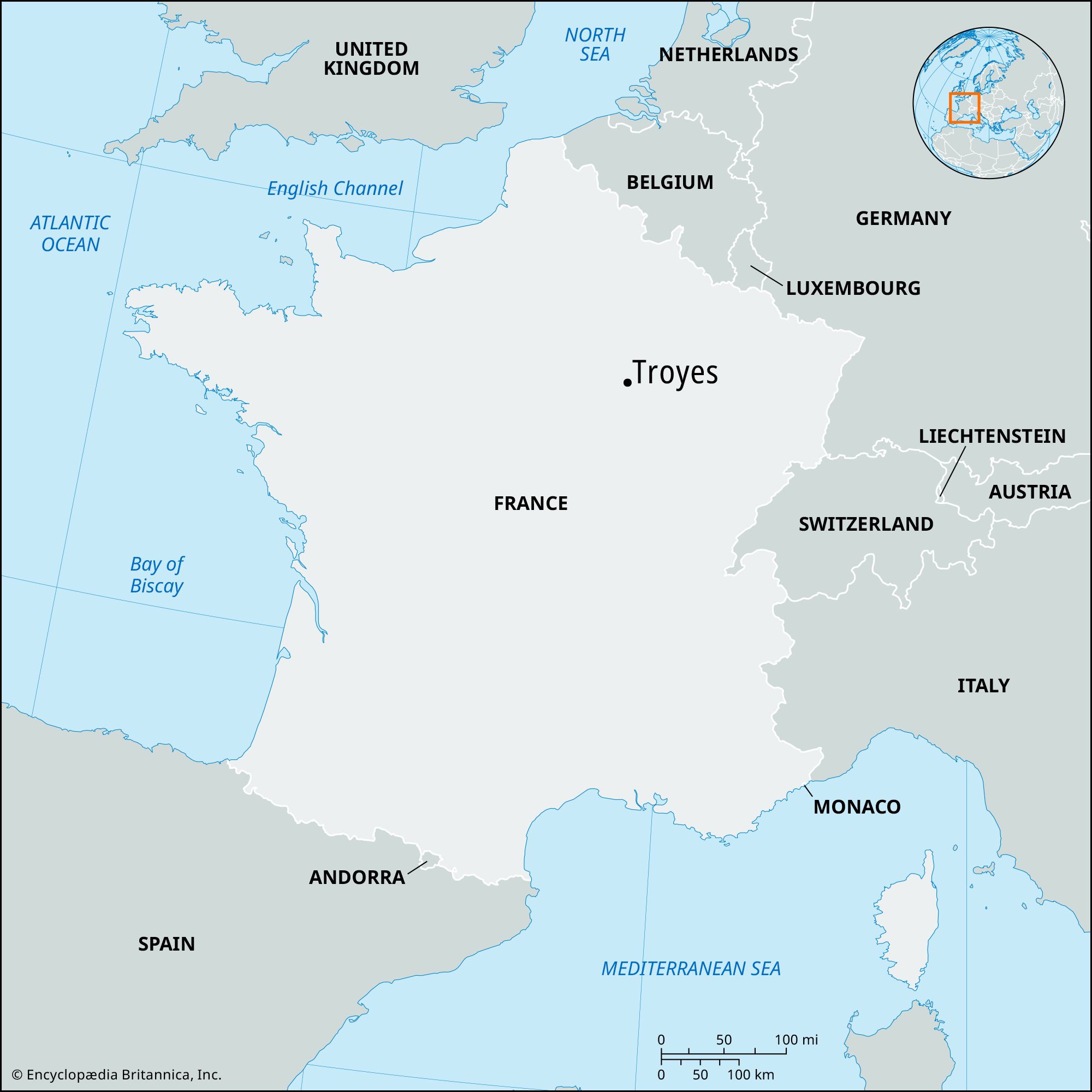



Troyes
-
What is Troyes in France?
Troyes is a town in northeastern France, southeast of Paris and directly south of Reims, and is the capital of the Aube département in the Grand Est région. It was the historical capital of Champagne.
Before Julius Caesar's conquest, Troyes was a town of the Gauls. Under the Roman emperor Augustus, it became the capital of the Gallic tribe known as the Tricasses. The city is also the namesake of troy weight. The end of the 15th century and the beginning of the 16th were periods of prosperity.
Landmarks include the church of Saint-Urbain, the church of Saint-Jean-au-Marché, and the cathedral of Saint-Pierre-et-Saint-Paul.
1 Britannica SourceCreated from Britannica articles using AI. AI can make mistakes, so verify using Britannica articles. -
Where is Troyes located in France?
Troyes is a town located in the Grand Est region of northeastern France, specifically in the Aube département. It lies southeast of Paris and directly south of Reims.
Historically, Troyes served as the capital of Champagne. The town has ancient roots, dating back to the Gauls before Julius Caesar's conquest. It later became a significant center, known for its great fairs that brought international recognition and prosperity. The city is also the namesake of the troy weight system.
3 Britannica SourcesCreated from Britannica articles using AI. AI can make mistakes, so verify using Britannica articles. -
What is Troyes famous for?
Troyes, the historical capital of Champagne, is known for its rich history and international trade fairs that brought the city exceptional prosperity. The city's name is also the origin of troy weight.
Of the 25 historical churches, nine remain, featuring stained glass windows, paintings, and statues from the 16th-century Troyes school of sculpture. The church of Saint-Urbain was founded by Pope Urban IV, a Troyes shoemaker's son. In the church of Saint-Jean-au-Marché, Henry V of England married Catherine of Valois in 1420. The cathedral of Saint-Pierre-et-Saint-Paul features a variety of Gothic styles and stained glass.
1 Britannica SourceCreated from Britannica articles using AI. AI can make mistakes, so verify using Britannica articles. -
What important historical events happened in Troyes?
Troyes, the historical capital of Champagne, boasts a rich history marked by significant events. Before Roman conquest, it was a Gaul town. Under Roman Emperor Augustus, it became the capital of the Gallic tribe known as the Tricasses.
During the Middle Ages, Troyes gained international recognition for its great fairs, becoming a commercial and financial hub in Europe. However, by the end of the 14th century, the fairs had declined in importance.
In 1420, Henry V of England married Catherine of Valois in Troyes, and the Treaty of Troyes recognized Henry as heir to the French throne. Joan of Arc was also celebrated in Troyes in 1429 after the city surrendered to her.
3 Britannica SourcesCreated from Britannica articles using AI. AI can make mistakes, so verify using Britannica articles. -
How does the architecture in Troyes reflect its history?
The architecture in Troyes reflects its rich and storied past. Of the 25 historical churches, nine remain, showcasing the Troyes school's early 16th-century sculpture, stained glass windows, and paintings. The church of Saint-Urbain exemplifies bold Gothic style, while the cathedral of Saint-Pierre-et-Saint-Paul exhibits a mix of Gothic styles and stained glass panels. Secular buildings like the Hôtel de Vauluisant, dating back to the 16th century, and the Troyes Municipal Library, established in 1651, also contribute to the city's architectural heritage.
2 Britannica SourcesCreated from Britannica articles using AI. AI can make mistakes, so verify using Britannica articles.
Troyes, town, capital of Aube département, Grand Est région, northeastern France. It is located southeast of Paris and directly south of Reims. The town was the historical capital of Champagne.
Before Julius Caesar’s conquest, Troyes was already a town of the Gauls. Under the Roman emperor Augustus, it became the capital of the Gallic tribe known as the Tricasses (hence its name). Converted to Christianity in the 3rd century, the town was threatened by the Huns in the 5th century and was defended against them by its bishop, St. Loup. Sacked by the Normans in 889, it soon came under the authority of the counts of Champagne, who founded a number of churches and almshouses there and established the great fairs which gained an international reputation and brought Troyes exceptional prosperity. The city also gave its name to the troy weight. The end of the 15th century and the beginning of the 16th were periods of prosperity, but in 1524 a fire destroyed 1,000 houses in Troyes. Calvinism had considerable success there, but in 1572 a great number of Protestants were put to death. Louis XIV’s revocation of the Edict of Nantes in 1685 dispersed the town’s Protestant population and greatly damaged its industrial prosperity; incessant war and increases in taxes completed the decline of the town. It was only during the 19th century that Troyes began the development which has continued since.

Of the 25 churches which formerly existed in the town, 9 have survived. Most of these have stained glass windows, paintings, and statues, many of which belong to the early 16th-century Troyes school of sculpture. The church of Saint-Urbain in bold Gothic style was almost certainly begun in the 13th century by Pope Urban IV, who was a Troyes shoemaker’s son. In the church of Saint-Jean-au-Marché (14th–17th century) on June 2, 1420, Henry V of England married Catherine of Valois, daughter of Charles VI. The Treaty of Troyes (May 21, 1420) had just recognized Henry as heir to the throne of France. The remarkable cathedral of Saint-Pierre-et-Saint-Paul (13th–17th century) is built in a variety of Gothic styles and has about 180 magnificent stained glass panels. A 20th-century inscription at the base of the tower records that Joan of Arc, escorting Charles VII to his crowning at Reims, was feted there in solemn dignity in 1429, after receiving the surrender of Troyes. The cathedral of Saint-Remy (14th–16th century) is notable for its 197-foot- (60-metre-) tall spire. Troyes’s notable secular buildings include the 16th-century Hôtel de Vauluisant, which houses a hosiery museum displaying among its collections stockings as worn by the kings of France. The building also houses a museum of the history of the province of Champagne. Troyes Municipal Library (1651) is housed in the former abbey of Saint-Loup and has a valuable collection of old books and manuscripts.




The once famous hosiery and knitwear factories of Troyes have lost their importance. Present-day industries in Troyes include the manufacture of machine and automobile parts, but services are the dominant economic activity. Troyes has a campus of the University of Reims. Pop. (1999) 60,958; (2014 est.) 60,750.