
- English:
- Styria

Steiermark
-
What is Steiermark?
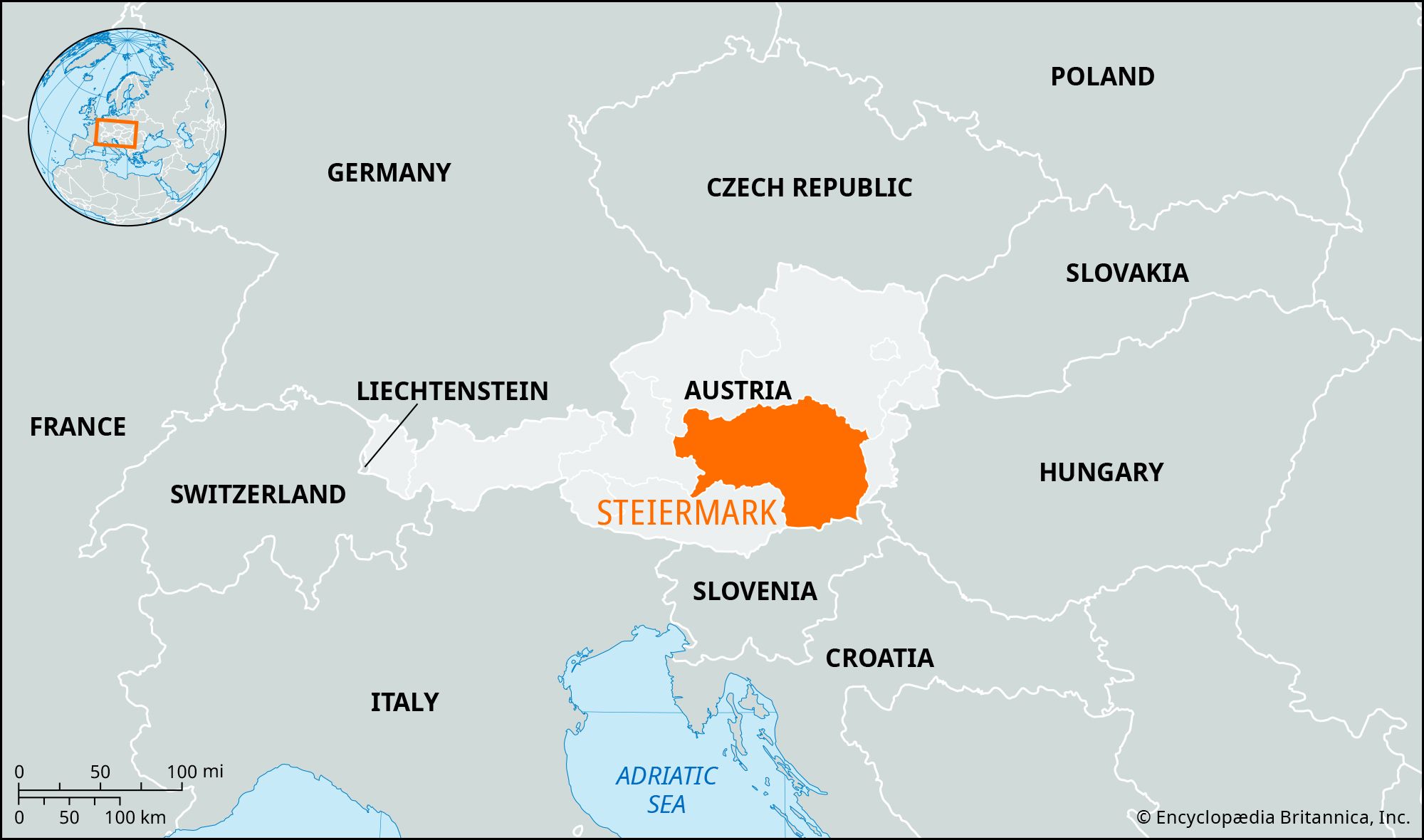
Steiermark, also known as Styria, is a federal state (Bundesland) in southeastern and central Austria, sharing a border with Slovenia to the south. It is also bordered by other Austrian states: Carinthia, Salzburg, Upper Austria, Lower Austria and Burgenland.
German is the primary language spoken in Steiermark, and the majority of the population identifies as Roman Catholic. Graz is the capital and largest urban center, with other principal cities including Leoben, Kapfenberg, and Bruck. Steiermark has a rich history, dating back to the Stone Age, and its economic growth has been significantly shaped by its abundant mineral resources, including iron ore from Erzberg.
4 Britannica SourcesCreated from Britannica articles using AI. AI can make mistakes, so verify using Britannica articles. -
Where is Steiermark located in Austria?
Steiermark, also known as Styria, is a federal state in southeastern and central Austria. It shares a border with Slovenia to the south and is surrounded by other Austrian states: Kärnten (Carinthia) to the south, Salzburg to the west, Oberösterreich and Niederösterreich (Upper and Lower Austria) to the north, and Burgenland to the east.
Upper Steiermark spans from the Limestone Alps in the north to the eastern groups of the Central Alps, encompassing the Mur, Mürz, Salza, and Upper Enns river valleys. Lower Steiermark features an upland and hill country, including the central Mur Valley with the Grazerfeld plain, the Koralpe and Packalpe mountains in the west, and a loam-covered hill country in the east.
2 Britannica SourcesCreated from Britannica articles using AI. AI can make mistakes, so verify using Britannica articles. -
What is the capital city of Steiermark?
Graz is the capital city of Steiermark, a federal state in southeastern Austria. Situated on the Mur River, Graz is Austria's second-largest city. The name Graz comes from gradec, a Slavic term for "small fortress." Graz became the center of Steiermark in the Middle Ages and a residence for the Leopoldine Habsburgs after 1379. Today, Graz is known for its historical significance, cultural attractions, and modern industries.
4 Britannica SourcesCreated from Britannica articles using AI. AI can make mistakes, so verify using Britannica articles. -
What are some important geographical features of Steiermark?
Steiermark, a federal state in southeastern and central Austria, has varied geographical features. Upper Steiermark, in the north, stretches from the Limestone Alps to the eastern groups of the Central Alps, encompassing the Mur, Mürz, Salza, and Upper Enns river valleys. Lower Steiermark features an upland and hill country, including the middle Mur Valley with the Grazerfeld plain, the Koralpe and Packalpe mountains, and loam-covered hills in the east.
Steiermark's economy has been shaped by its mineral resources, such as the Erzberg near Eisenerz, which has been a source of iron ore since Celtic times. The region also has brown coal (lignite) mines and produces magnesite, graphite, talc, gypsum, and salt. The Mura river also provides hydroelectric power.
3 Britannica SourcesCreated from Britannica articles using AI. AI can make mistakes, so verify using Britannica articles. -
What industries or products is Steiermark known for?
Steiermark's economy has historically relied on its rich mineral resources. The Erzberg mine near Eisenerz is a major source of Austria's iron ore, with mining operations dating back to Celtic times. Other significant resources include brown coal (lignite) extracted from Fohnsdorf and Köflach, as well as magnesite found in the Shale Alps.
Key industries in Steiermark involve metal and machine production, sawmills, and the automotive sector, including vehicle development and manufacturing. The region also has paper, cellulose, chemical, textile, leather, and food processing sectors. While agriculture employs a smaller percentage of the population, livestock raising and the cultivation of corn and fruit are common in the southeast.
2 Britannica SourcesCreated from Britannica articles using AI. AI can make mistakes, so verify using Britannica articles. -
How does Steiermark's culture differ from other Austrian states?
Steiermark's culture, like other Austrian states, maintains age-old rituals, customs, and a communal spirit. However, Steiermark is also known for preserving ancient folklore, songs, and dances, especially in its mountainous regions. The gray-green Steiermark suit is recognized as an Austrian national costume.
One notable tradition is the Glöcklerlauf festival, which is celebrated the evening before Epiphany (January 6), especially in the mountainous regions of Oberösterreich, Steiermark, and Tirol. During the festival, young men and boys wear loud bells and carry handmade masks to drive away winter's evil spirits.
The dialect of German spoken in Austria is Bavarian, except in the west. A Southern Bavarian subdialect is spoken in Tirol, Kärnten, and parts of Steiermark.
2 Britannica SourcesCreated from Britannica articles using AI. AI can make mistakes, so verify using Britannica articles.
Steiermark, Bundesland (federal state), southeastern and central Austria, bordering Slovenia on the south and bounded by Bundesländer Kärnten (Carinthia) on the south, Salzburg on the west, Oberösterreich and Niederösterreich (Upper and Lower Austria) on the north, and Burgenland on the east. It has an area of 6,327 square miles (16,387 square km). Upper Steiermark extends in the north from the Limestone Alps to the eastern groups of the Central Alps, embracing the valleys of the Mur, Mürz, Salza, and Upper Enns rivers. The Lower Steiermark upland and hill country consists of the middle Mur Valley with the Grazerfeld “plain” in the centre; the Koralpe and Packalpe rising above 6,500 feet (2,000 metres) in the west; and a gravel, loam-covered hill country in the east.
Inhabited since the Stone Age and mined as early as the Bronze Age, the region became part of the Celtic kingdom of Noricum, which was incorporated into the Roman Empire c. 15 bce. In the 5th century it was overrun by Germanic tribes, followed by the Avars and their Slav subjects (Slovenes). Subjected by the Bavarians in the 8th century, the country became a mark, or frontier territory, of the Frankish Empire. Further German colonization led to Germanization by c. 1300, except in the southern countryside. The area of modern Steiermark belonged to the duchy of Carinthia (Kärnten) after 976, but other northern areas of modern Steiermark were acquired in the 11th and 12th centuries by the counts, or margraves, of Traungau, whose main seat was at Styraburg, or modern Steyr (Oberösterreich). In 1180 the entire area became the duchy of Steiermark, or Styria, which passed to the Babenberg duke of Austria in 1192 until the extinction of the Babenberg line in 1246. In 1276 most of the area was ceded to the Habsburgs, and it became a crown land in 1282. Thereafter, its history was merged with that of Austria, although it was ruled only by junior branches of the House of Habsburg from 1379 to 1439 and from 1564 to 1619. After World War I, 2,329 square miles of southern Steiermark, including Marburg (Maribor), Cilli (Celje), and Pettau (Ptuj), were ceded to Yugoslavia. Steiermark has been a Bundesland ever since, except for the years 1938–45 when most of it formed a Reichsgau (party district) under the Anschluss, or incorporation into Germany.
Ethnically, Steiermark is German. Most inhabitants are Roman Catholic. Ancient folklore, song, and dance are preserved in the mountainous areas and the gray-green Steiermark suit is almost an Austrian national costume. The principal urban centres are Graz, the capital, Leoben, Kapfenberg, Bruck, Eisenerz, Knittelfeld, Köflach, Mürzzuschlag, and Fohnsdorf.



Steiermark’s economic development has always been determined by its mineral resources. The Erzberg near Eisenerz supplies most of Austria’s iron ore and has been mined since Celtic times. Brown coal (lignite) is mined at Fohnsdorf and Köflach and magnesite in the Shale Alps. The state also produces sizable amounts of graphite, talc, gypsum, and salt. Thermoelectricity is generated, and there are hydroelectric plants on the Mur and other rivers. Heavy industry is concentrated in the Mur Valley below Fohnsdorf and in the Mürz Valley. Metal and machine industries, sawmills, automobile development and production, and paper and cellulose industries are important; chemicals, textiles, leather, and food products are also manufactured. Major industrial sites are in Graz, Leoben, Bruck, and Kapfenberg. Agriculture employs a small percentage of the working population; livestock raising is widespread, and corn (maize) and fruit are cultivated in the southeast. There is a significant tourist trade, based on numerous mountain resorts. Pop. (2021) 1,251,683; (2023 est.) 1,269,801.