
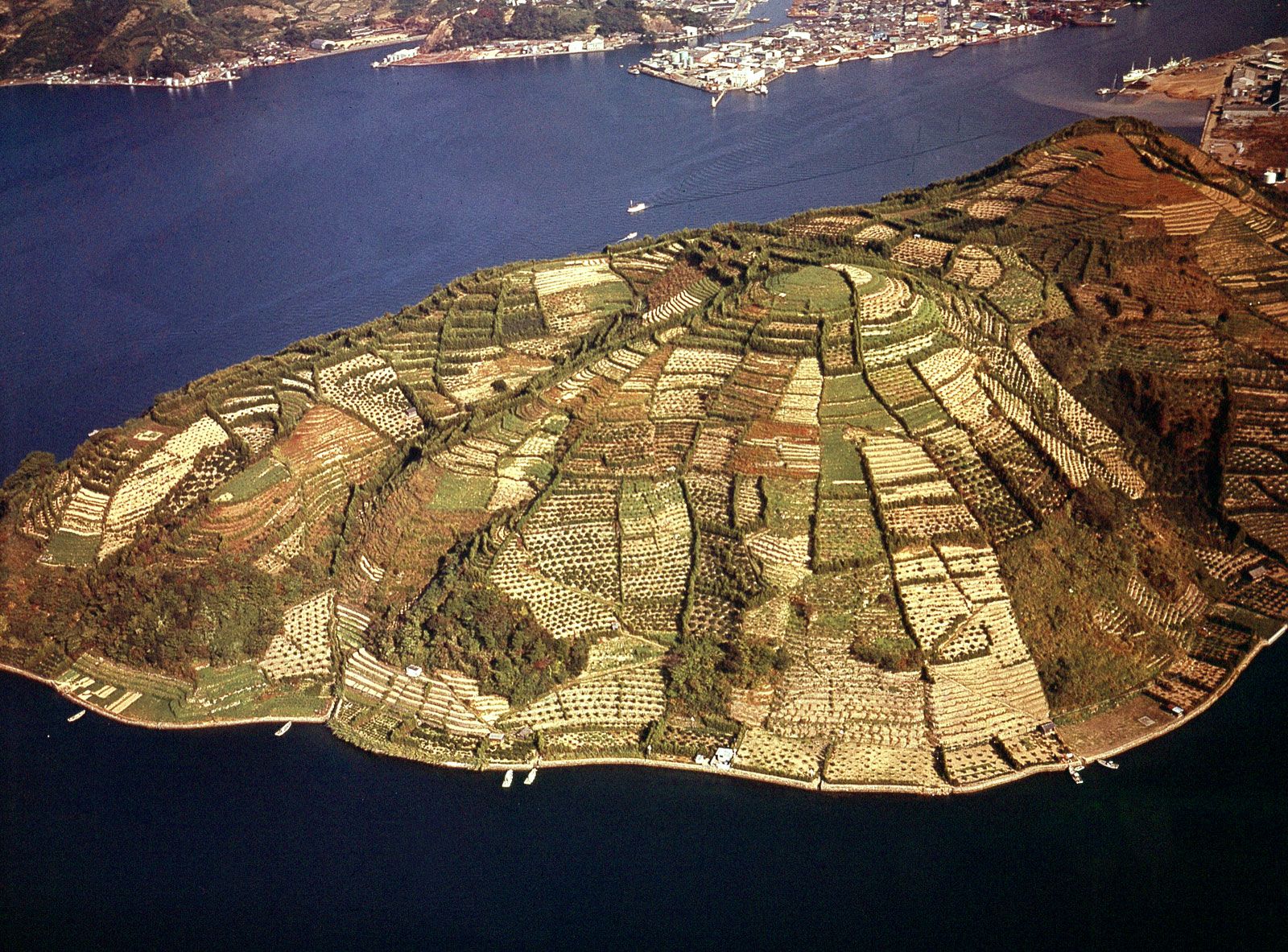



Shikoku
Shikoku, island, the smallest of the four main islands of Japan. It is separated from Honshu by the Inland Sea (north) and the Kii Strait (east) and from Kyushu by the Bungo Strait (west). The island is divided into the prefectures of Ehime, Kagawa, Kōchi, and Tokushima. Shikoku is also one of the country’s chihō (regions), which includes, in addition to the main island, nearby islands associated with its constituent prefectures.
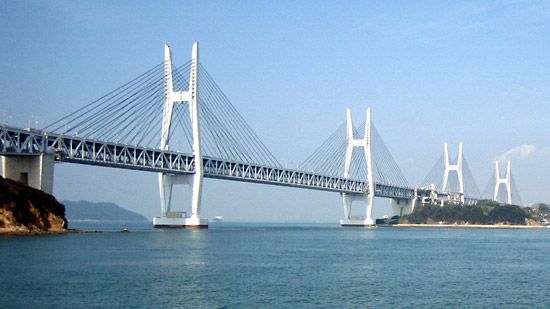
Much of the island’s landscape is mountainous, and the population is concentrated in urban areas on narrow plains along the coast. Agriculture is intensive in the north; rice, barley, wheat, and mandarin oranges are among the major crops. Fishing is well developed, and salt is produced from evaporated seawater. Industries produce petroleum, nonferrous metals, textiles, wood pulp, and paper. Important cities and industrial centres are Matsuyama, Takamatsu, Kōchi, and Tokushima. Shikoku is connected to Honshu by three multiple-span overwater bridges constructed in the late 20th century: the Ōnaruto Bridge in the east (via Awaji Island and the Akashi Strait Bridge), the Seto Great Bridge in the northeast-central area, and the Kurushima Strait Bridge in the northwest-central section. Area island, 7,063 square miles (18,292 square km); region, 7,259 square miles (18,802 square km). Pop. region, (2010) 3,977,282.


