


Britannica AI Icon
Adding us as a Preferred Source tells Google you trust our content, so our articles show up more often in your Google Search, Discover feed, and AI Overviews.
verifiedCite
While every effort has been made to follow citation style rules, there may be some discrepancies. Please refer to the appropriate style manual or other sources if you have any questions.
Select Citation Style
Feedback
Corrections? Updates? Omissions? Let us know if you have suggestions to improve this article (requires login).
Thank you for your feedback

Our editors will review what you’ve submitted and determine whether to revise the article.

Shepparton

Victoria, Australia

News •

'Strong, cheeky' Shepparton boy remembered after tragic river death • Nov. 6, 2026, 8:26 PM ET (ABC News (Australia))
Goulburn-Murray and Shepparton local news briefing: Friday, November 6, 2026 • Nov. 5, 2026, 4:22 PM ET (ABC News (Australia))
Eight arrested over alleged assault of off-duty police officer in Shepparton • Nov. 1, 2026, 9:20 PM ET (ABC News (Australia))
Man dies after being crushed by ramp in northern Victoria • Oct. 24, 2026, 11:46 PM ET (ABC News (Australia))
Goulburn-Murray and Shepparton local news briefing: Tuesday, October 20, 2026 • Oct. 19, 2026, 5:57 PM ET (ABC News (Australia))

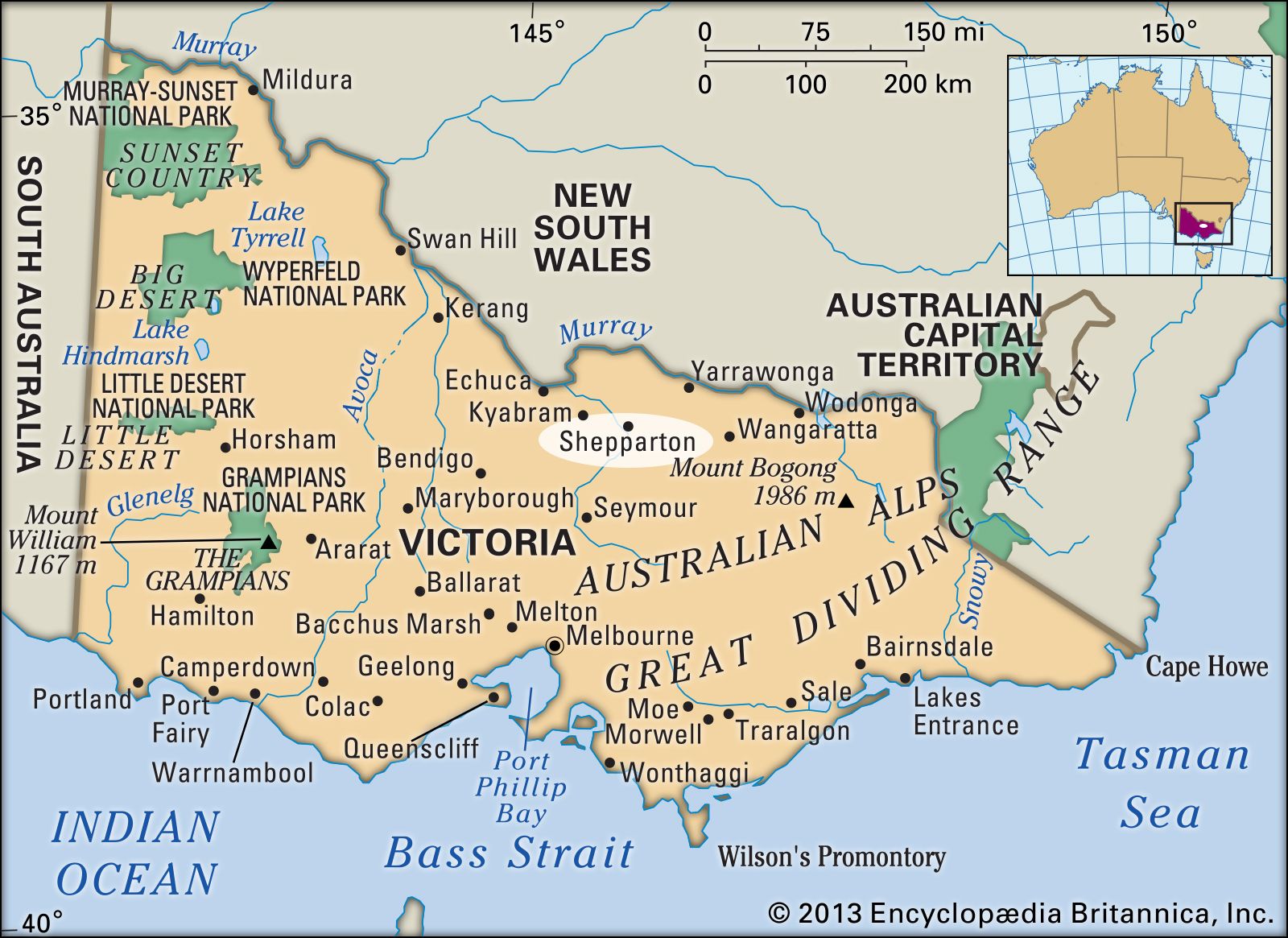
Shepparton, city, north-central Victoria, Australia, at the confluence of the Goulburn and Broken rivers, northeast of Melbourne. The site, called Canny-goopna (“River of Big Fish”) by the local Bangerang Aboriginal people, was settled as a sheep run in the early 1840s. The first European settlement was known as Macguire’s Punt, after a ferryman of the 1850s; the present name, which dates from 1853, came from an early settler, Sherbourne Sheppard. Proclaimed a shire in 1879, it prospered with regional agricultural development. In 1927 it was separated as a borough and became a city in 1949. It is now the headquarters of the Goulburn Valley Irrigation Area (including the Yarrawonga Weir, on the Murray River, and Eildon Weir, on the Goulburn), which supports fruits, garden vegetables, fodder, cereals, dairy, and poultry. Local industries include lumbering, fruit canning, textiles, wine making, terrazzo-flooring production, plastic packaging, and soap manufacturing. Light engineering firms include that of J. Furphy & Sons, makers of the water carts used by Australian soldiers in World War I. Nearby are the Department of Primary Industries, Tatura, which focuses on horticultural research, and the Dookie Agricultural College of the University of Melbourne. Pop. (2001) urban centre, 35,828; (2011) urban centre, 42,742.


This article was most recently revised and updated by Amy Tikkanen.
Discover the fascinating events that shaped the world, straight from our editors.
By clicking “Sign Up”, you consent to the Britannica Privacy Policy and Terms of Use.
