

- French:
- Sercq


Sark
-
What is Sark?
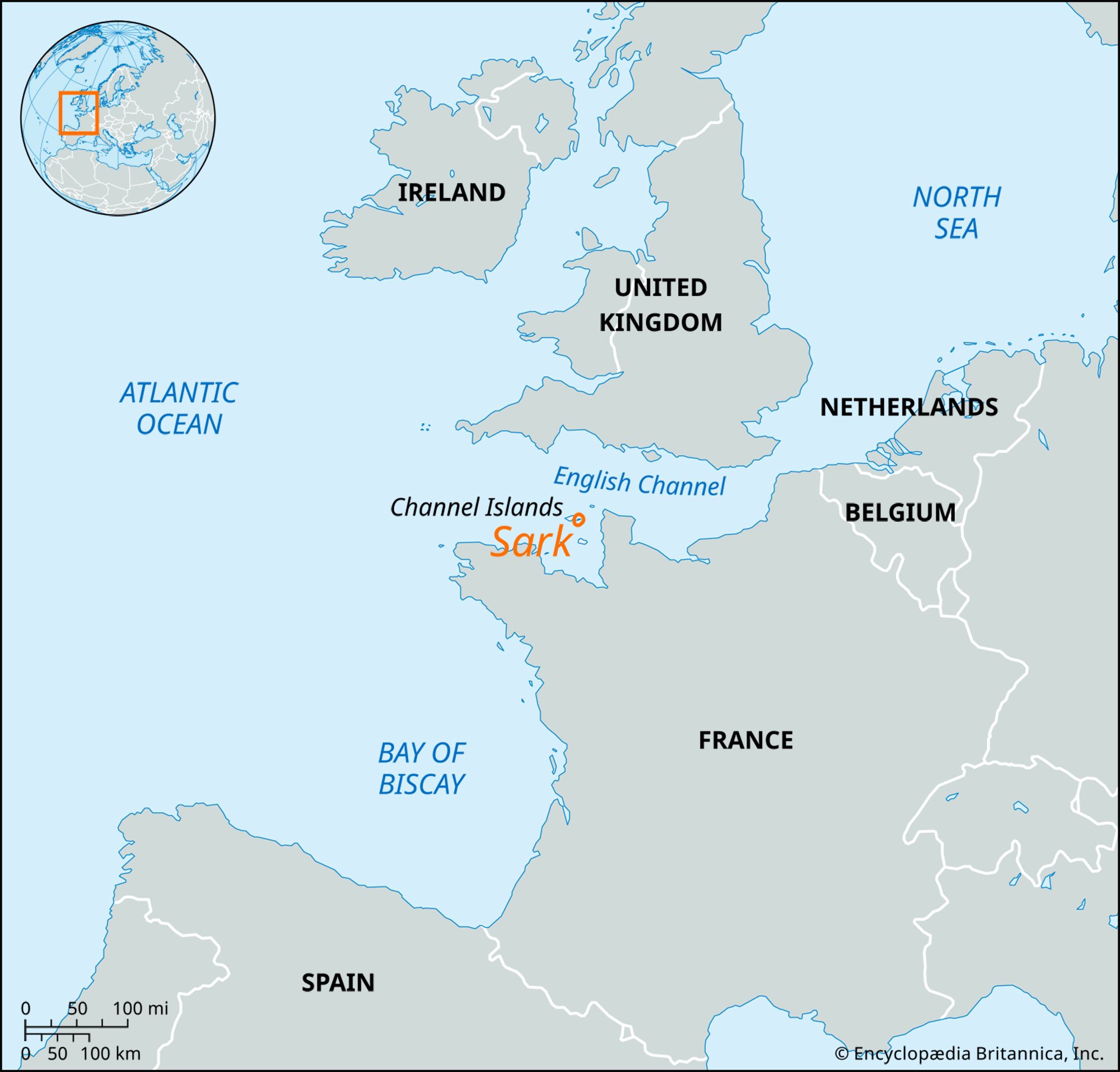
Sark is one of the Channel Islands and a dependency of Guernsey, located in the English Channel. It is situated 7 miles (11 km) east of Guernsey and about 25 miles (40 km) west of France's Cherbourg Peninsula. The island consists of two parts, Great Sark and Little Sark, connected by La Coupée, a narrow isthmus.
Sark's history dates back to around 1040 when William of Normandy gifted it to the Mont-Saint-Michel abbey. In 1565, Elizabeth I had it colonized to prevent it from becoming a pirate haven. Ruled by a feudal government into the 21st century, Sark transitioned to universal suffrage in 2008.
Notably, automobiles are prohibited; transportation relies on horse-drawn carriages and bicycles. The island is accessible only by boat, as airplanes are not allowed.
2 Britannica SourcesCreated from Britannica articles using AI. AI can make mistakes, so verify using Britannica articles. -
Where is Sark located?
Sark is one of the Channel Islands, a dependency of Guernsey, and is located in the English Channel, south of England's coast. Sark is 7 miles (11 km) east of Guernsey and roughly 25 miles (40 km) west of the Cherbourg Peninsula in France. The island is part of the Bailiwick of Guernsey.
4 Britannica SourcesCreated from Britannica articles using AI. AI can make mistakes, so verify using Britannica articles. -
What are the Channel Islands?
The Channel Islands are an archipelago in the English Channel, near France. They are British crown dependencies, not strictly part of the United Kingdom.
Sark is one of the Channel Islands and a dependency of Guernsey. It is located 7 miles (11 km) east of Guernsey. Sark consists of Great Sark and Little Sark, connected by La Coupée, a narrow isthmus. The smaller island of Brecqhou is nearby. Sark is a plateau with a scenic coast and cliffs. Automobiles are prohibited, with horse-drawn carriages and bicycles being common modes of transport.
3 Britannica SourcesCreated from Britannica articles using AI. AI can make mistakes, so verify using Britannica articles. -
How is Sark different from the other Channel Islands?
Sark is unique among the Channel Islands due to its history and traditions. Sark is part of the Bailiwick of Guernsey and has a distinct feudal government that lasted into the 21st century. In 2008, Sark changed its laws to introduce universal suffrage and transform the Chief Pleas into a popularly elected assembly. Uniquely, automobiles are prohibited; the island only allows farm tractors as motor vehicles, and horse-drawn carriages and bicycles are common for transportation.
3 Britannica SourcesCreated from Britannica articles using AI. AI can make mistakes, so verify using Britannica articles. -
What is unique about life on Sark?
Sark, part of the Channel Islands, has unique qualities. Measuring 3 miles (5 km) long and 1.5 miles (2.4 km) wide, the island consists of Great Sark and Little Sark, connected by La Coupée a narrow isthmus. Sark's feudal government evolved in April 2008 to universal suffrage and an elected assembly. Motor vehicles are prohibited, except for farm tractors, and the island is only accessible by boat, as airplanes are banned. Horse-drawn carriages and bicycles are common modes of transport.
1 Britannica SourceCreated from Britannica articles using AI. AI can make mistakes, so verify using Britannica articles. -
How is Sark governed and what are some interesting rules there?
Sark, a dependency of Guernsey in the Channel Islands, has a unique system of governance. Until 2008, Sark was the last feudal state in Europe, but reforms introduced universal suffrage and transformed the Chief Pleas into a popularly elected assembly. Sark is part of the Bailiwick of Guernsey. Justice is administered by the court of the seneschal, with appeals to Guernsey's Royal Court.
Interesting rules on Sark include a ban on automobiles (only farm tractors are allowed), a reliance on horse-drawn carriages and bicycles for transport, and a ban on airplanes. Additionally, canine populations are controlled, and only the seigneur can keep a female dog.
1 Britannica SourceCreated from Britannica articles using AI. AI can make mistakes, so verify using Britannica articles.
Sark, one of the Channel Islands, a dependency of Guernsey, located in the English Channel, south of England’s coast. Sark lies 7 miles (11 km) east of Guernsey and about 25 miles (40 km) west of the Cherbourg Peninsula of France. The island, which is 3 miles (5 km) long and 1.5 miles (2.4 km) wide at its broadest point, consists of two components, Great Sark and Little Sark, which are connected by La Coupée (a 300-foot- [90-metre-] long isthmus that is only about 30 feet [10 metres] wide). The smaller, privately owned island of Brecqhou (Brechou) is separated from Great Sark by the narrow Le Gouliot Channel. Sark is part of the Bailiwick of Guernsey. The island is essentially a plateau rising to 375 feet (114 metres), with a scenic coast encircled by precipitous cliffs. The island has three small harbours: Creux, La Maseline, and Havre Gosselin.
Apart from legends of St. Magloire (6th century), Sark first appears in history as a gift by William of Normandy (later William I, the Conqueror) to the Mont-Saint-Michel abbey about 1040. A century later it was in the hands of the Vernon family, lords of Néhou, who endowed the priory of St. Magloire as a dependency of the abbey of Montebourg. Sark reverted to the English crown in 1204 by Richard de Vernon’s forfeiture. Sark was governed by a royal provost who presided over a court of six jurats (magistrates chosen for life). The island was captured by the French in 1549 but was in English hands again by 1558. Thereafter, it remained under English control, except for a period of German occupation during World War II.
To prevent the island from becoming a nest of pirates, it was colonized by Hélier de Carteret, seigneur of St. Ouen in Jersey, under a patent of Elizabeth I (August 6, 1565). At first the court was modeled on that of Jersey, with bailiff and jurats, but this was changed in 1675 to one composed of seneschal, provost, greffier, tenants, seigneur, constable, and vingtenier. By 1951 the members were reduced to seigneur, seneschal, tenants, and 12 deputies. The Carterets were seigneurs until 1732, after which the seigneury changed hands several times. From 1927 until 1974 it was held by the dame of Sark, Sibyl Hathaway; on her death she was succeeded by her son Michael Beaumont as 22nd seigneur.



Sark’s feudal government survived into the 21st century, but in April 2008 the laws governing the island were changed to introduce universal suffrage and to transform the Chief Pleas into a popularly elected assembly. Previously the Chief Pleas had comprised 40 unelected tenants (heirs of the families that had originally come to the island as colonizers) and 12 elected deputies. In December 2008 the first election to the new 28-member Chief Pleas was held. Justice on Sark is administered by the court of the seneschal, with rights of appeal to the Royal Court of Guernsey. Police, if required, are supplied from Guernsey on repayment. The canine population is controlled, and no one but the seigneur may keep a female dog.
Human settlement on the island is scattered. Dairying is practiced, but the farmland (about a third of the island) includes substantial tillage, and there is some market gardening. Despite the importance of tourism to Sark’s economy, accommodation is limited, and most visitors come on day trips from Guernsey or on cruises. Automobiles are prohibited on the roads of Sark, and farm tractors are the only motor vehicles allowed. Horse-drawn carriages and bicycles are common means of transportation. The island may be reached only by boat since airplanes are banned. Area (including Brecqhou) 2.1 square miles (5.5 square km). Pop. (2001) 591.