


Santa Catarina
-
Where is the state of Santa Catarina located in Brazil?
Santa Catarina is a coastal state in southern Brazil. It is bordered to the north by the state of Paraná, to the south by Rio Grande do Sul, to the east by the Atlantic Ocean, and to the west by the Misiones province of Argentina. Florianópolis, the state capital, is located on the west coast of Santa Catarina Island.
3 Britannica SourcesCreated from Britannica articles using AI. AI can make mistakes, so verify using Britannica articles. -
What is the capital city of Santa Catarina?
The capital of Santa Catarina, a coastal state in southern Brazil, is Florianópolis. This port city is located on the western coast of Santa Catarina Island and is connected to the mainland by the Hercílio Luz Bridge. Florianópolis serves as the state's administrative and commercial center, and it is home to the Federal University of Santa Catarina. Florianópolis was designated the capital in 1889.
2 Britannica SourcesCreated from Britannica articles using AI. AI can make mistakes, so verify using Britannica articles. -
What are some common geographic features of Santa Catarina?
Santa Catarina, a coastal state in southern Brazil, is characterized by a landscape with few level grounds. A prominent feature is the great escarpment that rises behind the seacoast, resembling a mountain wall.
The state's highest point is Mount Igreja, which has an elevation of 5,932 feet (1,808 meters) and is located in the southeastern part of the state.
Santa Catarina has two principal river systems: the coastal rivers flowing eastward to the coast and those flowing south to the Uruguay River, which forms part of the state’s southern border. The Pelotas River forms much of the border between Santa Catarina and Rio Grande do Sul states.
3 Britannica SourcesCreated from Britannica articles using AI. AI can make mistakes, so verify using Britannica articles. -
What languages and cultures influence life in Santa Catarina?
Santa Catarina's culture is influenced by a mix of languages and cultures. The state was part of a Portuguese captaincy from 1532 onward, with the first settlement established in 1648.
During the 19th century, many non-Portuguese people immigrated to the area, including Germans, Italians, Poles, Ukrainians, and Russians. The Portuguese language is spoken by the majority, influencing the languages of the various immigrant groups. The dominant religion is Roman Catholicism, but several Protestant sects and spiritualism also have influence, especially in urban areas.
1 Britannica SourceCreated from Britannica articles using AI. AI can make mistakes, so verify using Britannica articles. -
What are important economic activities in Santa Catarina?
Santa Catarina has a diverse economy. The manufacture of wood products, including furniture and charcoal, is a major industry. Brazil's best coal is mined near Criciúma on the southern coast. Fishing and fish processing are important, and the state is a leading producer of pork and poultry. Much of Brazil's wheat, tobacco, and apples come from Santa Catarina. Food processing, as well as the manufacture of ceramic tiles, textiles, and mechanical equipment, are also significant. Tourism, especially from Argentina, is a major economic activity on the northern coast. In Lajes, livestock raising and diversified light industry are main economic activities, along with lumber, soy, corn, beans, wheat, potatoes, and apples.
3 Britannica SourcesCreated from Britannica articles using AI. AI can make mistakes, so verify using Britannica articles. -
What are some popular tourist attractions in Santa Catarina?
Santa Catarina, a coastal state in southern Brazil, boasts a variety of attractions. Florianópolis, the capital, is a port city located on Santa Catarina Island and is linked to the mainland by the Hercílio Luz Bridge.
The state's coastal valleys are home to cities like Blumenau, Joinvile, and Brusque, which were founded by German immigrants in the 1800s. On the northern coast, tourism is a major economic activity, especially from Argentina.
2 Britannica SourcesCreated from Britannica articles using AI. AI can make mistakes, so verify using Britannica articles.
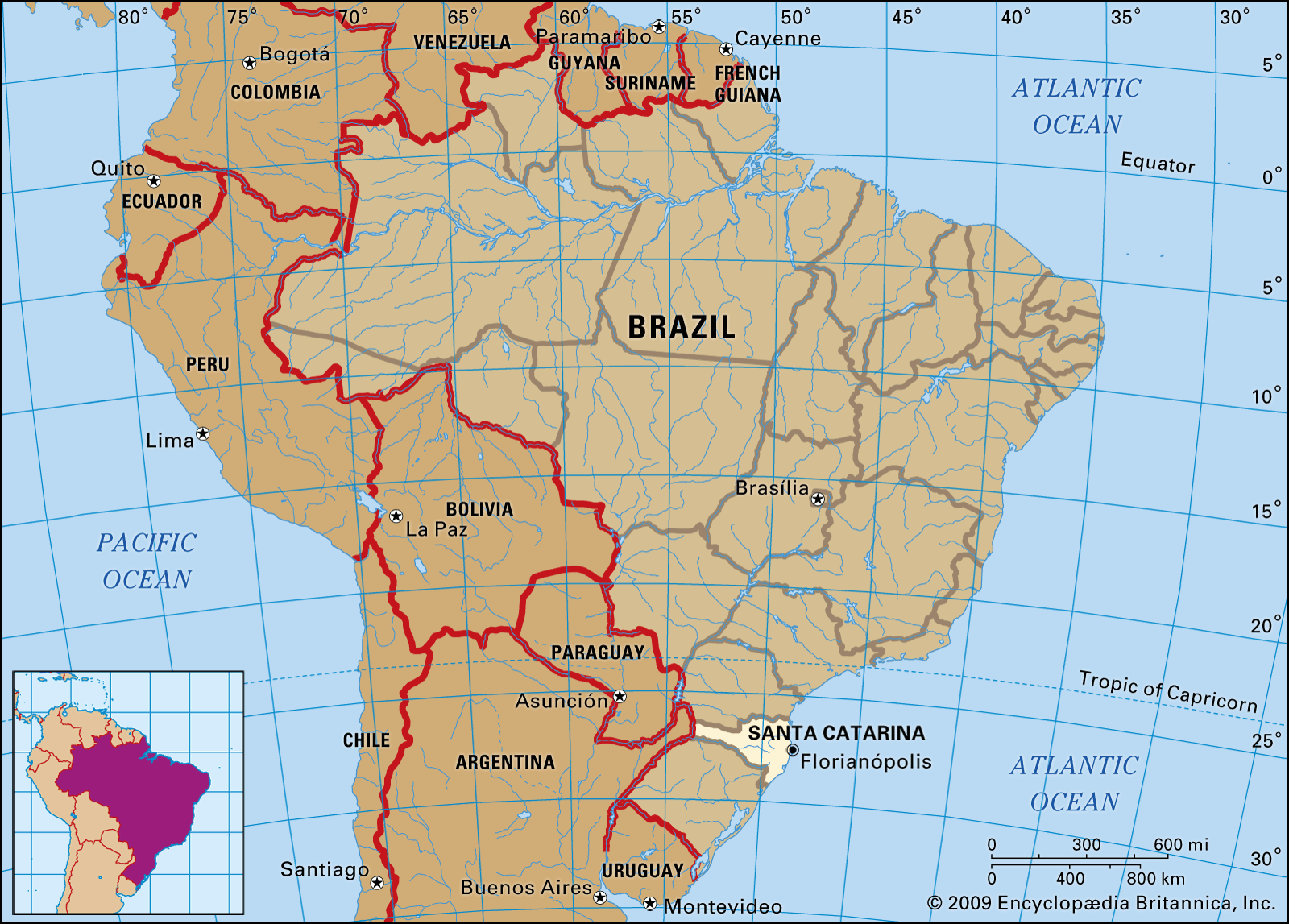
Santa Catarina, southern coastal estado (state) of Brazil, bounded to the north by the state of Paraná, to the south by the state of Rio Grande do Sul, to the east by the Atlantic Ocean, and to the west by Misiones province of Argentina. It is one of the smaller Brazilian states. The capital is Florianópolis, located on coastal Santa Catarina Island. The region was given various names by early Spanish and Portuguese cartographers; the name Santa Catarina is said to have been given in honour of St. Catherine of Alexandria by the Italian navigator Sebastian Cabot, when he was in the service of Spain.
Santa Catarina was part of a larger hereditary captaincy (district administered by a captain) established by the Portuguese crown in 1532, although the first Portuguese settlement, at what is today the port of São Francisco do Sul near the Paraná border, was not made until 1648. The region’s interior highland prairies were used for cattle raising, and early in the 18th century trading posts were opened along the cattle trails leading across the plateaus toward the coastal towns and the northern markets. The captaincy of Santa Catarina was created in 1738 to serve as an outpost in the Portuguese-Spanish territorial wars. It was governed from Rio de Janeiro by the military until 1822, when Brazil became an empire independent of Portugal. A revolution that spread northward from Rio Grande do Sul in 1839 created the short-lived Republic of Santa Catarina in the locality.
During the 19th century a considerable immigration of non-Portuguese peoples occurred. Germans arrived as early as 1829 and came in great numbers during the 1850s, settling along the coastal valleys and founding the cities of Blumenau, Joinvile, and Brusque. Many Italians immigrated after 1875, and Poles, Ukrainians, and Russians arrived in the 1880s. African slaves composed about 10 percent of the population in the 1870s; they were emancipated in 1888. Santa Catarina became a state of Brazil when, in 1889, a republic was proclaimed to replace the empire; Florianópolis was designated the capital.



Behind the seacoast a great escarpment rises like a mountain wall; Santa Catarina has little level ground. Its highest point is Mount Igreja, 5,932 feet (1,808 metres) in elevation, located in the southeastern part of the state. There are two principal river systems, one formed by the coastal rivers flowing eastward to the coast, the other flowing south to the Uruguay River, which forms part of the state’s southern border.
Rainfall is heavy, ranging from 47 to 97 inches (1,200 to 2,500 mm) annually. Average temperatures range from a summer high of about 69 °F (21 °C) to a winter low of about 48 °F (9 °C). Although much of the original forest cover, which consists of mixed tropical and subtropical vegetation, has been cleared, extensive reforestation programs are now being pursued.
The overwhelming majority of the population is white, the remainder predominantly Afro-Brazilian with a few Indians. The Portuguese spoken by the majority has also influenced the languages spoken by the descendants of the various immigrant groups. The dominant religion is Roman Catholicism; there are also several Protestant sects, and spiritualism has much influence, principally in urban areas.
There have been elementary schools in Santa Catarina for centuries, but secondary education became prevalent in the interior only in the 20th century. Higher education was introduced in 1919, and a number of universities are located in the major cities, the most prominent being the Federal University of Santa Catarina (founded 1960), in Florianópolis.
The trusted destination for professionals, college students, and lifelong learners.
SUBSCRIBE


A prominent feature of state welfare is the public-housing program. There were several hundred hospitals throughout the state in the late 20th century and several thousand doctors. The infant mortality rate is among the lowest in the country.
The manufacture of wood products forms a major part of Santa Catarina’s industry; these products include processed wood, furniture, and charcoal. Brazil’s best coal is mined near Criciúma on the southern coast. Fishing and fish processing are important, and Santa Catarina is one of the country’s leading pork and poultry producers. Much of Brazil’s wheat comes from the state, as does a large proportion of its tobacco and apples. Food processing and the manufacture of ceramic tiles, textiles, and mechanical equipment are also important. On the northern coast of Santa Catarina, tourism, especially from Argentina, is a major economic activity.
Two national highways cross Santa Catarina from north to south and one from east to west. A railway line crosses the centre of the state from south to north but is no longer of major significance. River and sea transport is poorly developed. The principal ports are Itajaí, São Francisco do Sul, Imbituba, and Laguna. There is an international airport near Florianópolis.
The theatre is popular in Florianópolis and Blumenau. The state Historical and Geographical Institute has been in existence since 1896 and the Academy of Letters since 1920. Area 36,813 square miles (95,346 square km). Pop. (2022) 7,762,154.