


Sámos
News •
-
Where is the island of Sámos located?
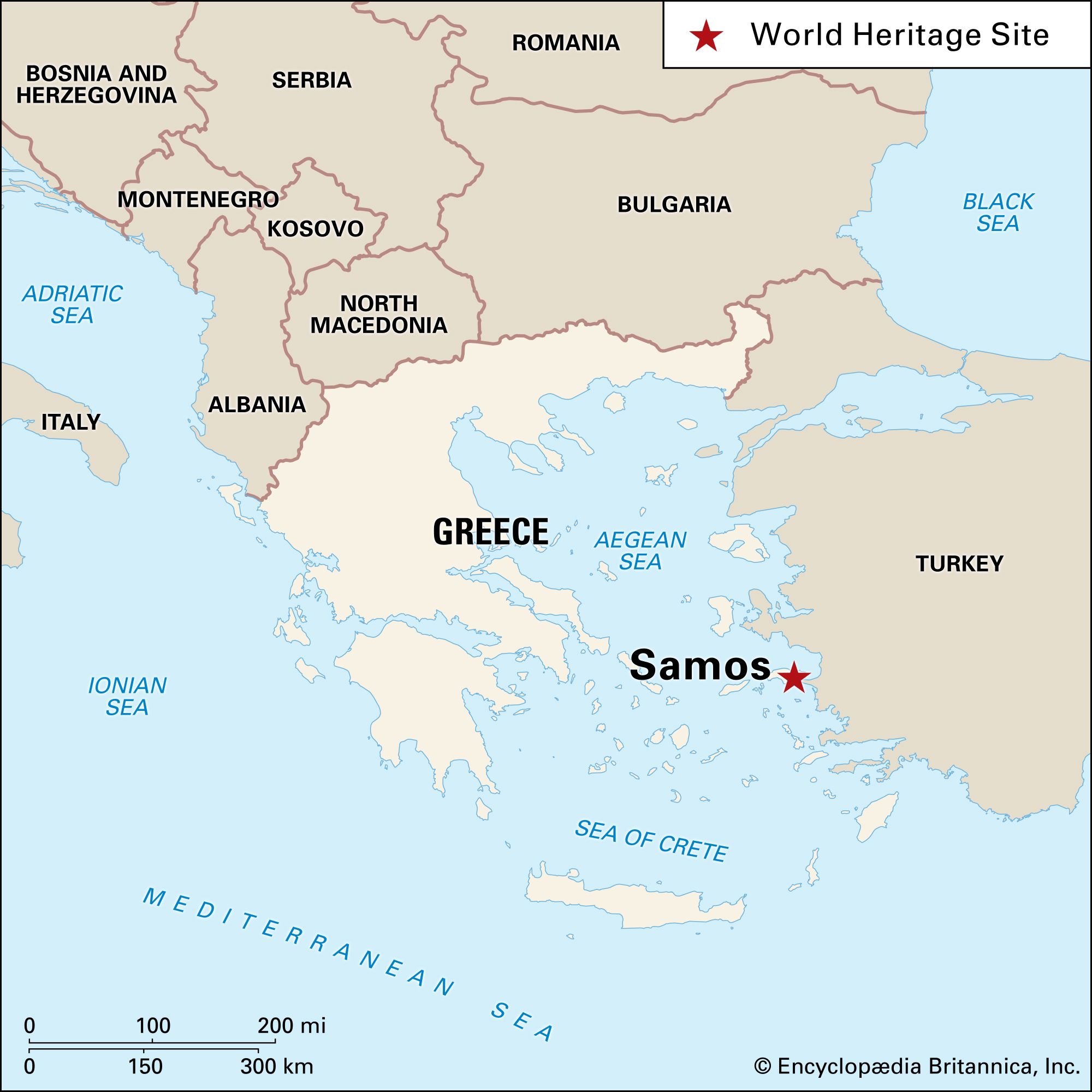
The Greek island of Sámos is located in the Aegean Sea, close to the coast of Asia Minor, from which the narrow Sámos Strait separates it. Mount Kerketeus, with a height of 4,701 feet (1,433 meters), is the island's tallest peak and forms its westernmost point. The city of Vathí is located at the head of a narrow, deepwater bay on the northern coast. Sámos is located north of the Dodecanese Islands off the coast of Turkey.
2 Britannica SourcesCreated from Britannica articles using AI. AI can make mistakes, so verify using Britannica articles. -
What country does Sámos belong to?
Sámos is a Greek island in the Aegean Sea, situated close to the coast of Asia Minor. It forms a dímos (municipality) and a perifereiakí enótita (regional unit) in the North Aegean region of eastern Greece. The island has a rich history, with evidence of settlements dating back to the Early Neolithic period.
Sámos was briefly independent after 394, but then fell alternately under Persian and Athenian sway. Annexation to Greece occurred in 1912, after the Turks evacuated the island.
The economy of Samos relies on fertile land, with vineyards, olive trees, fruit, cotton, and tobacco. The island's wines are exported to western Europe.
2 Britannica SourcesCreated from Britannica articles using AI. AI can make mistakes, so verify using Britannica articles. -
What is the geography of Sámos like?
The Greek island of Sámos is located in the Aegean Sea, very close to Asia Minor. It is a wooded and mountainous island. Mount Kerketeus, its highest peak, is 4,701 feet (1,433 metres) high and forms the island's western tip. The east coast is indented, while the south coast has broad, deep plains, except around the port of Tigáni, which is surrounded by hills.
2 Britannica SourcesCreated from Britannica articles using AI. AI can make mistakes, so verify using Britannica articles. -
Who are some famous people from Sámos?
Sámos is the birthplace of several famous individuals. Pythagoras, born around 570 BCE, was a philosopher, mathematician, and founder of the Pythagorean brotherhood. Aristarchus of Samos (c. 310–230 BCE) was a Greek astronomer who theorized that the Earth rotates on its axis and revolves around the Sun. Polycrates (flourished 6th century BCE) was the tyrant of Samos who gained naval supremacy in the eastern Aegean. Another Pythagoras, a Samian-born sculptor, had works cited by Pliny and Pausanias.
5 Britannica SourcesCreated from Britannica articles using AI. AI can make mistakes, so verify using Britannica articles. -
What are popular activities for tourists visiting Sámos?
Sámos, a Greek island close to Asia Minor, has Mount Kerketeus as its highest peak. The island is known for vineyards, olives, fruit, cotton, and tobacco. Wines from Sámos are exported to western Europe.
The island has a rich history, with early Neolithic settlements and later Ionian influence. The tyrant Polycrates ushered in Sámos's golden age in the 6th century BCE.
Tourists can explore the remains of a 5th-century-BCE temple and sanctuary of Hera, which, along with an ancient fortified port, is a UNESCO World Heritage site. Sámos was also the birthplace of Pythagoras.
2 Britannica SourcesCreated from Britannica articles using AI. AI can make mistakes, so verify using Britannica articles. -
How has the history of Sámos influenced its culture today?
Sámos's culture is deeply influenced by its long and varied history. As one of Greece's leading commercial centers by the 7th century BCE, Sámos developed a rich culture through trade with diverse civilizations.
The golden age under the tyrant Polycrates in 540 BCE left a lasting legacy. The island's alternating support for Persia and Athens, followed by Roman recognition as a free territory in 189, contributed to a unique cultural blend. Even after periods under Genoese and Turkish rule, Sámos retained its Greek identity, eventually joining Greece in 1912.
The island is the birthplace of philosopher and mathematician Pythagoras and the seat of a school of sculptors. The remains of Hera’s temple and an ancient fortified port are listed as UNESCO World Heritage Sites.
2 Britannica SourcesCreated from Britannica articles using AI. AI can make mistakes, so verify using Britannica articles.
Sámos, Greek island in the Aegean Sea, the closest one to the mainland of Asia Minor, from which it is separated by the narrow Sámos Strait. The island is wooded and mountainous; Mount Kerketeus, the highest peak (4,701 feet [1,433 metres]), forms the western tip of the island. The east coast is amply indented, but the smoother south coast has broad, deep plains except around the port of Tigáni, which is hemmed in by hills. It forms a dímos (municipality) and the perifereiakí enótita (regional unit) in the North Aegean (Modern Greek: Vóreio Aigaío) periféreia (region), eastern Greece. The city of Vathí is at the head of a narrow, deepwater bay on the north coast.
The island’s earliest settlers were of obscure origins, but there is evidence of Early Neolithic occupancy on the south coast, near Tigáni. About the 11th century bce the Ionians appeared, and by the 7th century the island was one of the leading commercial centres of Greece, trading with Black Sea peoples, Egypt, Cyrene (Libya), Corinth, and Chalcis and becoming a bitter rival of Miletus.
The Samian landed oligarchy was overturned in 540 bce by the tyrant Polycrates, bringing on what was perhaps the golden age of Sámos. He ruled in alliance with the Egyptian pharaoh and had a powerful fleet that blockaded the Persian-controlled mainland until his death about 522. Darius of Persia then took Sámos and partially depopulated it. In following decades the Samians alternately supported Persia and Athens, but after the defeat of Athens in the Peloponnesian War, Spartan hegemony replaced the Athenian. Briefly independent after 394, the island then fell alternately under Persian and Athenian sway, was caught up in rivalries between Asia Minor and Egypt during most of the 3rd century, and in 189 was recognized as a free territory by Rome and given to the kings of Pergamum in Asia Minor. In 133 and again in 88 it revolted against Rome and forfeited its autonomy.



Under Byzantine rule Sámos was for a time head of the Aegean military district. After the 13th century it passed to a Genoese trading company, and in 1453 it fell to the Turks in such a depopulated condition that they settled Albanians and other peoples there. During the War of Greek Independence (1821–29) Sámos revolted against Turkey and gained its freedom, but in 1832 it was handed back to Turkey to be administered by a Turkish-appointed Greek governor. Annexation to Greece came in 1912 after a brief bombardment by two Italian warships caused the Turks to evacuate.

The island remains fertile; land is devoted to vineyards, olive trees, and fruit, cotton, and tobacco production. Its wines are exported to western Europe. Near Tigáni, archaeologists uncovered the remains of a late 5th-century-bce temple and sanctuary of Hera. Sámos was the birthplace of the philosopher and mathematician Pythagoras and the seat of a school of sculptors. Another Pythagoras, a Samian-born sculptor, achieved works cited by the ancient historians Pliny and Pausanias. The remains of Hera’s temple and an ancient fortified port on the island were inscribed on UNESCO’s World Heritage List in 1992. Pop. (2001) 34,000; (2011) 32,977.