
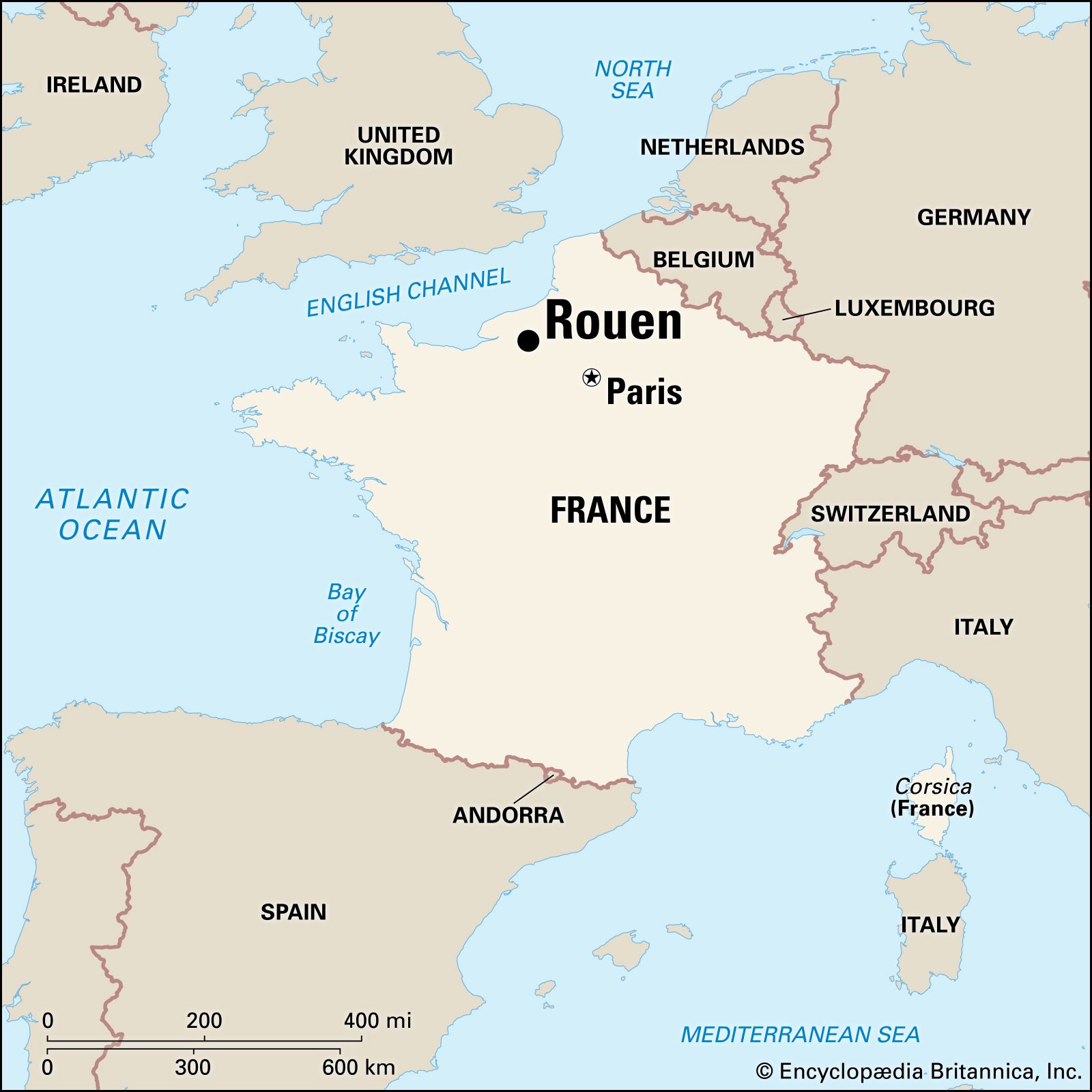





Rouen
-
What is Rouen?
Rouen, also known as Rotomagus to the Romans, gained importance in the 3rd century CE with the introduction of Christianity. The city is situated on the right bank of the Seine River and is known for its historical buildings.
Rouen Cathedral is considered one of France's finest Gothic churches, despite its variety of architectural styles and lack of symmetry. The city is a major port, serving partly as an outport of Paris. Joan of Arc was imprisoned and burned at the stake in Rouen in 1431.
2 Britannica SourcesCreated from Britannica articles using AI. AI can make mistakes, so verify using Britannica articles. -
Where is Rouen located in France?
Rouen is a port city and the capital of the Seine-Maritime département, in the Haute-Normandie région of northwestern France. It sits on the Seine River, approximately 78 miles (125 km) northwest of Paris. The old city is on the Seine River's right bank, surrounded by hills, and is known for its historical buildings.
Rouen has been called a ville-musée (museum-town) because of its many historical buildings. Rouen is a major port, serving partially as an outport of Paris.
1 Britannica SourceCreated from Britannica articles using AI. AI can make mistakes, so verify using Britannica articles. -
What is Rouen known for in history?
Rouen, known to the Romans as Rotomagus, gained importance in the 3rd century CE with the introduction of Christianity. The city's history is marked by significant events, including the Norman invasion in 876 and its subsequent rule under the English crown after the Norman Conquest of England in 1066. In 1430, Joan of Arc was imprisoned, tried, and burned at the stake in Rouen. The city was recaptured by the French in 1449, becoming a cultural center for the following century. During the Hundred Years’ War, Henry V of England besieged and took the city of Rouen from July 31, 1418, to January 19, 1419. Rouen is a major port city that serves as an outport of Paris.
2 Britannica SourcesCreated from Britannica articles using AI. AI can make mistakes, so verify using Britannica articles. -
What famous landmark can you find in Rouen?
Rouen Cathedral, considered one of France's finest Gothic churches, is a famous landmark in Rouen. Despite its varied architectural styles and asymmetry, the cathedral's immense facade, adorned with lacelike stonework, stands between two dissimilar towers. The central lantern tower, with its 19th-century spire, reaches 495 feet (151 meters), making it the highest church tower in France. The cathedral also features an 11th-century crypt, a 13th-century choir, and Renaissance tombs in the Lady Chapel.
2 Britannica SourcesCreated from Britannica articles using AI. AI can make mistakes, so verify using Britannica articles. -
Who was Joan of Arc and how is she connected to Rouen?
Joan of Arc, a French peasant girl, became a national heroine for her role in the Hundred Years’ War. Believing she was divinely guided, she led the French army to victory at Orléans in 1429.
Captured in 1430, Joan was imprisoned in a tower in Rouen, which still stands today. Tried for heresy by an ecclesiastical tribunal, she was burned at the stake in Rouen on May 30, 1431. Joan of Arc was canonized as a saint in 1920 and remains a French national hero.
4 Britannica SourcesCreated from Britannica articles using AI. AI can make mistakes, so verify using Britannica articles. -
How has Rouen's location on the Seine River influenced its development over time?
Rouen's location on the Seine River, approximately 75 miles (120 km) inland, has significantly shaped its development over time. The river allowed Rouen to serve as a major port, acting as an outport for Paris. In the 16th century, Rouen was France’s main seaport. This fostered the growth of industries like chemical, metalworking, and paper production. Today, the port primarily handles food product exports, reflecting the region’s agricultural importance. The Seine also facilitates connections with other major waterways, enhancing Rouen's accessibility and trade.
2 Britannica SourcesCreated from Britannica articles using AI. AI can make mistakes, so verify using Britannica articles.
Rouen, port city and capital of Seine-Maritime département, Haute-Normandie région, northwestern France. It is located about 78 miles (125 km) northwest of Paris, on the Seine River.
History
Known to the Romans as Rotomagus, the city first became important in the 3rd century ce, when Christianity was introduced there by St. Mellon, who was its first bishop. Invaded by the Normans in 876, it became subject to the English crown after the Norman Conquest of England (1066). In 1204 the French captured Rouen, and the city prospered until the Hundred Years’ War (1337–1453), when, in 1419, it was taken by Henry V of England. In 1430 St. Joan of Arc, the patron saint of France, was imprisoned at Rouen in a tower that still stands and now bears her name. Tried and condemned for heresy, she was burned at the stake by the English in the city on the Place du Vieux-Marché in May 1431. The city was recaptured by the French in 1449 and for the following century it was one of the main cultural centres of France. It suffered during the Wars of Religion (late 16th century), and more than half its population emigrated after 1685, when the revocation of the Edict of Nantes deprived French Protestants of their civil and religious liberties. The port and city then declined until the 19th century, when the textile trade brought it new prosperity. Rouen was occupied by the Germans during the 1870 Franco-Prussian War.
Contemporary city
The old city, on the right bank of the Seine River and surrounded by a natural amphitheatre of hills, has so many historical buildings that it has been called a ville-musée (museum-town). Indeed, much of this area was designated a preservation zone. Despite its variety of architectural styles (from early Gothic to late Flamboyant) and its lack of symmetry, Rouen cathedral is considered one of the finest Gothic churches in France. Damaged during World War II, it has been admirably restored. The immense facade, covered with lacelike stonework, stands between two dissimilar towers, the left dating mostly from the 12th century, and the right from the 15th century. Its Tour de Beurre has a carillon of 55 bells. The central lantern tower (13th–16th century), with a late 19th-century spire, is the highest church tower in France (495 feet [151 metres]). The cathedral also has an 11th-century crypt, a 13th-century choir, and Renaissance tombs in the Lady Chapel. The adjoining Archbishop’s Palace has a 15th-century facade, behind which stands the mainly 15th-century church of Saint-Maclou, a rich example of Flamboyant Gothic. The church of Saint-Ouen (mainly 12th–15th centuries) has a striking interior and 14th-century windows. Famous secular buildings include the late Gothic Palais de Justice and the 16th-century Hôtel de Bourgtheroulde. The Gros-Horloge, a Renaissance gateway (1527) with an ancient clock, standing next to a 14th-century belfry, is in the centre of the city. The Fine Arts and Ceramics Museum includes a collection of 17th- and 18th-century French paintings and Rouen ceramics. Other museums are devoted to the 17th-century dramatic poet Pierre Corneille and to the 19th-century novelist Gustave Flaubert, who were born there.




Although situated abut 75 miles (120 km) inland, Rouen is a major port, serving in part as an outport of Paris. Traditionally the port was associated with Rouen’s industrial development and was linked to the growth of the chemical, metalworking, and paper industries. Now, exports are mainly food products, reflecting the importance of agriculture in the surrounding region. Other manufacturing activities in the city include electrical and electronics equipment production, engineering, and food processing.
Rouen is also a growing business and service centre. Much of the city centre has been made conducive to tourism, with walking paths and retail shops. To the north of the centre, extensive residential development has taken place, especially near the suburb of Mont-Saint-Aignan. Many of the older industrial districts immediately to the south of the river, including a commercial centre in the Saint-Sever district, have been redeveloped.
Rouen is well-served by highways and by the Seine River. The city is connected to Paris by an electric railway network. A regional airport lies to the east of Rouen at Boos. Pop. (1999) 106,592; (2005 est.) 108,300.