


Quintana Roo
-
Where is Quintana Roo located?
Quintana Roo is a state in southeastern Mexico, located on the eastern side of the Yucatán Peninsula. It is positioned on the eastern side of the Yucatán Peninsula. The state is bordered to the north by the Yucatán Channel, which connects the Gulf of Mexico and the Caribbean Sea. To the east, it is bounded by the Caribbean Sea, and to the south, it shares borders with Belize and Guatemala. Campeche is to the west, and Yucatán state to the northwest. The state capital, Chetumal, sits on a bay at the mouth of the Hondo River, marking the border with Belize.
2 Britannica SourcesCreated from Britannica articles using AI. AI can make mistakes, so verify using Britannica articles. -
What is the capital city of Quintana Roo?
The capital of Quintana Roo, a state in southeastern Mexico, is Chetumal. It is located on the eastern Yucatán Peninsula, just north of the Belize border. Chetumal became the territorial capital in 1902 and the state capital in 1974. The city has a museum of Mayan culture and a city museum, as well as the University of Quintana Roo. Tourism is increasing in importance.
2 Britannica SourcesCreated from Britannica articles using AI. AI can make mistakes, so verify using Britannica articles. -
What is Quintana Roo best known for?
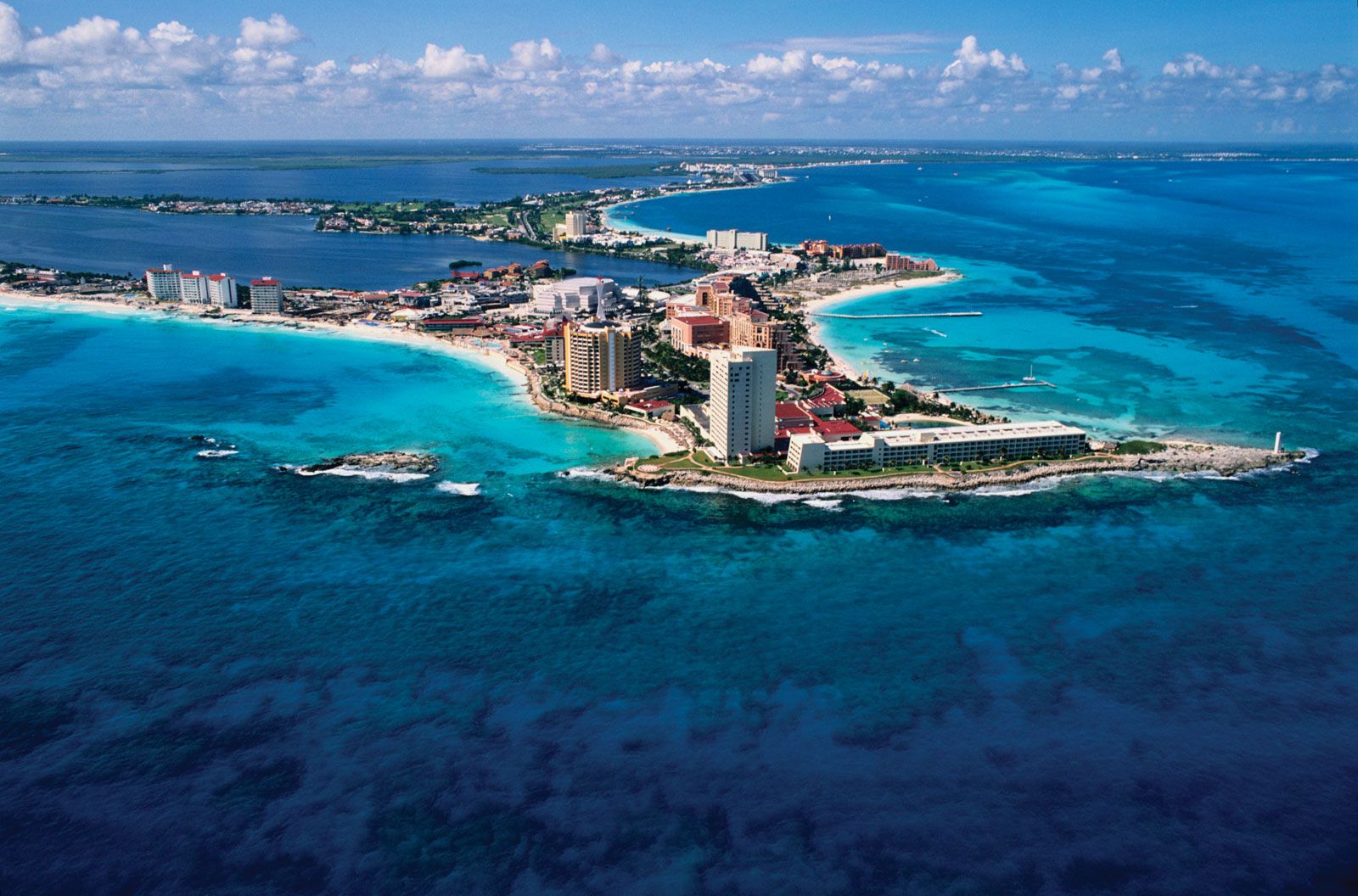
Quintana Roo, located on the eastern side of the Yucatán Peninsula, is best known for its resort cities of Cozumel and Cancún, which are part of the Maya Riviera. These cities attract a large number of tourists due to their beaches, Mayan archeological sites, and tropical climate. Tourism has driven the state's economic growth, with most of its income derived from services such as hotels, restaurants, and entertainment.
3 Britannica SourcesCreated from Britannica articles using AI. AI can make mistakes, so verify using Britannica articles. -
What are some popular tourist destinations in Quintana Roo?
Quintana Roo, located on the eastern side of the Yucatán Peninsula, is known for its hot, humid climate, forests, cenotes, and caves. Tourism has increased due to the construction of highways and airports in the region.
Popular attractions include the resort cities of Cozumel and Cancún, which are part of the Maya Riviera, and also the city of Playa del Carmen. Cancún has many white-sand beaches, palm groves, and coral reefs.
Other places include the Mayan ruins at El Meco, Tixmul, Cobá, and Tulum, and the Sian Ka’an Biosphere Reserve, a UNESCO World Heritage site with tropical forests and marine reefs.
3 Britannica SourcesCreated from Britannica articles using AI. AI can make mistakes, so verify using Britannica articles. -
What is the climate like in Quintana Roo?
Quintana Roo has a hot, humid climate. The state is a heavily forested lowland with cenotes (water-filled sinkholes) and limestone caves. Quintana Roo's Caribbean coast is prone to tropical storms and hurricanes. Sian Ka’an Biosphere Reserve, a UNESCO World Heritage site, features tropical forests and marine reefs southwest of Cozumel Island.
1 Britannica SourceCreated from Britannica articles using AI. AI can make mistakes, so verify using Britannica articles.
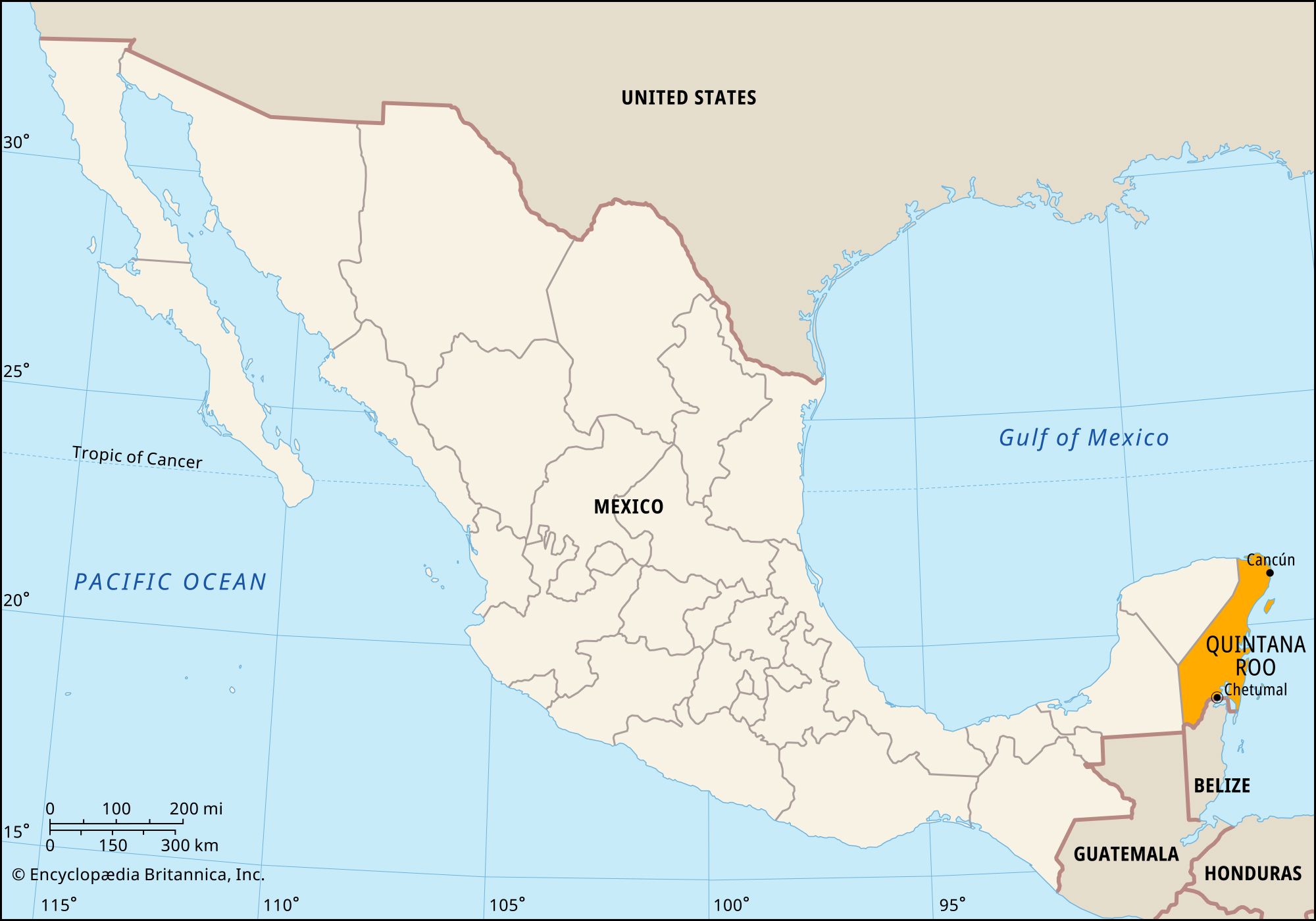
Quintana Roo, estado (state), southeastern Mexico, on the eastern side of the Yucatán Peninsula. Its northern shore is on the Yucatán Channel, a passage between the Gulf of Mexico and the Caribbean Sea; it is also bounded by the Caribbean to the east, by Belize and Guatemala to the south, by the state of Campeche to the west, and by the state of Yucatán to the northwest. The state capital, Chetumal, is located on a sheltered bay at the mouth of the Hondo River, on the frontier with Belize.
Quintana Roo occupies a hot, humid, and heavily forested lowland dotted with cenotes (water-filled sinkholes) and limestone caves. The state administers the coastal islands of Contoy, Mujeres, and Cozumel, among others, as well as cays and reefs off the Caribbean coast, which is occasionally struck by tropical storms and hurricanes. Sian Ka’an Biosphere Reserve, which was designated a UNESCO World Heritage site in 1987, comprises tropical forests and marine reefs southwest of Cozumel Island.

Dozens of Mayan cities rose to prominence in the region in pre-Hispanic times, as evidenced by ruins at El Meco, Tixmul, Cobá, Tulum, and elsewhere. In 1517 the first Spanish landing in Mexico was made at Cape Catoche, on the Yucatán Channel. Many of the present inhabitants are descendants of Maya who rebelled during the Caste War (an indigenous uprising in the Yucatán in 1847–53) and were not conquered again until the early 20th century. In 1902 the Quintana Roo territory was carved from parts of Yucatán and Campeche states. It was named for Andrés Quintana Roo, a writer and leader in the Mexican wars for independence (1810–21). In 1974 it was made a state.




Quintana Roo is sparsely settled; however, its population began increasing rapidly in the late 20th century, owing largely to growth in tourism that was aided by the construction of major highways and airports in the region. The main attractions in Quintana Roo are the resort cities of Cozumel and Cancún, part of the Maya Riviera, which also includes the city of Playa del Carmen. Cancún has outstripped Chetumal as the state’s largest city and commercial centre. Virtually all of the state’s income derives from services, including hotels, restaurants, entertainment, and other tourist-related activities. The chief crops are grains and tropical fruits. Mahogany, ebony, and other hardwoods are harvested, and sponges and turtles are caught along the coast.
State government is headed by a governor, who is elected to a single term of six years. Members of the unicameral legislature (the State Congress) are elected to three-year terms. Quintana Roo is divided into local governmental units called municipios (municipalities), each of which is headquartered in a prominent city, town, or village. Cultural institutions include a museum of Mayan culture and a city museum in Chetumal. The University of Quintana Roo (founded 1991) is located in Chetumal, and the University of the Caribbean (2000) is in Cancún. Area 19,387 square miles (50,212 square km). Pop. (2020) 1,857,985.