
- Afrikaans:
- Oranje-Vrystaat
- Major Events:
- South African War
- Peace of Vereeniging
- Bloemfontein Convention

Orange Free State
-
What was the Orange Free State?
The Orange Free State was a historical Boer state in Southern Africa that later became a province of the Union of South Africa in 1910. In 1995, the first post-apartheid South African government renamed the province Free State.
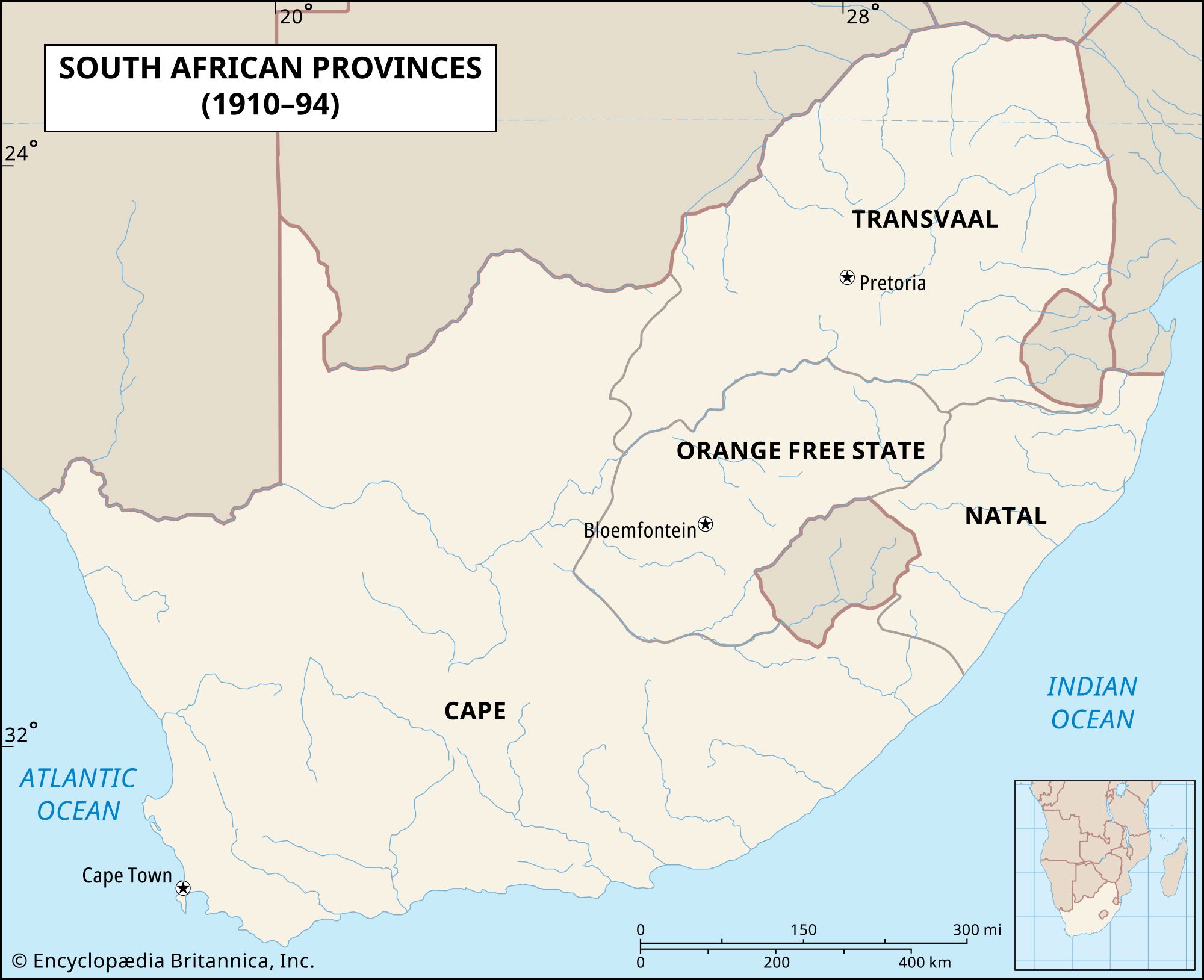
The Orange Free State was bordered by the Transvaal to the north, Natal and Lesotho to the east, and Cape Province to the south and west. The political structure of the state combined traditional Boer institutions with Dutch and American constitutional theory. The members of the unicameral legislative assembly were elected by white adult males only.
After British forces occupied Bloemfontein in 1900, the Orange Free State was annexed by Britain as the Orange River Colony. Self-government was restored in 1907.
2 Britannica SourcesCreated from Britannica articles using AI. AI can make mistakes, so verify using Britannica articles. -
Where was the Orange Free State located?
The Orange Free State, a historical Boer state in Southern Africa, was one of South Africa's four traditional provinces. It was bordered by the Transvaal to the north, Natal and the independent state of Lesotho to the east, and Cape Province to the south and west. In 1995, after apartheid was abolished, it was renamed Free State. Its capital, Bloemfontein, is the national judicial capital. The province is located on the Highveld, a plateau that rises to 6,000 feet (1,800 m) in the east and slopes to about 4,000 feet (1,200 m) in the west.
3 Britannica SourcesCreated from Britannica articles using AI. AI can make mistakes, so verify using Britannica articles. -
Who lived in the Orange Free State?
Before Europeans arrived, the Orange Free State was home to Bantu-speaking people like the Tswana. Later, the Sotho and Griqua people settled there.
Seminomadic pastoral farmers of Dutch descent, called Boers, began settling in the area, followed by a larger migration of Boer farmers seeking freedom from British rule after 1836.
In 1854, the local Boer settlers formed the independent Orange Free State. White adult males elected members to the Volksraad ("People's Council"). A president and executive council, also directly elected, held executive power.
By 1875, the Orange Free State had a population of approximately 125,000, with 26,000 whites holding citizenship. Today, Blacks make up more than three-fourths of the population, while whites account for less than one-tenth.
4 Britannica SourcesCreated from Britannica articles using AI. AI can make mistakes, so verify using Britannica articles. -
How did the Orange Free State become a province of South Africa?
The Orange Free State became a province of South Africa in 1910 through a series of historical events. Originally inhabited by Bantu-speaking people, Dutch farmers known as Boers settled in the area in the 19th century. They sought independence from British rule.
After the British initially annexed the territory, they eventually relinquished sovereignty, leading to the formation of the independent Orange Free State in 1854. The Orange Free State fought alongside the South African Republic (Transvaal) against Britain in the South African War (1899–1902). Although they initially won some battles, they were defeated, and Britain annexed the Orange Free State in 1900, renaming it the Orange River Colony.
In 1909, the South Africa Act unified the British colonies, including the Orange River Colony, into the Union of South Africa. Self-government was restored in 1907, and in 1910, it became the Orange Free State Province within the Union of South Africa. In 1995, after apartheid ended, it was renamed Free State.
3 Britannica SourcesCreated from Britannica articles using AI. AI can make mistakes, so verify using Britannica articles. -
What important events happened in the Orange Free State’s history?
The Orange Free State, a historical Boer state in Southern Africa, holds a significant place in South African history.
Key events:
* Early Settlement: In the early 19th century, Bantu-speaking people like the Tswana were displaced by Zulu military campaigns. Simultaneously, Dutch farmers known as Boers began settling the area.
* Great Trek: After 1836, more Boer farmers migrated north across the Orange River to escape British rule.
* British Sovereignty: In 1848, Britain annexed the territory between the Orange and Vaal rivers, but later relinquished sovereignty in 1854 through the Bloemfontein Convention, leading to the formation of the independent Orange Free State.
* Conflict and Prosperity: Under President J.H. Brand (1864-1888), the Orange Free State expanded by conquering the Sotho. The state prospered and established rail links with the British-ruled Cape Colony in the 1890s.
* South African (Boer) War: The Orange Free State allied with the South African Republic against Britain. Despite initial victories, British forces occupied Bloemfontein in 1900, and the Orange Free State was annexed as the Orange River Colony.
* Restoration and Union: Self-government was restored in 1907, and in 1910, it became the Orange Free State Province within the Union of South Africa. It was later renamed Free State in 1995.2 Britannica SourcesCreated from Britannica articles using AI. AI can make mistakes, so verify using Britannica articles. -
How has the Orange Free State influenced modern South Africa?
The Orange Free State, now known as Free State, has left an indelible mark on modern South Africa. Originally a Boer state, it became a province of the Union of South Africa in 1910 and was renamed in 1995.
The Free State's influence is evident in its economic contributions, particularly in agriculture, producing a significant portion of South Africa's corn and wool. The province's cultural landscape reflects a blend of Afrikaner and Black traditions, with the moralistic aspects of Afrikaner character and the influence of tribal life on Black culture still apparent. Bloemfontein, the provincial capital, serves as the national judicial capital, further cementing the region's importance. Additionally, the presence of the University of the Free State underscores its role in education and intellectual life.
2 Britannica SourcesCreated from Britannica articles using AI. AI can make mistakes, so verify using Britannica articles.
Orange Free State, historical Boer state in Southern Africa that became a province of the Union of South Africa in 1910. One of the four traditional provinces of South Africa, it was bordered by the Transvaal to the north, Natal and the independent state of Lesotho to the east, and Cape Province to the south and west. The first postapartheid South African government renamed the province Free State in 1995.
Before the arrival of Europeans, the area was the home of seminomadic Bantu-speaking peoples such as the Tswana. Europeans first crossed the Orange River northward to enter the area in the 18th century. Early in the 19th century the Tswana were dispersed by Zulu military campaigns, and their place was taken by the Sotho (Basotho) and Griqua peoples. At the same time, seminomadic pastoral farmers of Dutch descent, called trekboers or Boers, began to settle the area. After 1836 came the Great Trek, a migratory movement in which larger numbers of Boer farmers seeking freedom from British rule moved north across the Orange River. In 1848 the British annexed the territory between the Orange and Vaal rivers, proclaiming it the Orange River Sovereignty over the resistance of the Boer general Andries Pretorius. The British proved unable to build an orderly administration, however, and conflicts with the Sotho convinced the British to withdraw in 1854. On February 23, 1854, under the Bloemfontein Convention, the British relinquished their sovereignty, and the local Boer settlers formed the independent Orange Free State.
The political structure of this new state combined traditional Boer institutions with Dutch and American constitutional theory. The members of the unicameral legislative assembly, the Volksraad (“People’s Council”), were elected by white adult males only. A directly elected president and an executive council exercised the executive power. During the first few years of the new state’s existence, it was much harassed by raids from Sotho peoples from the east. The Sotho were at length conquered, and part of their territory was annexed under a treaty (1869) that determined the permanent boundary between Natal and Lesotho. These gains were made under the capable leadership of J.H. Brand, who was president of the Orange Free State from 1864 to 1888. The state prospered under his administration and accepted rail links with the British-ruled Cape Colony in the 1890s.



After L.S. Jameson’s abortive raid into the Transvaal in 1895, the Orange Free State was increasingly drawn into the tensions between Boers and British that resulted in the South African (Boer) War (1899–1902). In this conflict the Orange Free State fought against Britain by the side of its sister state, the South African Republic (i.e., the Transvaal), with which it had a defensive alliance. Under the leadership of Pres. M.T. Steyn and Gen. C.R. de Wet, the Orange Free State’s forces won some victories against the British army, but the two Boer republics could not ultimately prevail. In 1900, after British forces had occupied Bloemfontein, the Orange Free State was annexed by Britain as the Orange River Colony. The Boers continued to fight for two more years, but the Peace of Vereeniging (May 31, 1902) ended the independence of the Orange Free State and the South African Republic and reimposed British rule over them.
Self-government was restored in 1907, and in 1910 the colony became the Orange Free State Province within the Union of South Africa. The province remained unchanged when the Union of South Africa became the Republic of South Africa in 1961; but, after apartheid was abolished and the provincial governments were reorganized in 1993–94, the Orange Free State was renamed simply Free State.