


Natal
-
What was Natal in South Africa?
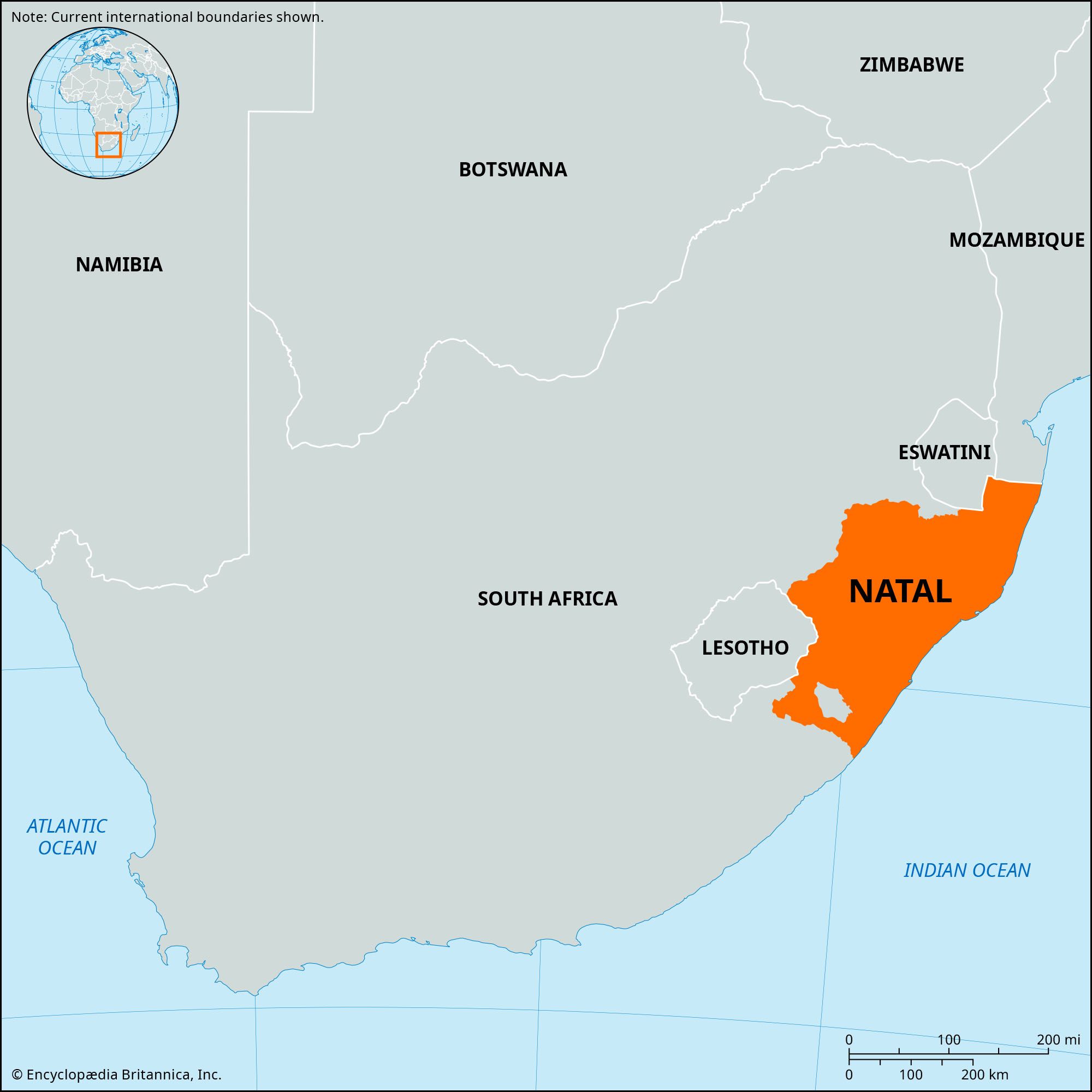
Natal was a former province of South Africa, the smallest of the four traditional provinces, located in the southeastern part of the country.
Portuguese navigator Vasco da Gama named the coast Terra Natalis (Christmas Land) in 1497. The British established a trading post at Port Natal (now Durban) in 1824. Afrikaners established the Republic of Natal in 1837, but the British annexed it in 1843. In 1893, Natal was granted internal self-government by the British. It became a province of the Union of South Africa in 1910 and of the Republic of South Africa in 1961. In 1994, KwaZulu was reincorporated into Natal province, which was renamed KwaZulu-Natal province.
1 Britannica SourceCreated from Britannica articles using AI. AI can make mistakes, so verify using Britannica articles. -
Where was Natal located within South Africa?
Natal, a former province of South Africa, was located in the southeastern part of the country. It was the smallest of the four traditional provinces. In 1910, Natal became a province of the Union of South Africa and, in 1961, of the Republic of South Africa. In 1994, Natal was renamed KwaZulu-Natal. KwaZulu-Natal is bounded by Swaziland and Mozambique to the north, the Indian Ocean to the east, Eastern Cape province to the south, Lesotho and Free State province to the west, and Mpumalanga province to the northwest.
3 Britannica SourcesCreated from Britannica articles using AI. AI can make mistakes, so verify using Britannica articles. -
When was Natal established as a province?
Natal was annexed by the British in 1843 and was administered as an adjunct of the Cape Colony until 1856, when it was made a crown colony with its own legislative council. Natal was granted internal self-government by the British in 1893. In 1910, Natal became a province of the Union of South Africa, and in 1961, it became a province of the Republic of South Africa. In 1994, KwaZulu was reincorporated into Natal province, which was then renamed KwaZulu-Natal province.
4 Britannica SourcesCreated from Britannica articles using AI. AI can make mistakes, so verify using Britannica articles. -
Who were the main groups of people living in Natal?
Natal, currently known as KwaZulu-Natal, was inhabited by various groups. The Nguni branch of Bantu-speaking people occupied the area from the 16th century. The Zulu clan, under leaders like Shaka, established a powerful kingdom in the 1820s and 1830s.
British traders established a post at Port Natal (now Durban) in 1824. In 1837, Afrikaners known as Voortrekkers entered the region. In 1860, increasing numbers of Indians arrived to work as indentured laborers on sugar plantations.
3 Britannica SourcesCreated from Britannica articles using AI. AI can make mistakes, so verify using Britannica articles. -
What important events happened in Natal's history?
Natal, currently known as KwaZulu-Natal, has a rich history marked by significant events. In 1497, Vasco da Gama sighted the coast and named it Terra Natalis. The Zulu clan, under leaders like Shaka, established a powerful kingdom in the 1820s and 1830s.
The British established a trading post at Port Natal (now Durban) in 1824. Voortrekkers entered the region in 1837, but conflict with the Zulus led to the massacre of Piet Retief and his followers in 1838. The Boers defeated the Zulus at the Battle of Blood River in December 1838, establishing the Republic of Natal.
The British annexed Natal in 1843. Natal was granted internal self-government in 1893 and became a province of the Union of South Africa in 1910. In 1994, KwaZulu was reincorporated into Natal, forming KwaZulu-Natal.
3 Britannica SourcesCreated from Britannica articles using AI. AI can make mistakes, so verify using Britannica articles. -
How has Natal changed since it stopped being a separate province?
Since ceasing to be a separate province, Natal, now known as KwaZulu-Natal, has undergone significant transformations. In 1994, with the end of apartheid, the nonindependent Black state of KwaZulu was reincorporated into Natal, leading to the province's renaming. This merger marked a move away from racial segregation, integrating diverse ethnic groups, with Zulus constituting the majority, into a unified province. KwaZulu-Natal has retained much of its cultural identity through language, folklore, and customs. The province's economy is divided, with a subsistence economy in formerly Black areas and a commercial economy dominated by whites.
2 Britannica SourcesCreated from Britannica articles using AI. AI can make mistakes, so verify using Britannica articles.
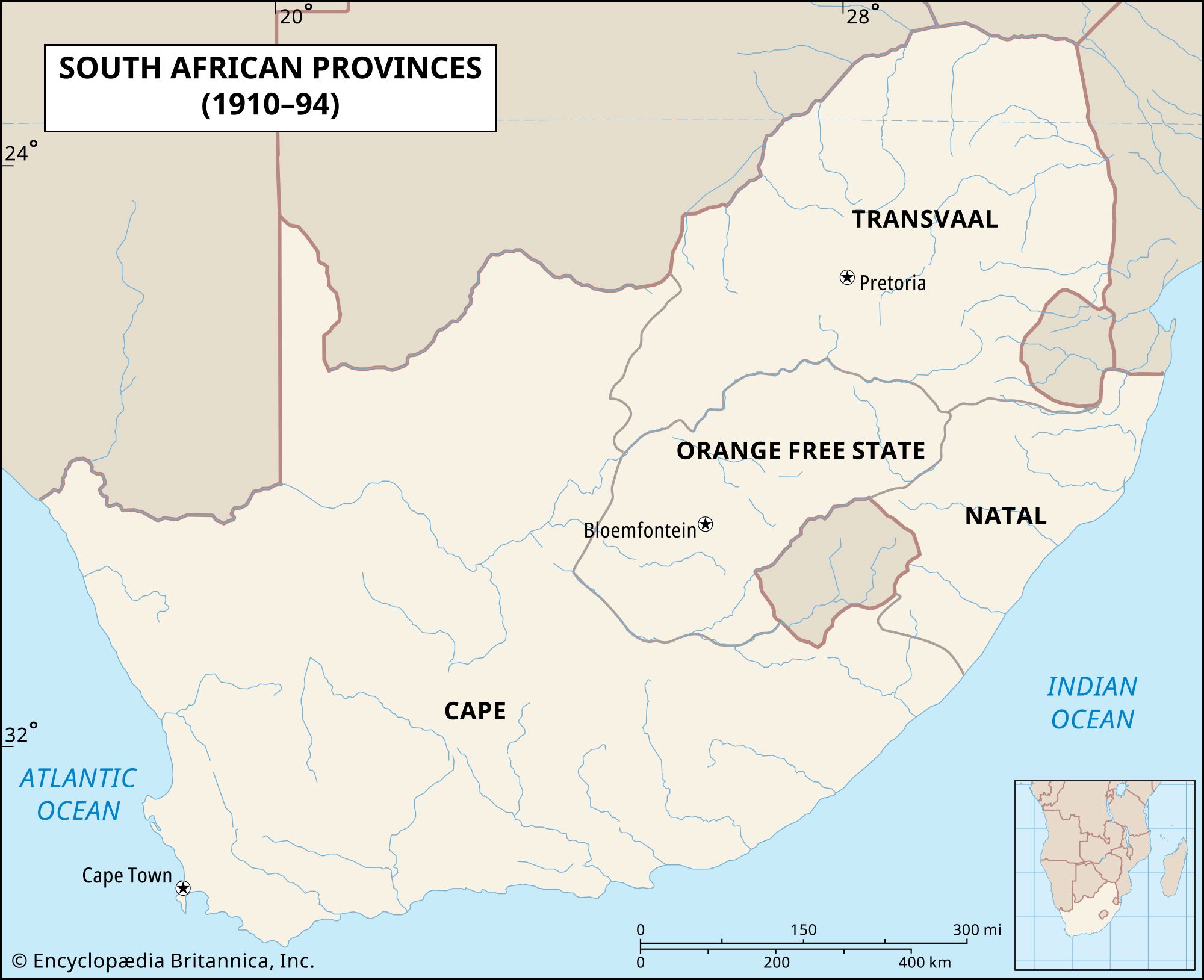
Natal, former province of South Africa. It was the smallest of the four traditional provinces and occupied the southeastern part of the country.
The Portuguese navigator Vasco de Gama sighted the coast along what is now Durban on Christmas Day in 1497 and named the country Terra Natalis, after the Portuguese word (“Natal”) for Christmas. The Portuguese maintained a trading settlement farther north at Delagoa Bay from the 1540s. The interior of Natal had been occupied since the 16th century by the Nguni branch of the Bantu-speaking peoples. In the 1820s and ’30s the Zulu clan of the Nguni, under the successive leadership of Dingiswayo (1807–17), Shaka (1817–28), and Dingane (1828–40), developed highly trained regiments and new fighting tactics that enabled the Zulus to establish a powerful kingdom north of the Tugela River. Shaka launched devastating military campaigns south of the Tugela River that disrupted or destroyed the peoples in that area. Those not killed or conscripted by the Zulus fled to other regions or went into hiding, leaving much of the region temporarily depopulated. In the meantime, the British had established a trading post at Port Natal (now Durban) in 1824, and that same year they signed a treaty with Shaka ceding them Port Natal and about 50 miles (80 km) of coastline to a depth of 100 miles (160 km) inland. The British made little attempt to develop the interior, which continued to be decimated by the Zulus.
The British settlement at Port Natal did grow, however, and in 1835 Capt. A.F. Gardiner secured from Dingane a treaty ceding the southern half of Natal to the British. The apparently empty interior was entered in October 1837 by the Voortrekkers, i.e., Afrikaners who had left the British-ruled Cape Colony. They crossed the passes of the northern Drakensberg Mountains under the leadership of Piet Retief and others. Retief obtained from Dingane the promise of nearly all of Natal if he recovered some stolen cattle for the Zulu leader. Retief’s promptness in this task so alarmed Dingane that he had Retief and more than 60 of his followers massacred in February 1838. In December 1838 the Boers under the overall command of Andries Pretorius defeated the Zulus at the Battle of Blood River, destroying more than 3,000 of Dingane’s army. Dingane was replaced by his brother Mpande, who made concessions to the Boers (Afrikaners) and established himself north of the Tugela in a vassal state known as Zululand.



The Afrikaners established the Republic of Natal with its capital at Pietermaritzburg and its northern border at the Tugela River. The new Boer republic was soon unsettled by an influx of natives returning to Natal to resettle the lands they had abandoned to the Zulus. The British, moreover, opposed the establishment of any independent state on the coast of southern Africa. The British annexed Natal in 1843. In response, many of the former republic’s Afrikaner inhabitants left for the Transvaal and the Orange Free State and were replaced by new immigrants, mainly from Britain. Natal was given a local administration but remained basically an adjunct of the Cape Colony until 1856, when it was made a crown colony and given its own legislative council. The chief diplomatic agent for the Natal government, Theophilus Shepstone, introduced (from 1849) a policy aimed at reserving large tracts of land for the native Bantu peoples, who by then greatly outnumbered whites in the colony. From 1860, increasing numbers of Indians also entered the colony to work as indentured laborers in the sugar plantations on the coast. The Natal colony was extended by successive acquisitions—notably that of Zululand, of which the British had assumed control after their victory over the Zulus in the Anglo-Zulu War (1879). Zululand was formally annexed by the British in 1887 and made a part of Natal in 1897, becoming the eastern part of the colony.
Natal was granted internal self-government by the British in 1893. A railroad running from Durban to Pretoria in the Transvaal was completed in 1895, and in 1898 Natal joined the customs union of the South African states. During the South African War (1899–1902), Natal was invaded by Boer forces, which were checked by the British defense at Ladysmith (now uMnambithi). Natal remained pro-British throughout the war on account of the British origins of its ruling white minority. In 1910 the colony became a province of the Union of South Africa and in 1961 of the Republic of South Africa. Natal remained the base of pro-British sentiments in South Africa in the 20th century.
The Black reserves that had been set aside under the Native Land trust (1864) eventually came to form the extensive, but highly fragmented, nonindependent Black state of KwaZulu. This served as the legal homeland for all of the country’s Zulus under the South African government’s system of apartheid, or racial separation. In the late 1980s and early ’90s, Natal and KwaZulu became the scene of violent clashes between rival Black political parties that were vying for the support of Black South Africans prior to the establishment of majority rule under a projected new constitution. Thousands of people died in this conflict, which pitted Zulu supporters of the Inkatha Freedom Party against adherents of the African National Congress. When the new South African constitution abolished the apartheid system, KwaZulu in 1994 was reincorporated into Natal province, which was renamed KwaZulu-Natal province.