

- Also called:
- Holy Mountain
- Modern Greek:
- Áthos Óros or Áyion Óros
- On the Web:
- UNESCO World Heritage Convention - Mount Athos (Oct. 28, 2026)


Mount Athos
-
What is Mount Athos?
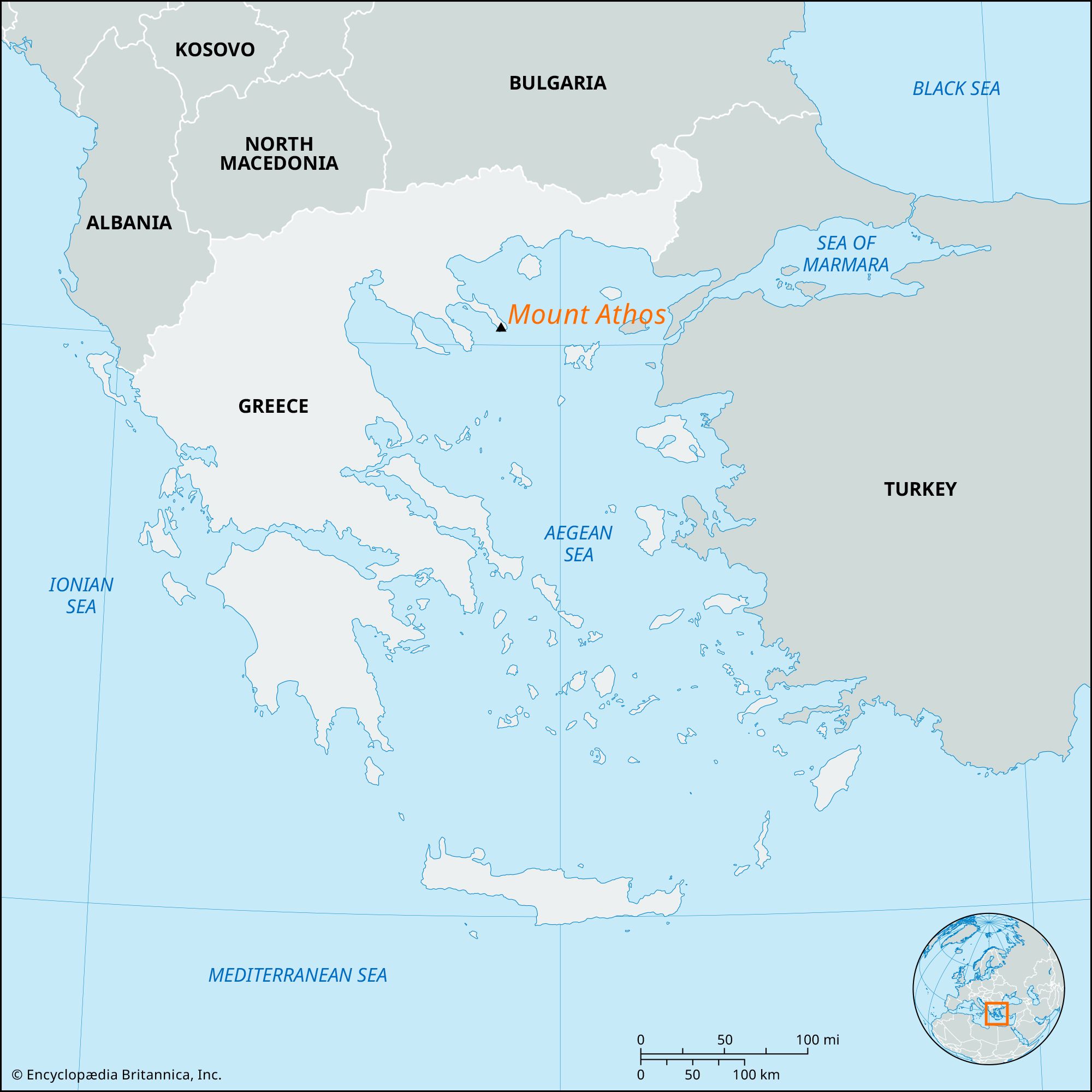
Mount Athos is a mountain and peninsula in northern Greece, specifically the easternmost of three promontories that extend from the Chalcidice Peninsula into the Aegean Sea. This 30-mile-long peninsula is home to a semiautonomous republic of Greek Orthodox monks, who live in 20 monasteries and dependencies. Organized monastic life on Mount Athos began in 963 CE. A traditional rule prohibits women and female animals from the Holy Mountain. Mount Athos was designated a UNESCO World Heritage site in 1988.
2 Britannica SourcesCreated from Britannica articles using AI. AI can make mistakes, so verify using Britannica articles. -
Where is Mount Athos located in Greece?
Mount Athos is located in northern Greece, on the easternmost promontory of the Chalcidice Peninsula which is part of the Macedonia region. The promontory, known as Akti, extends into the Aegean Sea. The mountain rises abruptly at the southern tip, reaching a height of 6,670 feet (2,033 meters). It is a semiautonomous region inhabited by Greek Orthodox monks. Mount Athos was designated a UNESCO World Heritage site in 1988.
3 Britannica SourcesCreated from Britannica articles using AI. AI can make mistakes, so verify using Britannica articles. -
Why is Mount Athos considered an important religious site?
Mount Athos is an important religious site because it is home to a semiautonomous community of Greek Orthodox monks who inhabit 20 monasteries and dependencies. Organized monastic life began there in 963 CE, when St. Athanasius the Athonite founded the first monastery, the Great Laura. The mountain has an almost pan-Orthodox character due to the endowment of monasteries by Russia and other Slavic countries. Mount Athos is considered a UNESCO World Heritage site.
1 Britannica SourceCreated from Britannica articles using AI. AI can make mistakes, so verify using Britannica articles. -
Who lives on Mount Athos today?
Today, Mount Athos is inhabited by Greek Orthodox monks who live in 20 monasteries and dependencies. Mount Athos is a semiautonomous republic in northern Greece. The Greek government is represented by a governor appointed by the Ministry of Foreign Affairs, but the actual administration is in the hands of the Holy Council, with one representative from each monastery. The executive power lies with the Epistasia, which consists of four representatives who rotate annually.
1 Britannica SourceCreated from Britannica articles using AI. AI can make mistakes, so verify using Britannica articles. -
How is life different on Mount Athos compared to other places?
Life on Mount Athos differs significantly from most other places due to its unique status as a semiautonomous monastic republic. Located in northern Greece, it is home to Greek Orthodox monks living in 20 monasteries and dependencies. A key feature is the traditional prohibition against women and female animals, contributing to its distinct, isolated environment. The administration is managed by the Holy Council, with the Greek government represented by a governor, highlighting its semiautonomy. This combination of religious devotion, self-governance, and exclusion of women shapes a way of life unlike anywhere else.
1 Britannica SourceCreated from Britannica articles using AI. AI can make mistakes, so verify using Britannica articles. -
What are some rules or traditions unique to Mount Athos?
Mount Athos, a mountain in northern Greece, is a semiautonomous region inhabited by Greek Orthodox monks. A key tradition unique to Mount Athos is the prohibition of women and female animals from entering the Holy Mountain. This tradition has been in place for centuries. Mount Athos is a monastic republic comprised of 20 self-governing monasteries and smaller monastic communities. The mountain’s semiautonomy is guaranteed by the Greek constitution. Actual administration is in the hands of the Holy Council, with executive power vested in the Epistasia.
2 Britannica SourcesCreated from Britannica articles using AI. AI can make mistakes, so verify using Britannica articles.
Mount Athos, mountain in northern Greece, site of a semiautonomous republic of Greek Orthodox monks inhabiting 20 monasteries and dependencies (skítes), some of which are larger than the parent monasteries. It occupies the easternmost of the three promontories of the Chalcidice (Khalkidhikí) Peninsula, which projects from the Macedonia region into the Aegean Sea. The Aktí promontory, 30 miles (50 km) long and 6.5 miles (10.5 km) wide at its broadest point, has a mountainous spine thickly wooded on the north and culminating in the marble peak of Athos (6,670 feet [2,033 metres]), which rises abruptly from the sea at the southern tip. The capital and only town of the subdivision is Kariaí (Karyaes). Mount Athos was designated a UNESCO World Heritage site in 1988.
The mountain was discussed by Homer in the Iliad. In the 5th century bce the Persian king Xerxes I, to avoid taking his fleet around the treacherous cape, cut a 1.5-mile- (2.4-km-) long canal through Aktí’s neck, traces of which are still visible. Although hermits inhabited Athos before 850 ce, organized monastic life began in 963, when St. Athanasius the Athonite, with the help of his Byzantine imperial patron, Nicephorus II Phocas, founded the first monastery, the Great Laura. Despite objections by the hermits to organized community monasticism, the rule of St. Athanasius was imposed on them by the Byzantine emperor John I Tzimisces, who granted Athos its first charter (Typikon). A traditional prohibition bars women and female animals from the Holy Mountain. Several more monasteries were built in the 11th century. With the endowment of monasteries by Russia and other Slavic countries, the peninsula took on an almost pan-Orthodox character. By 1400, the number of monasteries had reached 40 (half of which survive); the last to be built was Stavronikita, which was reconstructed in the 16th century (it has been damaged several times by fire).
In the 15th century some of the monasteries abandoned the strict regimen of the community under the rule of an abbot for a more liberal system in which monks could possess personal property and be governed by two annually elected trustees (epitropoi).



When the Turks captured Thessaloníki (Salonika) in 1430, the monks submitted to Turkish rule, a relation that led to the rapid decline and impoverishment of the monasteries and increased adoption of the more liberal system of governance. In reaction, the first skítes, or ascetic settlements, were founded in the 16th century, grouped around a common church as dependencies of the monasteries. In 1783 the patriarch Gabriel IV introduced successful reforms with a new charter. The Athos community suffered greatly from Turkish depredations during the War of Greek Independence (1821–29), when entire libraries were burned. By contrast, the patronage of the tsars in the 19th century brought about the expansion of the Russian monasteries and their properties.
The community’s present constitution dates from 1924 and is guaranteed by the Greek constitution of 1975. The Greek government is represented by a governor (dioikitís) appointed by the Ministry of Foreign Affairs to underline the mountain’s semiautonomy, but actual administration is in the hands of the Holy Council (Ierá Sýnaxis), consisting of one representative of each of the monasteries. Executive power is vested in the Epistasia, composed of four representatives by annual rotation. About half of the monasteries are conservative, with much stricter rules on discipline and fasting. Most of the monasteries hug the coast and consist of a quadrangle of buildings enclosing a church. The churches contain some of the most important examples of Byzantine art, icons, and treasures. The surviving libraries hold a vast number of classical and medieval manuscripts, most of which have been cataloged. Area 130 square miles (336 square km). Pop. (2001) 1,961; (2011) 1,811.