


- Greek:
- Zankle
- Latin:
- Messana


Messina
-
Where is Messina located in Italy?
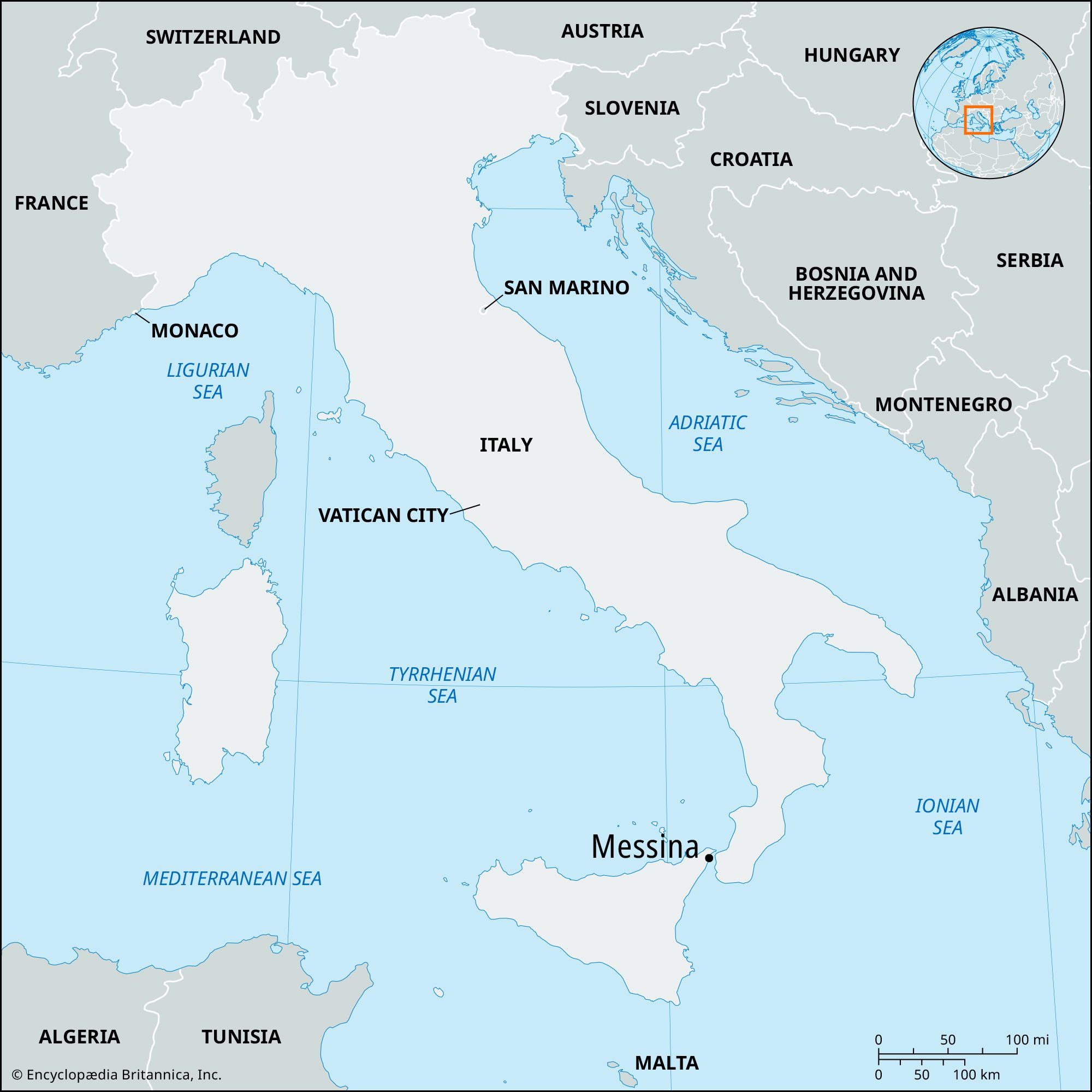
Messina is a city and port located in the extreme northeastern part of Sicily, Italy, on the lower slopes of the Peloritani Mountains. It lies on the Strait of Messina, opposite Reggio di Calabria.
Originally a Siculan colony called Zankle, it was founded around 730 BCE by settlers from Chalcis. Throughout its history, Messina has been ruled by Greeks, Carthaginians, Romans, Goths, Byzantines, and Arabs, before eventually becoming part of the Kingdom of the Two Sicilies and then Italy.
Messina was severely damaged by earthquakes in 1783 and 1908 but was rebuilt with modern infrastructure. Today, it is an important port city with a university, marine biological institute, and botanical gardens.
1 Britannica SourceCreated from Britannica articles using AI. AI can make mistakes, so verify using Britannica articles. -
What is Messina known for?
Messina, an Italian port city in northeastern Sicily, is known for its location on the Strait of Messina, which separates Sicily from mainland Italy. The city's harbor was originally named Zankle ("Sickle") because of its shape. Messina has a long history, having been founded as a Siculan colony around 730 BCE and later ruled by Greeks, Carthaginians, Romans, Arabs, and Normans. The city was severely damaged by earthquakes in 1783 and 1908 but was rebuilt in a modern style. Today, Messina is an important port city with a focus on trade, citrus fruit industries, and manufacturing.
2 Britannica SourcesCreated from Britannica articles using AI. AI can make mistakes, so verify using Britannica articles. -
What is the significance of the Strait of Messina?
The Strait of Messina is a channel in the Mediterranean Sea that separates Sicily from Italy, linking the Tyrrhenian and Ionian seas. This 20-mile-long strait is narrow, only 2 miles wide in the north and 10 miles wide in the south.
Historically, sailors feared the Strait of Messina because of its challenging currents and the imposing rocks and whirlpools of Scylla and Charybdis, which were portrayed as female monsters in Greek mythology. Today, the strait is known for its scenic banks, archaeological remains, resorts, and abundant fish and plankton.
2 Britannica SourcesCreated from Britannica articles using AI. AI can make mistakes, so verify using Britannica articles. -
What important historical events have taken place in Messina?
Messina, a city and port in northeastern Sicily, has a rich history marked by several significant events. Founded around 730 BCE by settlers from Chalcis, it was initially named Zankle. In 264 BCE, Messina allied with the Romans, leading to Roman intervention and the First Punic War, after which Messina became a free city and an ally of Rome.
Throughout its history, Messina has been under the rule of various powers, including the Goths, Byzantines, and Arabs. In 1061, the Normans liberated the city, which then prospered as a commercial and cultural hub. In 1943, during World War II, Messina was a crucial point for the Axis Powers to reinforce their troops against the Allied invasion of Sicily. The Allies entered Messina on August 17, 1943.
3 Britannica SourcesCreated from Britannica articles using AI. AI can make mistakes, so verify using Britannica articles. -
How did the 1908 earthquake impact Messina?
The Messina earthquake and tsunami of 1908 almost completely destroyed Messina and Reggio di Calabria, as well as dozens of other coastal towns nearby. Striking at approximately 5:20 a.m. local time on December 28, the earthquake's epicenter was located under the Strait of Messina, which divides Sicily from Calabria. The main tremor lasted over 20 seconds and had a magnitude of 7.5 on the Richter scale.
The earthquake was followed by a tsunami with waves as high as 40 feet (13 meters) that crashed against the coasts of northern Sicily and southern Calabria. Over 80,000 people died because of the disaster. Many survivors were moved to other Italian cities, while others moved to the United States. The Messina earthquake of 1908 is said to be Europe's worst earthquake ever.
3 Britannica SourcesCreated from Britannica articles using AI. AI can make mistakes, so verify using Britannica articles. -
What are some famous landmarks or cultural traditions found in Messina?
Messina, a city and port in northeastern Sicily, has a rich history dating back to 730 BCE. It was founded as Zankle, later renamed Messene.
Surviving landmarks include the cathedral and the Church of Annunciata dei Catalani, which were rebuilt in the 12th century. The National Museum houses art salvaged from the 1908 earthquake. The city has a university founded in 1548, a marine biological institute, and botanical gardens.
Messina is known for trade, citrus fruit industries, and the manufacturing of chemicals, pharmaceuticals, and foodstuffs.
1 Britannica SourceCreated from Britannica articles using AI. AI can make mistakes, so verify using Britannica articles.
Messina, city and port, extreme northeastern Sicily, Italy, on the lower slopes of the Peloritani Mountains, on the Strait of Messina opposite Reggio di Calabria. It was an ancient Siculan colony, first mentioned about 730 bce, founded by settlers from Chalcis, who called it Zankle (“Sickle”), from the shape of the harbour.
In the early 5th century bce it was occupied by Greek fugitives from Persian-occupied Miletus and Samos. The fugitives were assisted by Anaxilas, tyrant of Rhegium (Reggio di Calabria), who then ruled over Rhegium and Zankle, the name of which he changed to Messene in honour of his native region of Messenia in the Peloponnese. After regaining its independence, the city was destroyed by the Carthaginian Himilco in 396 bce. It was reconquered and rebuilt by the Syracusan tyrant Dionysius and was later involved in the war between the Carthaginians and the Syracusan tyrant Agathocles. It fell in 289 bce to the Mamertini, Campanian mercenaries in the service of Agathocles, who made it the centre for their domination of Sicily. Pressed by Syracuse and the Carthaginians, the Mamertini allied themselves with the Romans in 264 bce; Roman intervention led to the First Punic War, at the end of which Messene was a free city and an ally of Rome.
When the western Roman Empire fell, Messana was taken successively by the Goths, the Byzantines (535 ce), and the Arabs (842). The city suffered severe damage when the Byzantines attempted to reconquer it. Liberated in 1061 by the Norman leader Robert Guiscard (later Count Roger I of Sicily), the city prospered under the Normans as a commercial and cultural centre. The Swabian Holy Roman emperor Henry VI died there in 1197. When the Swabian dynasty ended with the death of Manfred in 1266, Messina passed to the Angevins (house of Anjou) of France and later, with the rest of Sicily, to the Aragonese and then to the Spanish Bourbons. It participated in the Risorgimento (movement for Italian political unity) risings in 1821, 1847, and 1848 and was liberated with the rest of the Kingdom of the Two Sicilies in 1860.




Severely damaged by an earthquake in 1783 and almost totally destroyed by another quake in 1908, Messina was rebuilt in modern style with wide streets and low, reinforced-concrete buildings. Notable surviving or restored landmarks include the cathedral and the Church of Annunciata dei Catalani, possibly of Byzantine origin, both rebuilt by the Normans in the 12th century. The National Museum houses works of art saved from the 1908 earthquake. Among numerous noteworthy modern buildings is the campanile adjacent to the cathedral. Messina has a university founded in 1548, a marine biological institute, and botanical gardens.
The contemporary city is an important port, and in 1943 it was the principal point used by the Axis Powers to reinforce its troops and supplies to counter the Allied invasion of Sicily. It is connected with the Italian mainland by ferry service (including train ferry and hydrofoil boats) across the strait to Reggio di Calabria and Villa San Giovanni; Messina also has rail service to Palermo and Syracuse. The city’s principal occupations are trade, citrus fruit industries, the manufacture of chemicals, pharmaceutical products, foodstuffs and preserves, and the operation of the port and dockyards. Its exports include fruit, wine, olive oil, chemical and pharmaceutical products, medicinal articles, and building materials. Pop. (2004 est.) 248,616.