



- German:
- Luzern


Lucerne
News •
-
Where is Lucerne located in Switzerland?
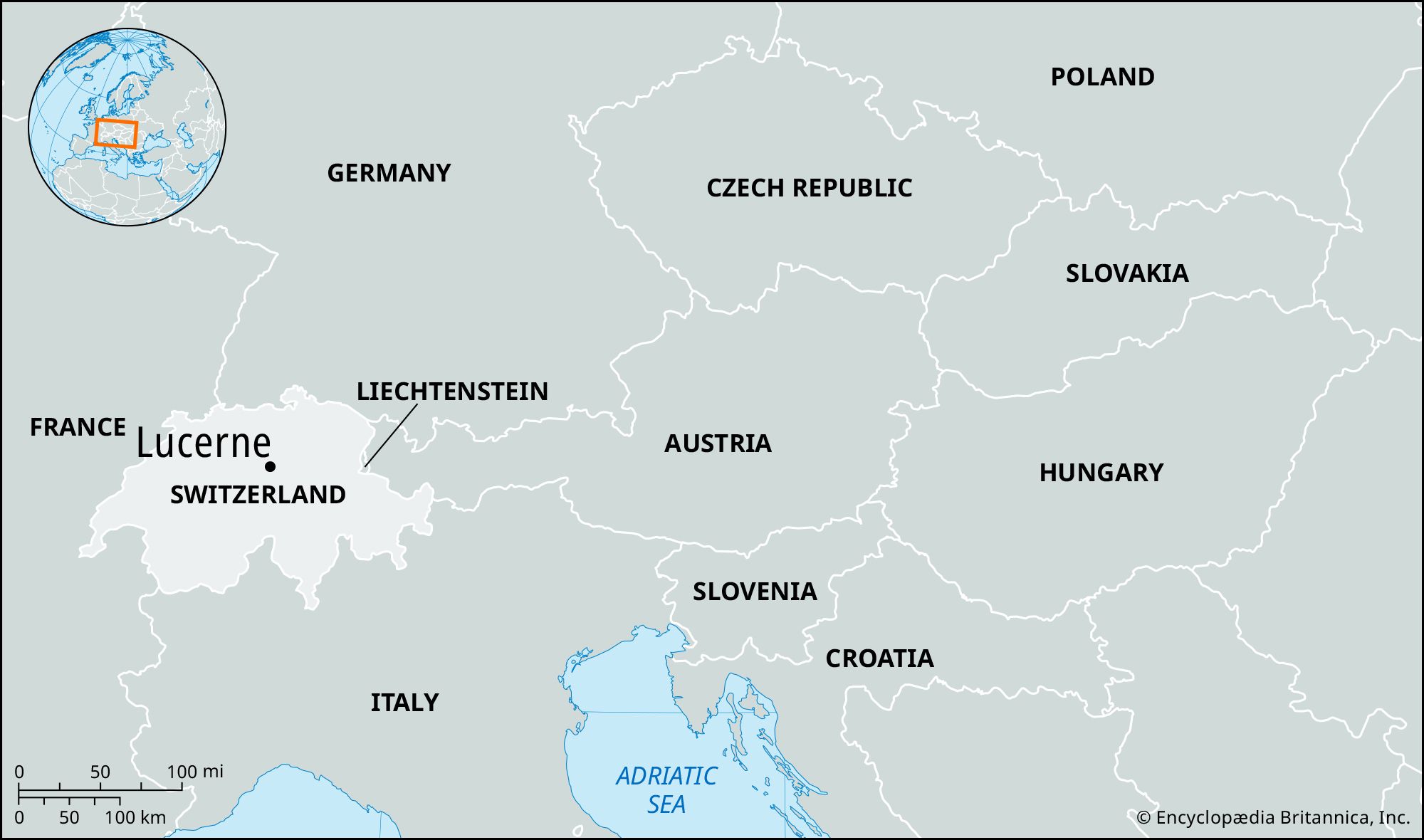
Lucerne is a city in central Switzerland, serving as the capital of the Lucerne canton. The city sits on the Reuss River, where it flows out of the northwestern branch of Lake Lucerne, southwest of Zürich. Lucerne is divided into two parts by the Reuss River, which is crossed by seven bridges. Because of its location and temperate climate, Lucerne is a popular tourist destination.
3 Britannica SourcesCreated from Britannica articles using AI. AI can make mistakes, so verify using Britannica articles. -
What is Lucerne known for?
Lucerne, a city in central Switzerland, is known for its picturesque setting on Lake Lucerne and the Reuss River. It's a popular tourist destination due to its magnificent surroundings, temperate climate, and easy access.
Lucerne is also known for its historical significance as an important trade center and for its well-preserved medieval architecture, including the Musegg Wall with nine watchtowers and the Chapel Bridge. The city is also known for the International Festival of Music, a leading classical event.
3 Britannica SourcesCreated from Britannica articles using AI. AI can make mistakes, so verify using Britannica articles. -
What is the Chapel Bridge in Lucerne?
The Chapel Bridge (Kapellbrücke) in Lucerne is a distinctive landmark. Until 1993, when a fire damaged it, the Kapellbrücke, built in 1333, was the oldest bridge in the city. The bridge is roofed and was decorated with paintings depicting events. Lucerne lies on the Reuss River, where it emerges from Lake Lucerne in central Switzerland. The city is divided into two parts by the river, which is crossed by seven bridges within the town.
2 Britannica SourcesCreated from Britannica articles using AI. AI can make mistakes, so verify using Britannica articles. -
Why do many tourists visit Lucerne each year?
Lucerne attracts many tourists each year due to its magnificent surroundings, temperate climate, and accessibility by road and rail. Situated on the Reuss River, where it exits Lake Lucerne, the city boasts a picturesque setting.
Popular attractions include the Musegg Wall with its nine watchtowers, the Lion of Lucerne monument, and the Swiss Transport Museum. Steamer services on the lake connect to mountain railways and cableways, providing access to winter sports. Lucerne also offers a casino, beaches, and hosts events like the International Festival of Music and pre-Lenten carnival.
3 Britannica SourcesCreated from Britannica articles using AI. AI can make mistakes, so verify using Britannica articles. -
How does Lake Lucerne influence the city and its activities?
Lake Lucerne significantly shapes the city of Lucerne and its activities. The city, named after the lake, lies where the Reuss River emerges from the lake's northwestern branch, making it a picturesque location and a major tourist destination.
Lucerne's temperate climate and accessibility by road and rail have helped it grow into a popular resort. Lake Lucerne facilitates steamer services connecting to mountain railways and cableways, enhancing access to surrounding attractions. The city also hosts rowing and sailing regattas and an international music festival.
2 Britannica SourcesCreated from Britannica articles using AI. AI can make mistakes, so verify using Britannica articles. -
What are some important cultural or historic events related to Lucerne?
Lucerne, Switzerland, boasts a rich history and culture, marked by significant events:
-
Foundation of Lucerne: The city grew from a fishing village near the Benedictine monastery of St. Leodegar, founded in the 8th century. Lucerne was likely chartered around 1178.
-
Joining the Swiss Confederation (1332): Lucerne joined the alliance formed by Uri, Schwyz, and Unterwalden, seeking independence from the Habsburgs. This solidified its place in Swiss history, with the alliance winning independence after the Battle of Sempach in 1386.
-
Cultural landmarks: Lucerne is known for its picturesque setting and well-preserved historical sites, such as the Spreuerbrücke bridge (1407) and the Musegg town walls. The Culture and Convention Centre, designed by Jean Nouvel, opened in 1998.
-
International Music Festival: The International Festival of Music, held annually in late summer, is a prominent classical event.
4 Britannica SourcesCreated from Britannica articles using AI. AI can make mistakes, so verify using Britannica articles. -

Lucerne, city, capital of Lucerne canton, central Switzerland, lying on the Reuss River where it issues from the northwestern branch of Lake Lucerne (German: Vierwaldstätter See; French: Lac des Quatre Cantons), southwest of Zürich. The city’s name was derived from the Benedictine monastery of St. Leodegar (Luciaria), founded in the 8th century. From the nearby fishing village grew a city, probably chartered about 1178, whose inhabitants were originally serfs of the monastery. After the opening of the St. Gotthard Pass (c. 1230), Lucerne developed into an important trade centre between the upper Rhine and Lombardy. In 1291 the monastery and city were purchased by Rudolf IV of Habsburg (also called Rudolf I of Germany), against the will of the citizens, who desired independence. Political instability under Rudolf’s successors led Lucerne in 1332 to join the alliance formed by the cantons of Uri, Schwyz, and Unterwalden in 1291. The group won independence after the Battle of Sempach (1386) against the Habsburg army. By 1415 Lucerne had acquired most of the territory of the present canton, by either treaty, armed occupation, or purchase. It became the leader of the Catholic cantons at the Reformation and was the seat of the papal nuncio from 1579 to 1874. The city’s aristocratic regime was compelled to abdicate in 1798 under the onslaught of the Napoleonic armies. Lucerne was for a time the capital of the Helvetic Republic, resuming its status as the cantonal capital in 1803.
Divided into two parts by the Reuss River, which is crossed by seven bridges within the town, Lucerne has one of the most picturesque settings in Switzerland. The Spreuerbrücke (1407), now the oldest bridge, is roofed and decorated with some 56 paintings, scenes from the Dance of Death, dating from the early 17th century. Until its destruction by fire in 1993, the Kapellbrücke (1333; “Chapel Bridge”) was the oldest bridge. It was similarly decorated. The old town on the right bank is distinguished by well-preserved 14th-century town walls (Musegg) with nine watchtowers, quaint alleys, and squares with medieval, Renaissance, and Baroque houses. Notable buildings are the old town hall (1602–06), housing the historical museum; Am Rhyn House (1617); St. Peter’s Chapel (1178; altered 1750); the Hofkirche (an 8th-century cathedral and collegiate church of St. Leodegar); and the Mariahilf Church (1676–81). Other landmarks are Bertel Thorvaldsen’s “Lion of Lucerne” monument (1819–21), in memory of the Swiss guards slain while defending the Tuileries in Paris in 1792; the Glacier Garden, a relic of the Ice Age excavated in 1872–75; and the comprehensive Swiss Transport Museum (1959). On the left bank are the cantonal government building, Regierungsgebäude, or Ritterscher Palast (1557–64; a Jesuit college 1577–1804); the State Archives (1729–31), with a Rococo Marian chamber and library and the Central Library (1951), housing the numismatic, natural history, and Helvetica collections; the St. Francis Xavier (Jesuit) Church (1667–77); the 14th-century Gothic Franciscan Church with Rococo transepts; the Corporation Building (1675); the new town hall (1913); the Richard Wagner Museum (1933); the modern St. Anthony’s Chapel (1954); the Art Gallery and Congress Hall (Kunst- und Kongresshaus; 1932–33). The Culture and Convention Centre, directly on Lake Lucerne, was designed by the renowned French architect Jean Nouvel and was opened in 1998.
In addition to various cantonal and municipal schools, there are the central Swiss Transport School, the Swiss Catholic School of Sacred Music, the Central Swiss Technical College, and the Swiss Schools of Bakery and of Hotel Keeping. Lucerne is also the seat of the Supreme Cantonal Court, a commercial tribunal, a criminal court, a juvenile court, and the Federal Insurance Court.




Because of its magnificent surroundings, temperate climate, and easy access by road and rail, Lucerne has become one of the largest and most important tourist resorts in Switzerland. Steamer services on the lake connect with various mountain railways and cableways, and there is a direct narrow-gauge rail connection with the winter-sports centre of Engelberg. Facilities include a casino, beaches, rowing and sailing regattas, horse-racing and show-jumping competitions, an annual international music festival, and a traditional pre-Lenten carnival. Lucerne’s commercial and industrial activities depend largely on the tourist trade. The population is German speaking and largely Roman Catholic. Pop. (2007 est.) city, 57,890; urban agglom., 200,282.