

- Major Events:
- French Revolutionary wars
- treaties of Rastatt and Baden
- Related Places:
- Italy

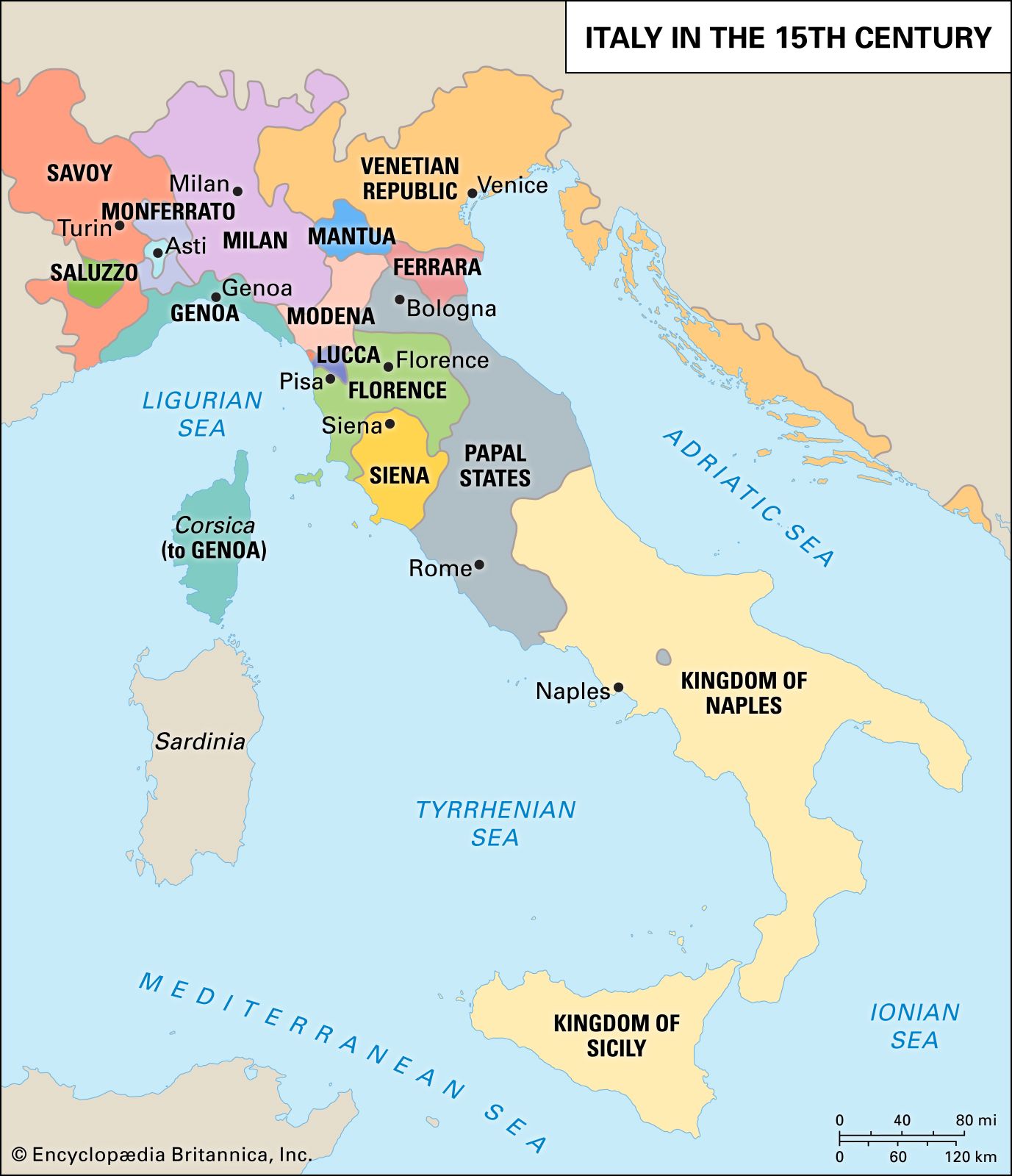
Kingdom of Naples
-
What was the Kingdom of Naples?
The Kingdom of Naples was a state in southern Italy from the medieval period to 1860, often politically connected with Sicily.
In 1130, Roger II united Norman acquisitions and became king of Sicily and Apulia. The kingdom prospered under the Hohenstaufen emperors, becoming a centralized state and a commercial and cultural hub. Charles of Anjou moved the capital to Naples in 1266, but his rule led to Sicily's separation in 1282. Naples briefly prospered under King Robert (1309–43) but then faced dynastic disputes. In 1442, Alfonso V of Aragon united Naples and Sicily, calling it the Kingdom of the Two Sicilies.
Under Spanish rule from 1504, Naples declined economically. After the War of the Spanish Succession, it came under the Austrian Habsburgs before Charles III of Spain conquered it in 1734. The Bourbon kings initiated reforms, but the French Revolution halted progress. In 1860, Giuseppe Garibaldi's invasion led to Naples joining a unified Italy.
3 Britannica SourcesCreated from Britannica articles using AI. AI can make mistakes, so verify using Britannica articles. -
Where was the Kingdom of Naples located?
The Kingdom of Naples was a state located on the southern portion of the Italian Peninsula from the Middle Ages to 1860. The city of Naples lies on the west coast of Italy, southeast of Rome, along the Bay of Naples.
The Kingdom of Naples was often united politically with Sicily, and in 1443, became known as the Kingdom of the Two Sicilies.
3 Britannica SourcesCreated from Britannica articles using AI. AI can make mistakes, so verify using Britannica articles. -
When did the Kingdom of Naples exist?
The Kingdom of Naples existed as a state in southern Italy from the Middle Ages to 1860. In 1130, Roger II united Norman acquisitions and became king of Sicily and Apulia. The kingdom reached its height under the Hohenstaufen emperors, becoming a major commercial and cultural center.
Charles of Anjou gained control in 1266 and moved the capital to Naples. In 1442, Alfonso V of Aragon united Naples with Sicily, calling it the Kingdom of the Two Sicilies. The kingdom was under Spanish rule for two centuries starting in 1504, then came under the Austrian Habsburgs before the Spanish Bourbons took control in 1734.
After periods of French rule under Napoleon's brother and brother-in-law, the Bourbon kings returned. In 1860, Giuseppe Garibaldi's invasion led to the kingdom's unification with northern Italy.
3 Britannica SourcesCreated from Britannica articles using AI. AI can make mistakes, so verify using Britannica articles. -
Who ruled the Kingdom of Naples at different times?
The Kingdom of Naples was ruled by various figures throughout its history.
-
Angevin Dynasty: In 1266, the Angevin dynasty came to power, revitalizing Naples. They were patrons of the arts and constructed notable landmarks such as the Castel Nuovo and the Sant'Elmo fortress.
-
Alfonso V of Aragon: Naples flourished culturally under Alfonso V of Aragon, who attracted intellectuals and artists. In 1453, Byzantine art was introduced.
-
Spanish Habsburgs: In 1503, the Spanish Habsburgs took control of Naples, ruling with autocratic viceroys for over two centuries. Their reign was marked by grand constructions and occasional revolts.
-
Spanish Bourbons: Naples became an independent kingdom under the Spanish Bourbons in 1734, with Don Carlos (later Charles III of Spain) as king.
-
Napoleonic Rule: From 1805 to 1815, Joseph Bonaparte and Joachim Murat, both appointed by Napoleon, governed the Kingdom of Naples, implementing legislative reforms.
-
Bourbon Restoration: Following Napoleon's fall, the Bourbons reclaimed Naples with Austrian support. However, their governance was marred by corruption, leading to the kingdom's incorporation into the Kingdom of Italy under Giuseppe Garibaldi in 1860.
2 Britannica SourcesCreated from Britannica articles using AI. AI can make mistakes, so verify using Britannica articles. -
-
How was the Kingdom of Naples connected to other Italian states?
The Kingdom of Naples, which covered the southern portion of the Italian Peninsula from the Middle Ages to 1860, had intricate connections with other Italian states, shaped by warfare, dynastic rule, and economic factors.
During the Spanish rule, the Kingdom of Naples, along with Sicily and Milan, were under direct Spanish rule and owed their allegiance to the sovereign according to their own laws and traditions. Though these states' foreign policy interests were subordinate to Spain, the king was responsive to embassies sent by various groups outside official channels until 1700.
After the War of the Spanish Succession (1701–14), a new pattern of state relations emerged in Italy between Austrian Habsburgs, Spanish Bourbons, and the independent states.
3 Britannica SourcesCreated from Britannica articles using AI. AI can make mistakes, so verify using Britannica articles. -
What happened to the Kingdom of Naples and why did it end?
The Kingdom of Naples, which covered the southern portion of the Italian Peninsula, existed from the Middle Ages to 1860. It began in the 12th century when the Normans united their acquisitions in southern Italy and Sicily.
The kingdom experienced a period of prosperity under early rulers but later faced dynastic disputes and foreign interference. In 1734, the Spanish Bourbons gained control, and Naples became a significant European capital. However, the Bourbon kings' suppression of progressive ideas led to revolts and instability.
In 1860, Giuseppe Garibaldi's invasion led to the kingdom's collapse and its absorption into the Kingdom of Italy following a plebiscite.
2 Britannica SourcesCreated from Britannica articles using AI. AI can make mistakes, so verify using Britannica articles.
Kingdom of Naples, state covering the southern portion of the Italian Peninsula from the Middle Ages to 1860. It was often united politically with Sicily.
By the early 12th century the Normans had carved out a state in southern Italy and Sicily in areas formerly held by the Byzantines, Lombards, and Muslims. In 1130 Roger II, on uniting all the Norman acquisitions, assumed the title of king of Sicily and Apulia. The existence of this Norman state was at first contested by the popes and Holy Roman emperors, who claimed sovereignty over the south. In the late 12th century the kingdom passed to the Hohenstaufen emperors (the most notable of whom was Emperor Frederick II, king of Sicily from 1198 to 1250). Under these early rulers the kingdom was at the height of its prosperity. Politically, it was one of the most centralized states of Europe, economically it was a major commercial centre and grain producer, and culturally it was a point of diffusion of Greek and Arab learning into western Europe.
After the extinction of the legitimate Hohenstaufen line, Charles of Anjou, brother of the French king Louis IX, gained control of the kingdom (1266), in response to an invitation from the pope, who feared the south would pass to a king hostile to him. Charles transferred the capital from Palermo, Sicily, to Naples, a shift that reflected the orientation of his policy toward northern Italy, where he was leader of the Guelf (pro-papal) party. But his harsh rule and heavy taxation provoked the revolt known as the Sicilian Vespers (1282), which resulted in the political separation of Sicily from the mainland and in the acquisition of the island’s crown by the Spanish house of Aragon. The episode had important consequences for both Naples and Sicily. In the struggles between the Angevins and the Aragonese that lasted for more than a century, the real victors were the barons, whose powers were extended by grants from the kings. In the prevailing anarchy, feudalism gained a firm hold on both kingdoms.



Naples enjoyed a brief period of prosperity and importance in Italian affairs under Robert, king of Naples (1309–43), but from the mid-14th to the 15th century, the history of the kingdom was a story of dynastic disputes within the Angevin house. Finally, in 1442, Naples fell to the ruler of Sicily, Alfonso V of Aragon, who in 1443 assumed the title of king of the Two Sicilies—i.e., of Sicily and Naples. The title was retained by his son and grandson, Ferdinand I and Ferdinand II.
At the end of the 15th century the Kingdom of Naples continued to be involved in the struggles among the foreign powers for domination of Italy. It was claimed by the French king Charles VIII, who held it briefly (1495). Won by the Spanish in 1504, Naples and Sicily were ruled by viceroys for two centuries. Under Spain the country was regarded merely as a source of revenue and experienced a steady economic decline. Provoked by high taxes, the lower and middle classes rebelled in July 1647 (Revolt of Masaniello), but the Spanish and the barons combined to suppress the uprising in 1648.
As a result of the War of the Spanish Succession (1701–14), the Kingdom of Naples came under the influence of the Austrian Habsburgs. (Sicily, for a brief period, was held by Piedmont.) In 1734 the Spanish prince Don Carlos de Borbón (later King Charles III) conquered Naples and Sicily, which were then governed by the Spanish Bourbons as a separate kingdom. During the 18th century the Bourbon kings, in the spirit of “enlightened despotism,” sponsored reforms to rectify social and political injustices and to modernize the state.
The Bourbon king Ferdinand IV was halted in his course of reform by the example of the French Revolution, which released a flood of republican and democratic ideas. These ideas appealed strongly to those liberals—middle-class intellectuals, nobles, and churchmen alike—who had seen the Bourbon reforms as designed rather to increase the king’s power than to benefit the nation. “Patriots” began to conspire and were countered by persecution. Ferdinand’s army joined the allied forces against republican France in the War of the Second Coalition—with disastrous results. Naples was seized by the French, and Ferdinand fled to Sicily. On January 24, 1799, the Parthenopean Republic was proclaimed but was left unprotected. The city of Naples, abandoned by the French, fell to Ferdinand’s forces on June 13, 1799, after desperate resistance by the patriots. Before yielding, they had been promised freedom to remain or to go into exile, but on June 24 Horatio Nelson’s fleet arrived, and Nelson, in agreement with the powers in Sicily, repudiated the terms of the capitulation. Many captured republicans were put to death. Ferdinand returned to Naples, but his further machinations with the Austrians and British exasperated Napoleon. After defeating the Austrians at Austerlitz, he sent his brother Joseph to conquer Ferdinand’s kingdom. Napoleon first annexed the kingdom to France, then declared it independent, with Joseph as king (March 30, 1806). When Joseph was transferred to Spain (1808), Napoleon gave Naples to his brother-in-law Joachim Murat. Under the French, Naples was modernized by the abolition of feudalism and the introduction of a uniform legal code, and Murat was deservedly popular as king. Ferdinand IV (later Ferdinand I of the Two Sicilies) was twice forced to flee to Sicily, which he held with the aid of the British.
The trusted destination for professionals, college students, and lifelong learners.
SUBSCRIBE


With the Restoration of 1815, the kingdom, now officially called the Two Sicilies, eventually aligned with the conservative states of Europe. Because many in the kingdom adopted liberal ideas while the kings were more and more confirmed in their absolutism, political clashes were inevitable. Serious revolts broke out in 1820, when Ferdinand I was forced to grant a constitution, and again in 1848 under Ferdinand II, when Sicily tried to win its independence. The poor political and economic condition of the kingdom led to its easy collapse in the face of Giuseppe Garibaldi’s invasion in 1860, and both Naples and Sicily voted overwhelmingly for unification with northern Italy in the plebiscite of October of the same year.