


Kecskemét
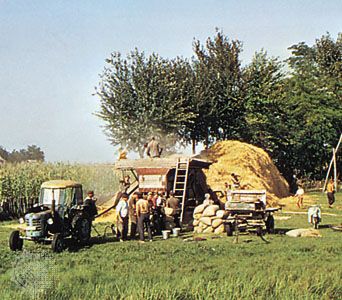
Kecskemét, city of county status and seat of Bács-Kiskun megye (county), central Hungary. Long established as a centre for handicrafts and cattle raising, it has also grown in importance for its viticulture, vegetables, and fruit. It is surrounded by flat sandy farmland, often referred to as “the orchard of Hungary.” The locality provides a substantial portion of the country’s fruit, notably apricots, and produces preserves, syrups, and liqueurs in large quantity, notably Kecskemét apricot brandy (barackpálinka).
The city dates back to the Árpád dynasty (9th–14th century), and by the 14th century it had become one of the privileged half-agrarian “field-towns” (oppida). It survived the Turkish occupation relatively unscathed as a khas, a possession of the sultan under his protection. Kecskemét’s polygonal main square is surrounded by public buildings and by a great Roman Catholic church and a Franciscan monastery. The city’s old Reform church was built between 1680 and 1684 by special permission of Sultan Mehmed IV. The synagogue (1862) has in its courtyard the remains of an older synagogue (1818), which now houses an exhibition and conference centre. There are many other churches and buildings of architectural and historical significance, including the Ornamental Palace (1902) and City Hall (1895). Among the city’s museums are the Museum of Hungarian Native Artists, the Bozsó Collection, and the Leskowsky Collection of Musical Instruments. The Hungarian dramatist József Katona was born in Kecskemét, as was the composer Zoltán Kodály, for whom the internationally renowned Zoltán Kodály Institute of Music Pedagogy (1975) is named.
Kecskemét’s principal industries, in addition to fruit processing, are textiles and the manufacture of agricultural machinery and consumer goods. The city, 50 miles (80 km) southeast of Budapest, is on the rail and road arteries to Szeged. Pop. (2011) 111,411; (2017 est.) 110,813.



