
- Russian:
- Kareliya
- Finnish:
- Karjala


Karelia
-
What is Karelia?
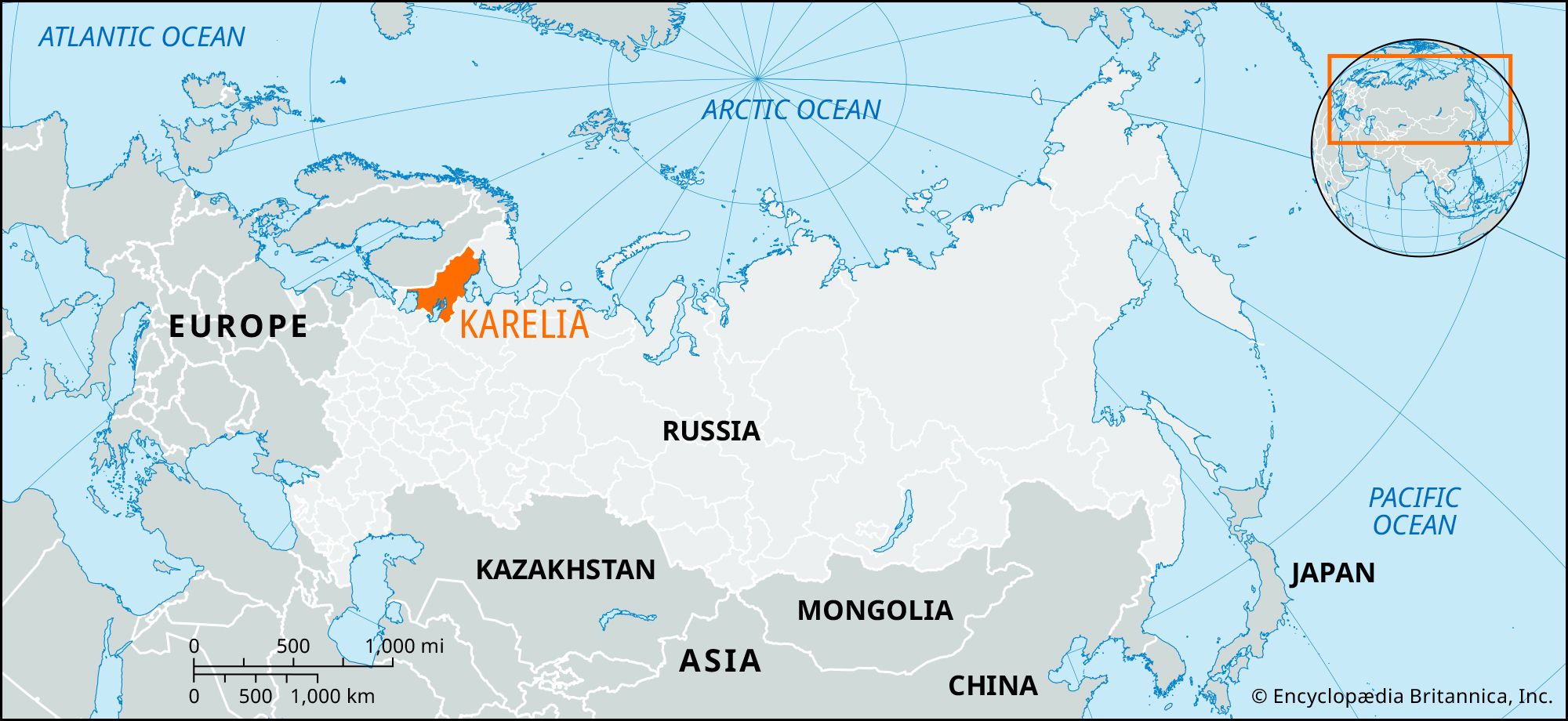
Karelia, a republic in northwestern Russia, is bordered by Finland to the west and the White Sea to the east. Its capital is Petrozavodsk. The area's surface consists mainly of a broad, flat, swampy plain marked by glacial effects, with numerous lakes and short rivers. Half of Karelia is forested with taiga, and its climate includes cold winters and short, cool summers.
Historically, eastern Karelia became part of Russia in 1323, while Peter I acquired western Karelia from Sweden in 1721. The population consists of Russians, Karelians, Belarusians, Ukrainians, and Finns. Major industries include mining, metallurgy, timber, and food processing.
3 Britannica SourcesCreated from Britannica articles using AI. AI can make mistakes, so verify using Britannica articles. -
Where is Karelia located within Russia?
Karelia is a republic in the far northwestern part of Russia, bordering Finland to the west and the White Sea to the east. It is also bordered to the north by Nenets and to the south by Lake Ladoga. The republic's capital, Petrozavodsk, is located on the western shore of Lake Onega.
3 Britannica SourcesCreated from Britannica articles using AI. AI can make mistakes, so verify using Britannica articles. -
What is the capital city of Karelia?
The capital of the Republic of Karelia in northwestern Russia is Petrozavodsk. The city is located on the western shore of Lake Onega. Peter the Great founded Petrozavodsk in 1703 as an ironworks to supply ordnance to his new capital, St. Petersburg. Today, Petrozavodsk is a major industrial center with engineering and timber-working industries.
3 Britannica SourcesCreated from Britannica articles using AI. AI can make mistakes, so verify using Britannica articles. -
What languages are commonly spoken in Karelia?
Karelia is a republic in northwestern Russia where several languages are spoken. These include Russian, Karelian proper, and Olonets. Karelian has two major dialects: Karelian proper and Olonets, also known as aunus in Finnish. The Ludic dialects are considered a blend of Karelian and Veps.
Karelian, a member of the Finno-Ugric branch of the Uralic language family, is spoken in the Republic of Karelia and by emigrants in neighboring Finland. The Karelian language group is one of the less numerous Baltic-Finnic groups. Russians constitute the majority of the population, but there are also Karelians, Belarusians, Ukrainians, and Finns.
4 Britannica SourcesCreated from Britannica articles using AI. AI can make mistakes, so verify using Britannica articles. -
What are some important natural features of Karelia?
Karelia, a republic in northwestern Russia, has a landscape marked by features from the ice ages. The area consists of a broad, flat, swampy plain, with finger-shaped lakes and swampy depressions between long, narrow ridges of glacial deposition in the south. Glaciation in the north scoured away surface deposits, leaving rock outcrops and thousands of lake-filled hollows, causing numerous rapids in the region’s short rivers. About half of Karelia is dense taiga, with pine, spruce, and birch. Sphagnum peat bogs are common in swampy areas.
Created from Britannica articles using AI. AI can make mistakes, so verify using Britannica articles. -
How has Karelia's history been influenced by Finland and Russia?
Karelia's history is intertwined with both Finnish and Russian influence. Eastern Karelia became part of Russia in 1323, while Peter the Great gained Western Karelia from Sweden in 1721. In the 19th century, Russia's control over Finland led to the administrative reunification of the area.
After Finland's independence in 1917, a 1920 treaty gave eastern Karelia to the Soviets and western Karelia to Finland. However, the Soviet Union annexed western Karelia after the Russo-Finnish War of 1939–40, and the Finnish population largely relocated to Finland. Karelia's status shifted, becoming an autonomous republic in 1923, a full union-republic in 1940, and reverting to an autonomous republic in 1956.
5 Britannica SourcesCreated from Britannica articles using AI. AI can make mistakes, so verify using Britannica articles.
Karelia, respublika (republic), far northwestern Russia. It is bordered to the north by Nenets, to the east by the White Sea, to the south by Lake Ladoga, and to the west by Finland. The capital is Petrozavodsk, on the western shore of Lake Onega.
Underlain by a part of the ancient rocks of the Baltic crystalline shield, the surface of the republic is largely a broad, flat, and swampy plain that shows the effects of the ice ages. Finger-shaped lakes and swampy depressions between long, narrow ridges of glacial deposition occur in the south. In the north, glaciation has scoured away the surface deposits, leaving thousands of lake-filled hollows and rock outcrops that produce innumerable rapids in the region’s many short rivers. About half of Karelia is forested, with dense taiga dominated by pine, spruce, and birch growing in podzolic soils that are poor and thin. In the swampy areas sphagnum peat bogs are common. The cold winter climate is modified by warm, humid air masses from the west, but incursions of Arctic air cause severe cold spells. During February, the coldest month, temperatures average 14 °F (−10 °C) in the south and 7 °F (−14 °C) in the north. Summers are short, cool, and susceptible to frosts, with average temperatures of 61 °F (16 °C) in the south and 57 °F (14 °C) in the north. Annual precipitation, mostly in the form of snow, varies from 16 inches (400 mm) in the north to 24 inches (600 mm) in the south, with snow cover in the Ladoga region accumulating to 40 inches (1,000 mm).
Eastern Karelia has been a part of Russia since 1323. Western Karelia was obtained by Peter I (the Great) from Sweden by treaty in 1721, and the area was administratively reunited with the grand duchy of Finland in the 19th century when Russia obtained suzerainty over all Finland. Following the Russian Revolution of 1917 and the proclamation of Finnish independence, a 1920 peace treaty left eastern Karelia in Soviet hands and awarded western Karelia to Finland. Western Karelia was annexed by the Union of Soviet Socialist Republics after the latter’s victory in the Russo-Finnish War (1939–40), however. After a 1947 peace treaty between the Soviets and Finland confirmed the annexation, almost the entire Finnish population of western Karelia moved into Finland.



Since 1917, the status of Karelia has changed several times; in 1923 it became an autonomous republic; in 1940, after the addition of western Karelia, it was given full union-republic status; and in 1956 Karelia reverted to its present status. Russians constitute the majority of the population, but there are also Karelians, Belarusians, Ukrainians, and Finns. The republic is only sparsely inhabited.
Mining, metallurgy, and timber working and processing are the major industries. Others include power engineering, machine building, and food processing. Iron ore, copper, mica, titanium, and pegmatite are the chief minerals mined. The metallurgical industry is concentrated at Petrozavodsk, the capital, and Vyartsilya, near the Finnish border. Timber cutting and processing is the largest industry, producing saw timber, pit props, railway ties, paper and pulp, furniture, veneer, and prefabricated materials. Agricultural land occupies less than 3 percent of the total area, with much of this used for pasture to support dairy cattle and other livestock or to breed mink and blue polar foxes for fur. Fishing is important on lakes, rivers, and along the White Sea coast.
A railway connects Petrozavodsk with St. Petersburg (southwest) and Murmansk (north). Equally important is the White Sea–Baltic Canal (141 miles [227 km]), a link in the waterway system that allows oceangoing vessels to travel from Belomorsk on the White Sea to St. Petersburg on the Baltic. Area 66,600 square miles (172,400 square km). Pop. (2005 est.) 703,080.