




Islington
-
What is Islington?
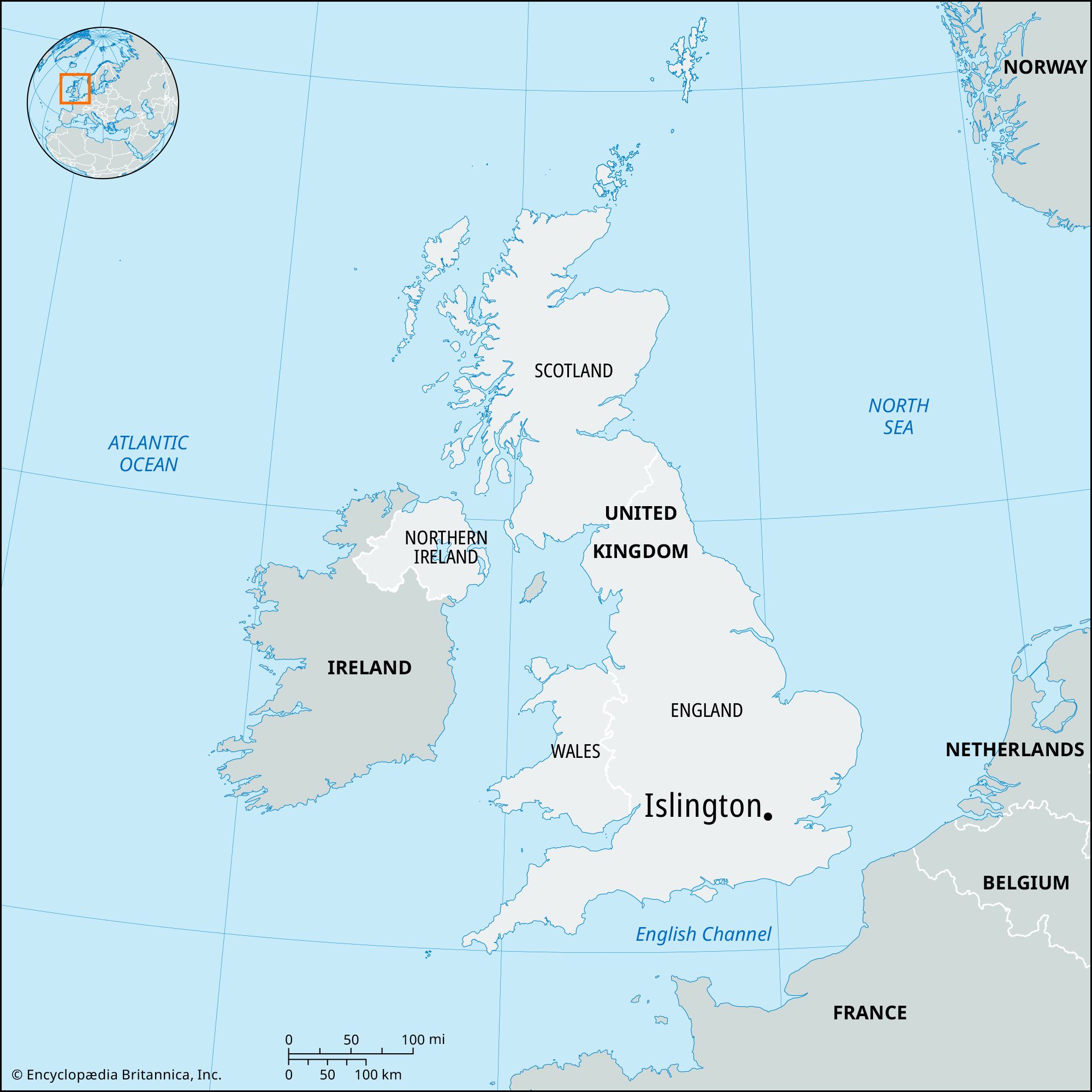
Islington is an inner borough of London, situated north of the City of London, and part of the historic county of Middlesex. Established in 1965, it was formed by combining the former metropolitan boroughs of Islington and Finsbury.
The borough includes areas such as Finsbury Park, Upper Holloway, Highbury, Holloway, Islington, and Clerkenwell. Islington, originally known as Gislandune to the Anglo-Saxons, appeared in the Domesday Book (1086) as Iseldone.
Over time, Islington has grown from rural pleasure gardens to an urban area with residential squares and historic landmarks such as the Sadler’s Wells Theatre and the Charterhouse. The borough is known for its social and ethnic diversity, with a significant presence of African and Afro-Caribbean populations.
1 Britannica SourceCreated from Britannica articles using AI. AI can make mistakes, so verify using Britannica articles. -
Where is Islington located within London?
Islington is an inner borough of London, situated directly north of the City of London. It is part of the historic county of Middlesex. The name Islington originally referred to the northern portion of the borough. The borough includes areas such as Finsbury Park, Upper Holloway, Highbury, Holloway, Islington, and Clerkenwell, from north to south. The N1 postal district is the village of Islington.
4 Britannica SourcesCreated from Britannica articles using AI. AI can make mistakes, so verify using Britannica articles. -
What are some well-known neighborhoods or areas in Islington?
Islington, an inner borough of London, includes several well-known areas. From north to south, these include Finsbury Park, Upper Holloway, Highbury, Holloway, Islington, and Clerkenwell.
As London expanded, Clerkenwell became more residential in the 16th and 17th centuries. Medicinal wells were discovered in Islington and Clerkenwell, and one such spa led to the construction of Sadler’s Wells Theatre on its site. Urban growth in the 19th century led to the development of Canonbury Square, Lloyd Square, and Myddleton Square.
1 Britannica SourceCreated from Britannica articles using AI. AI can make mistakes, so verify using Britannica articles. -
What are some historical or cultural sites in Islington?
Islington, an inner borough of London, has many historical and cultural sites. Sadler’s Wells Theatre is a notable theatre that originally opened in 1683, and the current building, built in 1931, is known for opera and ballet. Canonbury Tower, dating back to the 16th century, houses the Tower Theatre. The Charterhouse, constructed in the 14th century as a Carthusian monastery, later became a hospital and school. Bunhill Fields, located on City Road, is the burial ground for many famous religious Dissenters, including William Blake and Daniel Defoe.
1 Britannica SourceCreated from Britannica articles using AI. AI can make mistakes, so verify using Britannica articles. -
How has Islington changed or developed over time?
Islington's development spans from its Anglo-Saxon roots as Gisla’s Hill to its current status as an inner London borough. Originally a northern area outside London, Islington saw residential expansion in the 16th and 17th centuries, especially around Clerkenwell, following the discovery of medicinal wells. Urban growth accelerated with the arrival of the Regent’s Canal in 1812, the New North Road in 1812, and the North London Railway in the 1850s, leading to the creation of Canonbury Square and other squares.
Today, Islington's economy is dominated by the service sector, though some light manufacturing and traditional craft shops remain. While gentrification has restored many residential areas, Islington maintains its social and ethnic diversity, with significant African and Afro-Caribbean populations.
1 Britannica SourceCreated from Britannica articles using AI. AI can make mistakes, so verify using Britannica articles.
Islington, inner borough of London, England, located directly north of the City of London. It is part of the historic county of Middlesex. The present borough was established in 1965 by amalgamation of the former metropolitan boroughs of Islington and Finsbury. It includes the areas of (from north to south) Finsbury Park, Upper Holloway, Highbury, Holloway, Islington, and Clerkenwell. The name Islington originally referred to the northern portion of the borough. Known as Gislandune (Gisla’s Hill) to the Anglo-Saxons, it appeared in Domesday Book (1086) as Iseldone.
As London spread beyond its northern wall in the 16th and 17th centuries, Clerkenwell and its environs became residential. In Islington and in Clerkenwell, medicinal wells were discovered, and one famous spa gave its name to the Sadler’s Wells Theatre built on its site. Gradually, however, the rural pleasure gardens were overtaken by urban growth associated with the Regent’s Canal (started 1812), the New North Road (1812) and other roads, and the North London Railway (1850s). Canonbury Square, Lloyd Square, and Myddleton Square were created in the late 18th and early 19th centuries.
Many famous religious Dissenters (Nonconformists), including John Bunyan, Daniel Defoe, Isaac Watts, William Blake, and George Fox, the founder of the Society of Friends (Quakers), are buried at Bunhill Fields, City Road. Facing the cemetery is Wesley’s Chapel, with the house (now a museum) and burial place of John Wesley. Also associated with the borough are John Milton, who lived on Bunhill Row; Samuel Johnson, who worked at St. John’s Gate; Oliver Goldsmith, who occupied Canonbury House; Edward Lear, who lived in Bowman’s Mews; caricaturist George Cruikshank, who lived in Amwell Street; and Charles Lamb, who lived on Duncan Terrace. Film director Alfred Hitchcock got his start at Islington Studios.




Notable theatres are the Tower Theatre at the 16th-century Canonbury Tower; the Little Angel Theatre, which features marionettes; and Sadler’s Wells, which opened in 1683 (the present theatre, built in 1931, is famous for opera and ballet performances). Buildings of historic interest include the 14th-century Charterhouse, which was built as a Carthusian monastery and later became a hospital and school. The Armoury House of the Honourable Artillery Company was constructed in the 1730s on Artillery Ground, which has been in use since 1642. Educational institutions include the City University (founded 1894 as Northampton Institute; university status 1966) and the University of North London (founded 1971 as Polytechnic of North London; university status 1992).
The service sector dominates the economy, but there is some light manufacturing, and traditional craft shops survive in the Clerkenwell district. The rail line between London and Edinburgh approaches King’s Cross Station through the borough, which is well served by London Underground (subway) lines.
Many residential squares and terraces have been returned from multiple occupancy to single-family ownership, but this process of gentrification has not destroyed Islington’s social and ethnic variety or the vitality of its streets. Islington includes large populations of Africans and Afro-Caribbeans. Ethnic minorities account for about one-fifth of the borough’s population. Area 5.7 square miles (15 square km). Pop. (2001) 175,597; (2011) 206,125.