


- Also called:
- Ife or Ife-Lodun

Ile-Ife
-
What is Ile-Ife?
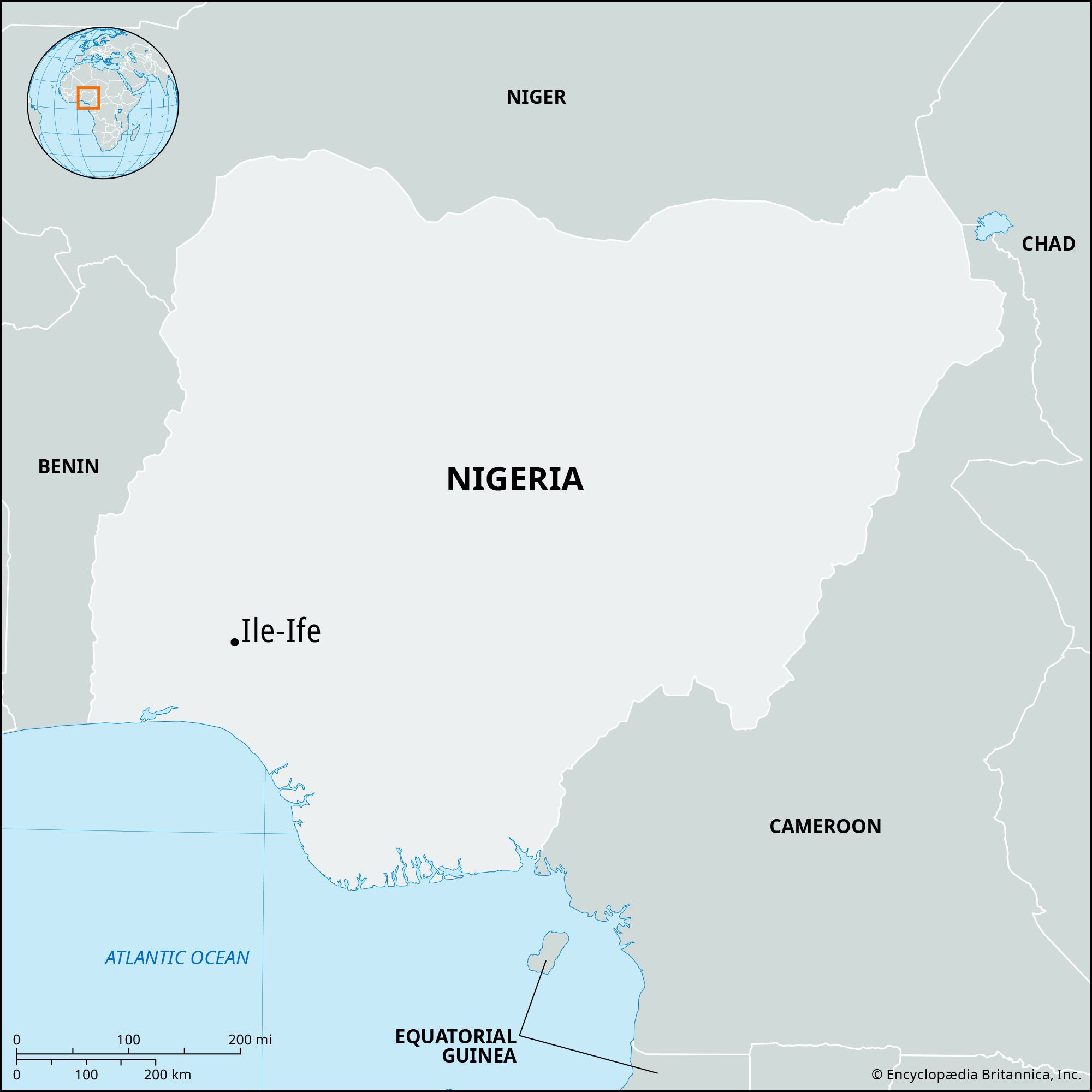
Ile-Ife, located in southwestern Nigeria's Osun state, is a significant town for the Yoruba people. It is considered their oldest town and holy city, believed to be the birthplace of humankind and founded by the deity Oduduwa's son. By the early 11th century, it was the capital of a well-established kingdom.
Ife is known for its naturalistic terra-cotta heads and bronze pieces created through the cire perdue ("lost-wax") process from the late 12th or early 13th century. Although Benin City and Old Oyo later became more politically important, Ife remained the Yoruba's chief religious center.
1 Britannica SourceCreated from Britannica articles using AI. AI can make mistakes, so verify using Britannica articles. -
Where is Ile-Ife located in Nigeria?
Ile-Ife is a town in Osun state, southwestern Nigeria, at the intersection of roads from Ibadan, Ilesha, and Ondo. It is one of the larger centres and likely the oldest town of the Yoruba people and is considered by the Yoruba to be a holy city and the legendary birthplace of humankind.
2 Britannica SourcesCreated from Britannica articles using AI. AI can make mistakes, so verify using Britannica articles. -
Why is Ile-Ife important in Nigerian history?
Ile-Ife holds significant importance in Nigerian history as one of the oldest and largest towns of the Yoruba people. Considered a holy city and the legendary birthplace of humankind by the Yoruba, its kingdom was well-established by the early 11th century.
By the late 12th or early 13th century, Ile-Ife's artisans were producing naturalistic terra-cotta heads and bronze pieces. Though Benin City and Old Oyo later became more politically important, Ile-Ife remained the chief religious center for the Yoruba. In 1948, it was the site of the inaugural Conference of the Society of the Descendants of Oduduwa, a group of Yoruba nationalists who formed the core of the Action Group, a national political party.
1 Britannica SourceCreated from Britannica articles using AI. AI can make mistakes, so verify using Britannica articles. -
What are some famous historical features of Ile-Ife?
Ile-Ife, a town in southwestern Nigeria, is one of the oldest Yoruba settlements and is considered a holy city and the legendary birthplace of humankind. By the late 12th or early 13th century, Ife artisans were producing naturalistic terra-cotta heads and bronze pieces made by the cire perdue ("lost-wax") process, for which the Ife kingdom is now well known. The afin ("palace") of the ooni, the spiritual head of the Yoruba people, is in the center of Ile-Ife. The palace is also the site of the Ife Museum (1954), which contains a collection of cire-perdue bronze castings and terra-cotta sculptures.
1 Britannica SourceCreated from Britannica articles using AI. AI can make mistakes, so verify using Britannica articles. -
How has Ile-Ife influenced Yoruba culture?
Ile-Ife holds a significant place in Yoruba culture as its oldest town and spiritual hub. Considered the legendary birthplace of humankind by the Yoruba people, Ile-Ife is believed to have been founded by a son of the deity Oduduwa.
Ife's naturalistic art, particularly its terra-cotta heads and bronze sculptures crafted through the cire perdue process, greatly impacted Yoruba sculptural style, influencing the representation of human figures throughout Yorubaland. As the chief religious centre for the Yoruba, Ile-Ife has had a great cultural influence over the Edo kingdom of Benin to the southeast.
2 Britannica SourcesCreated from Britannica articles using AI. AI can make mistakes, so verify using Britannica articles. -
What are some examples of art and traditions that originated in Ile-Ife?
Ile-Ife, a city in southwestern Nigeria, is known as the oldest Yoruba town and the legendary birthplace of humankind. Ile-Ife is the origin of many significant artistic and cultural traditions:
- Terra-cotta and bronze sculpture By the late 12th or early 13th century, Ile-Ife's artisans were producing naturalistic terra-cotta heads and bronze pieces via the cire perdue (lost-wax) process.
- Religious and spiritual authority Ile-Ife is considered a holy city by the Yoruba people and is the chief religious centre for the Yoruba. The oni (king) of Ile-Ife is the spiritual head of the Yoruba people.
- Craftsmanship The Yoruba have traditionally been among the most skilled and productive craftsmen in Africa, working as blacksmiths, weavers, leatherworkers, glassmakers, and ivory and wood carvers.
- Bronze casting In the 13th and 14th centuries, Yoruba bronze casting using the lost-wax (cire perdue) method reached a peak of technical excellence never subsequently equaled in western Africa.
3 Britannica SourcesCreated from Britannica articles using AI. AI can make mistakes, so verify using Britannica articles.
Ile-Ife, town, Osun state, southwestern Nigeria. The town lies at the intersection of roads from Ibadan (40 miles [64 km] west), Ilesha, and Ondo. It is one of the larger centres and probably the oldest town of the Yoruba people. Considered by the Yoruba to be a holy city and the legendary birthplace of humankind, it was held to have been founded by a son of the deity Oduduwa and was certainly the capital of a well-established kingdom (probably named for Ifa, the god of divination) by the early 11th century. By the late 12th or early 13th century, its artisans were producing the naturalistic terra-cotta heads and bronze pieces made by the cire perdue (“lost-wax”) process for which the Ife kingdom is now well known. Ife had great political and cultural influence over the Edo kingdom of Benin to the southeast.
Although Benin City and Old Oyo (Katunga) became the seats of political kingdoms more important than Ife, the town remained the chief religious centre for the Yoruba. In return for the ida oranyan (“sword of Oranyan”)—a symbol of spiritual authority named after a historical ruler of Benin and Oyo and given to an alaafin (alafin; “king”) of Oyo upon his coronation—the alaafin had to promise not to attack Ife. When Alaafin Awole tried to raid Ife territory for slaves in 1793, it brought severe internal resistance and the series of wars that led to the collapse of the Oyo empire. Although Ife managed to avoid the attacks by the Muslim Fulani that struck other parts of Yorubaland, it was weakened in the 1820s through struggles for control of the internal slave trade with Owu, to the southwest. After an ooni (oni; “king”) of Ife allowed Yoruban Oyo refugees from the Ilorin Fulani conquest to build the walled town of Modakeke just outside Ife, he was poisoned. After Ife declared war (1882) against Ibadan, its forces were repulsed when they attacked Modakeke. Shortly afterward a combined army from Ibadan and Modakeke nearly destroyed Ife.
In the centre of modern Ile-Ife is the afin (“palace”) of the present ooni, the spiritual head of the Yoruba people, who has custody of the sacred staff of Oranmiyan (Oranyan), an 18-foot (5.5-metre) granite monolith in the shape of an elephant’s tusk. The palace compound is also the site of the Ife Museum (1954), which contains a collection of cire-perdue bronze castings and terra-cotta sculptures that was partly acquired by the German archaeologist Leo Frobenius in 1910 and subsequently expanded through excavations at the Wunmonije compound (1938–39) and at nearby Ita Yemoo (1957).




Obafemi Awolowo University (formerly the University of Ife) was founded in 1961, with classes beginning the following year. One of Nigeria’s major universities, it is located north of the town; it operates a teaching hospital and has a major library. The affiliated Institute of Agricultural Research and Training operates the Moor Plantation for agricultural research and has the country’s largest specialized agricultural library. Institutes of education (operating a mobile library service) and physical education are also centred in the town and affiliated with the university. Ile-Ife is the seat of the Historical Society of Nigeria (1955) and has several teacher-training colleges. In 1948 Ife was the site of the inaugural Conference of the Society of the Descendants of Oduduwa, a group of Yoruba nationalists who formed the core of the Action Group, a national political party.
Ile-Ife is a major collecting point for cocoa and cotton grown in the surrounding area. Palm oil and kernels, yams, cassava (manioc), corn (maize), pumpkins, and kola nuts are cultivated for local markets. Ile-Ife’s inhabitants are primarily town-dwelling farmers. Pop. (2006) local government area, 644,373.