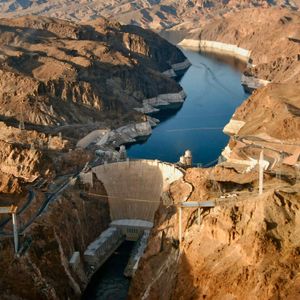
Hoover Dam Bypass Project
Quick Summary
The Hoover Dam Bypass Project involved the construction of a bridge near the Hoover Dam in the United States. This project was initiated in January 2005 and completed in October 2010 with the opening of a concrete arch bridge. This bridge, spanning 1,060 feet (322 meters), was the longest of its kind in North America at the time of its completion. The purpose of the bypass was to alleviate traffic congestion on the dam's crest, which had been a federal highway and a route for travelers between Nevada and Arizona. The old road on the dam's crest is now reserved for visitors to the dam.1
The Hoover Dam itself, located in Black Canyon on the Colorado River at the Arizona-Nevada border, was constructed between 1930 and 1936. It is the highest concrete arch-gravity dam in the United States and impounds Lake Mead, one of the world's largest artificial lakes. The dam serves multiple purposes, including flood and silt control, hydroelectric power generation, agricultural irrigation, and domestic water supply. It was named in honor of President Herbert Hoover. At its completion in 1935, it was the world's largest hydroelectric producer, a title it held until 1948.12
Ask Britannica AI about this topic
Britannica doesn't have a full article on this topic, so we've curated a list of our relevant coverage.