




- Spanish:
- Guatemala or
- In full:
- Ciudad de Guatemala


Guatemala City
News •
-
What is Guatemala City?
Guatemala City is the capital of Guatemala, the largest city in Central America, and the country's political, social, cultural, and economic center. It is located in a valley in the central highlands at 4,897 feet (1,493 meters) above sea level, which gives it a temperate and invigorating mountain climate.
Guatemala City was founded in 1776 to replace Antigua Guatemala as the capital after Antigua Guatemala was destroyed by an earthquake in 1773. The modern city was largely rebuilt after earthquakes in 1917–18. Nearly half of the capital invested in the country is handled in Guatemala City, and it accounts for over half of the republic's industrial establishments and production. Industrial activity is concentrated in the environs of Guatemala City.
2 Britannica SourcesCreated from Britannica articles using AI. AI can make mistakes, so verify using Britannica articles. -
Where is Guatemala City located?
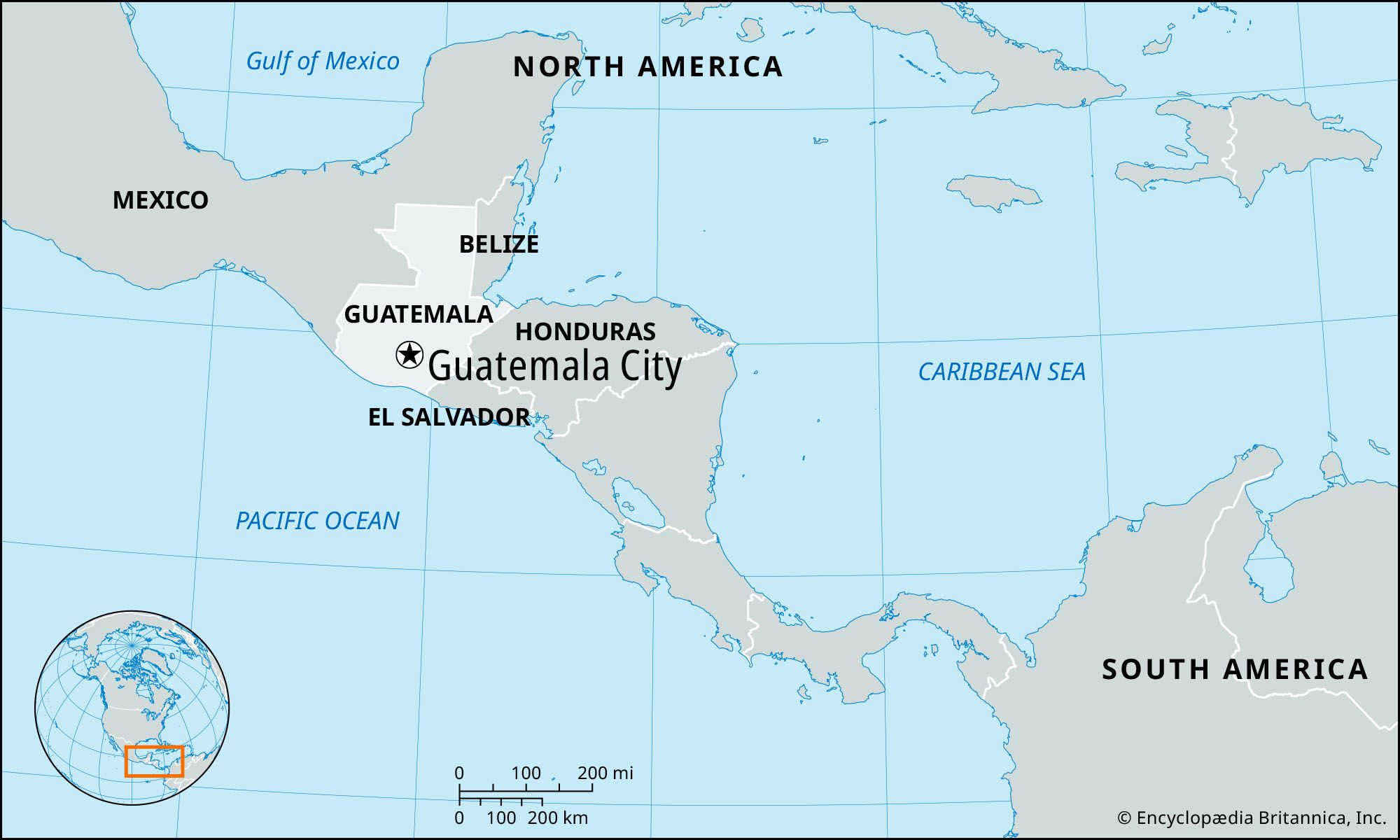
Guatemala City is the capital of Guatemala. It is the largest city in Central America and serves as Guatemala's political, social, cultural, and economic center. The city is located in a valley in the central highlands at 4,897 feet (1,493 meters) above sea level, providing it with a temperate mountain climate. Guatemala is bordered by Mexico to the north and west, by Belize and the Gulf of Honduras to the northeast, by Honduras to the east, by El Salvador to the southeast, and by the Pacific Ocean to the south.
2 Britannica SourcesCreated from Britannica articles using AI. AI can make mistakes, so verify using Britannica articles. -
Why is Guatemala City important in Guatemala?
Guatemala City is the capital of Guatemala and the largest city in Central America. It serves as the country's political, social, cultural, and economic hub, handling nearly half of the country's capital investment and over half of its industrial production. The city is the focus of highway, rail, and air transport, making it the country's commercial and banking center. Guatemala City dominates the country's cultural life as the location of the main campus of the San Carlos University of Guatemala, as well as other institutions and museums. Industrial activity is heavily concentrated in the city's environs.
2 Britannica SourcesCreated from Britannica articles using AI. AI can make mistakes, so verify using Britannica articles. -
What is the population and size of Guatemala City?
Guatemala City, the capital of Guatemala, is the largest city in Central America and the country's political, social, cultural, and economic center. The city's population was estimated to be 942,348. Guatemala City lies in a valley in the central highlands at 4,897 feet (1,493 meters) above sea level. Guatemala, the country, has an area of 42,042 square miles (108,889 square kilometers) and a population of 16,581,000. The population of Guatemala in 2025 is estimated to be 16,865,000.
3 Britannica SourcesCreated from Britannica articles using AI. AI can make mistakes, so verify using Britannica articles. -
What are some cultural or historical landmarks in Guatemala City?
Guatemala City, the capital of Guatemala, is rich in cultural and historical landmarks. The city was founded in 1776 to replace Antigua Guatemala as the capital.
Cultural and historical landmarks:
* National Archaeological Museum: This museum has a collection of Mayan artifacts.
* Ixchel Museum of Indian Attire: It is one of the more highly recognized centers of cultural activity.
* National Museum of Archeology and Ethnology and of Arts and Popular Crafts: These museums are well-known cultural institutions.
* Cathedral (1815): A major religious structure.
* Churches of San Francisco, Santo Domingo, and La Merced: Santo Domingo is famous throughout Central America for its Holy Week procession. La Merced was rebuilt after 1917.
* Minerva Park: Here, you can find a remarkable concrete relief map of the country.
* Olympic City: It was built for the Central American Olympic Games of 1950.3 Britannica SourcesCreated from Britannica articles using AI. AI can make mistakes, so verify using Britannica articles. -
How does Guatemala City impact the country's economy, education, and government?
Guatemala City serves as Guatemala's political, social, cultural, and economic hub. The city handles almost half of the country's capital investment and over half of its industrial production. It is the center for highway, rail, and air transport, as well as the country's commercial and banking center. A stock exchange was established in Guatemala City in 1987.
Guatemala City dominates the country's cultural life and is home to the main faculties of the San Carlos University of Guatemala, along with other institutions for education. The country's universities are concentrated in the capital.
3 Britannica SourcesCreated from Britannica articles using AI. AI can make mistakes, so verify using Britannica articles.
Guatemala City, capital of Guatemala, the largest city in Central America, and the political, social, cultural, and economic center of Guatemala. Lying in a valley of the central highlands at an elevation of 4,897 feet (1,493 meters) above sea level, it has a temperate and invigorating mountain climate.
Guatemala City was founded in 1776 to replace Antigua Guatemala, which had been virtually destroyed by an earthquake in 1773, as the capital of the captaincy general of Guatemala. After independence from Spain was declared in 1821, Guatemala City served successively as the capital of the province of Central America under the Mexican Empire of Agustín de Iturbide (1822–23), the Central American Federation (1823–33), the state, and, finally, the independent Republic of Guatemala. Distrust of the city in other areas of Central America and the prevalence of open fighting in the city’s streets and public buildings was a factor in the demise of the federation and in the failure of subsequent attempts to revive it. When Quezaltenango, which had become the capital of Guatemala in all but name, was destroyed by an earthquake in 1902, many of the leading families moved to Guatemala City.
The modern city was largely rebuilt after the disastrous earthquakes of 1917–18, which shook the city intermittently for six weeks. The characteristic appearance created by low massive structures has been modified somewhat by the erection of steel and concrete multistoried hotels and office and apartment buildings of modern design. Elegant residential districts have grown up on the borders of the old city, particularly toward the south, and low-cost housing units have been constructed in various parts of the urban area.



In addition to the government offices and services concentrated there, Guatemala City handles nearly half of the capital invested in the country and accounts for more than half of the industrial establishments and production of the republic. It is the focus of highway, rail, and air transport and is the commercial and banking center of the country.

Guatemala City also dominates the cultural life of the country. It is the seat of the principal faculties of the San Carlos University of Guatemala (established 1676 in Antigua Guatemala); the major institutions for artistic, commercial, vocational, and military education; the Society of Geography and History; and several important museums. Public buildings of note include the National Palace, the post office, police headquarters, the National Archives, the National Archaeological Museum (with its collection of Mayan artifacts), the National Library, and the modern cluster of buildings around the city hall. Among the major religious structures are the cathedral (1815) and the churches of San Francisco, Santo Domingo (famous throughout Central America for its Holy Week procession), and La Merced (colonial but rebuilt after 1917).
Other points of interest include the remarkable concrete relief map of the country in Minerva Park, the archaeological and historical museums, the colonial aqueduct, the central market, and Olympic City, built for the Central American Olympic Games of 1950.
In the environs of Guatemala City are the villages of Chinautla, famous for hand-formed pottery, Mixco, which supplies the capital with fruits and vegetables, and the Indian towns of San Pedro and San Juan Sacatepéquez, all of which suffered extensive damage in the earthquake of 1976. Several villages were evacuated when the nearby Pacaya volcano erupted in 2000. Pop. (2018) 923,392.
The trusted destination for professionals, college students, and lifelong learners.
SUBSCRIBE

