
- Also known as:
- Guyana Esequiba

Essequibo
-
Where is the Essequibo region located?
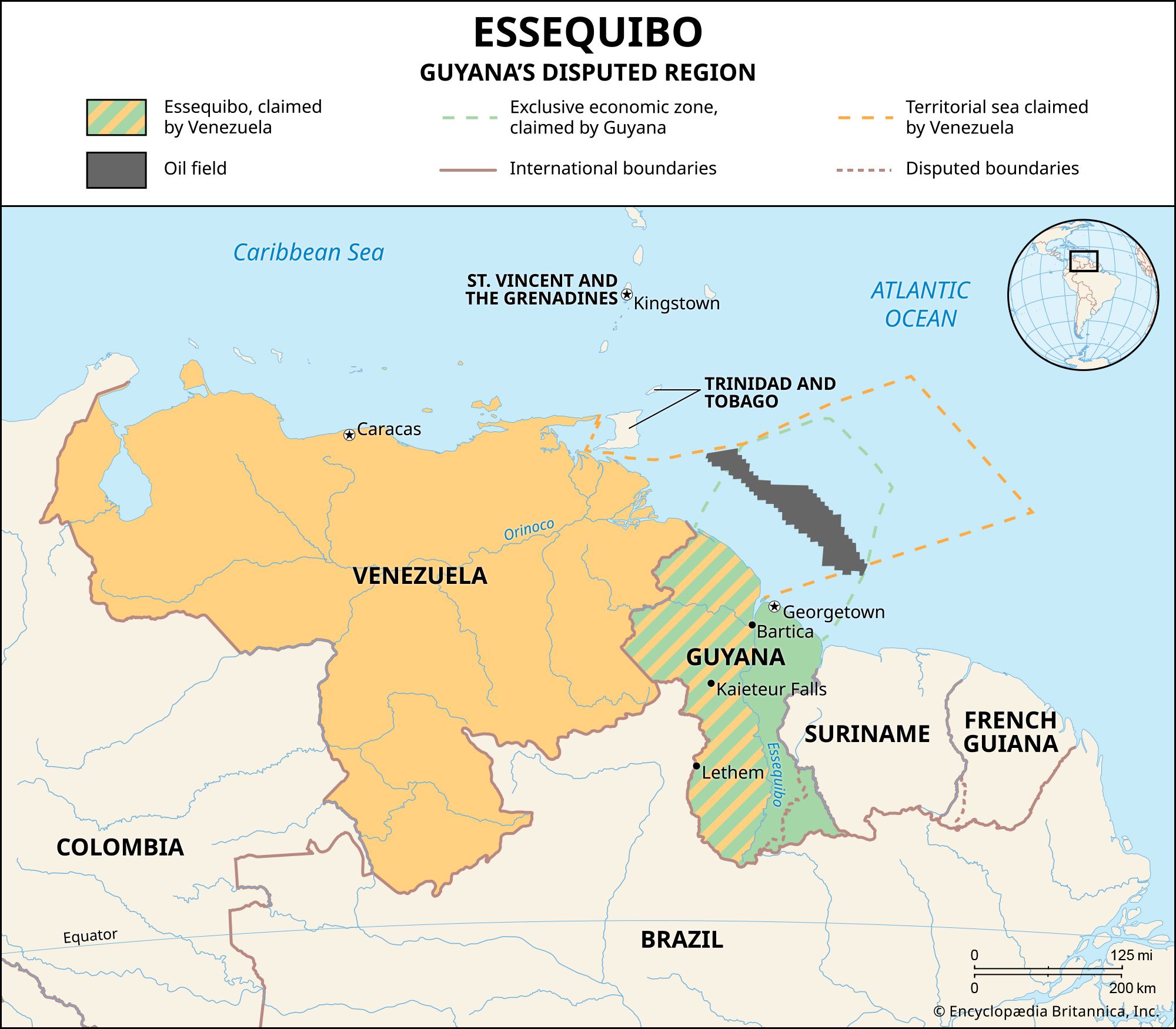
The Essequibo region is located along the northeastern coast of South America, comprising roughly the western two-thirds of Guyana. Venezuela also claims this area. The region is separated from the rest of Guyana by the Essequibo River and is bordered by Venezuela to the west, Brazil to the south and west, and the Atlantic Ocean to the north.
Essequibo is mainly a hinterland forest with highlands, savannas, and low coastal plains. It is known for its biodiversity and natural resources, including hydrocarbons and precious metals. The Essequibo River, Guyana’s longest river, flows northward for about 630 miles (1,010 km) before emptying into the Atlantic Ocean. The area has rich sociocultural and linguistic diversity and includes six of Guyana’s ten administrative regions.
1 Britannica SourceCreated from Britannica articles using AI. AI can make mistakes, so verify using Britannica articles. -
What country is most of the Essequibo region part of?
The Essequibo region, located along the northeastern coast of South America, is a point of contention between Guyana and Venezuela. Most of the Essequibo region is part of Guyana, comprising roughly the western two-thirds of the country. Venezuela, however, claims the area as its own.
The Essequibo River separates the region from the rest of Guyana. The area is bordered by Venezuela to the west, Brazil to the south and west, and the Atlantic Ocean to the north. The region is rich in natural resources, including hydrocarbons and precious metals.
2 Britannica SourcesCreated from Britannica articles using AI. AI can make mistakes, so verify using Britannica articles. -
What river runs through the Essequibo region?
The Essequibo River flows through the Essequibo region. Rising in the Acarai Mountains on the Brazilian border, it flows northward for approximately 630 miles (1,010 km) to the Atlantic Ocean. The river is the largest between the Amazon and the Orinoco, and with its tributaries, drains more than half of Guyana. The Essequibo River’s freshwater habitat is home to many species of wildlife, including 58 endemic fish species.
3 Britannica SourcesCreated from Britannica articles using AI. AI can make mistakes, so verify using Britannica articles. -
Why is the Essequibo region important to Guyana?
The Essequibo region is vital to Guyana because it constitutes roughly the western two-thirds of the country and is rich in biodiversity and natural resources. The area is primarily a hinterland forest but also contains highlands, savannas, and low coastal plains.
Essequibo has a wealth of natural resources, including hydrocarbons and precious metals. Guyana's economy was radically transformed in 2015 with the discovery of a rich offshore oil field in the country’s waters. The Essequibo River's freshwater habitat is home to many species of wildlife, including 58 endemic fish species. Demographically, the area is characterized by rich sociocultural and linguistic diversity and encompasses six of Guyana’s 10 administrative regions.
2 Britannica SourcesCreated from Britannica articles using AI. AI can make mistakes, so verify using Britannica articles. -
What is the border dispute involving the Essequibo region?
The Essequibo region, which makes up about two-thirds of Guyana, is the subject of a protracted border dispute that dates back to the period of Spanish colonial rule. During the Spanish colonial era, the area was part of Venezuela, which laid claim to it after gaining independence in the early 19th century.
In 1899, international arbitrators awarded the contested region to British Guiana, but in 1966, an agreement was established to reconsider the border dispute. Venezuela's claims intensified after oil was discovered off Essequibo in 2015. In 2018, the UN submitted the dispute to the International Court of Justice (ICJ), a move contested by Venezuela. Tensions further escalated when Guyana auctioned oil exploration licenses in 2023, leading Venezuela to hold a referendum to incorporate Essequibo. Despite an ICJ prohibition, the referendum endorsed Venezuela's claim.
1 Britannica SourceCreated from Britannica articles using AI. AI can make mistakes, so verify using Britannica articles. -
How has the Essequibo region affected relations between Guyana and Venezuela?
The Essequibo region, comprising roughly the western two-thirds of Guyana, has long been a point of contention between Guyana and Venezuela. Venezuela claimed the area after gaining independence from Spain in the early 19th century.
Tensions flared, particularly after the 2015 discovery of oil in the Atlantic Ocean off Essequibo, which promised considerable economic potential for Guyana. In December 2023, Nicolás Maduro heightened the urgency of Venezuela’s claim by holding a referendum to establish a state in Essequibo. This led to increased political brinkmanship, with both countries agreeing to avoid escalating the conflict. Some observers believe Maduro's actions were an attempt to stoke nationalist sentiment amid internal challenges.
2 Britannica SourcesCreated from Britannica articles using AI. AI can make mistakes, so verify using Britannica articles.
Essequibo, region along the northeastern coast of South America that comprises roughly the western two-thirds of Guyana but is also claimed by Venezuela. Separated from the rest of Guyana by the Essequibo River, Essequibo is bordered to the west by Venezuela, to the south and west by Brazil, and to the north by the Atlantic Ocean. During the Spanish colonial era, the area was part of Venezuela, which laid claim to it after Venezuela gained its independence from Spain in the early 19th century. However, in 1899 international arbitrators from Britain, Russia, and the United States awarded the contested region to what was then the U.K. colony of British Guiana. An agreement in 1966 between Britain, Venezuela, and independent Guyana established a commission to reconsider the border dispute. Venezuela’s ongoing claims to the region intensified after oil was discovered in the Atlantic Ocean off Essequibo in 2015. Area 61,600 square miles (159,500 square km).
Geography

Essequibo is primarily a hinterland forest, similar in makeup to Guyana as a whole. The terrain also encompasses highlands, savannas, and low coastal plains. This biodiverse ecoregion contains an abundance of natural resources, including hydrocarbons and precious metals. The longest of Guyana’s rivers, the Essequibo River rises in the Acaraí Mountains and flows northward for some 630 miles (1,010 km) before it empties into the Atlantic Ocean. It is the largest river between the Amazon and Orinoco rivers and is paralleled on the east by the Demerara River for a relatively short distance. The Essequibo River’s freshwater habitat is home to many species of wildlife, including 58 endemic fish species.
Dominated by jungle terrain, Guyana is relatively sparsely inhabited, and Essequibo is no exception. Demographically, the area is characterized by rich sociocultural and linguistic diversity. Essequibo encompasses six of Guyana’s 10 administrative regions.



History
European colonization
Essequibo’s protracted territorial dispute dates from the period of Spanish colonial rule. In the late 15th century, explorer Christopher Columbus observed the Guyanese coast, and Spain subsequently claimed much of the northern part of the continent of South America, including present-day Guyana and Venezuela. Although the Spanish initially claimed the Essequibo region, it was the Dutch who settled the Essequibo valley, set up trading posts in the river basin’s lush land, and established the first settlement in Guyana in 1616. Soon after, they began to import enslaved people to cultivate sugarcane and developed the frontier over the next two centuries.
Control of Guyana shifted several times in the late 18th century, primarily among the British, French, and Dutch. In 1814 Britain acquired Essequibo, along with the regions of Demerara and Berbice, from the Netherlands. However, the treaty under which that land was obtained did not delineate its western boundary, most likely because the border between Spanish and Dutch possessions in the area had never been formally defined. Nonetheless, in 1831 Britain united the three territories to form the colony of British Guiana.
Exploration of British Guiana, the Schomburgk Line, and the origin of the territorial dispute
Meanwhile, neighboring Venezuela, having attained its independence from Spanish rule, asserted its own claim to sovereignty over Essequibo, which Spain had considered to be part of the Captaincy General of Venezuela. In 1835 the British Royal Geographical Society commissioned Robert Hermann Schomburgk to explore British Guiana. In 1839, at the end of his mission, Schomburgk made known his belief that the borders of the colony should be fixed by survey, and in 1841 the British government sent him back to British Guiana to do that. The boundary that he demarcated between British Guiana and Venezuela (the Schomburgk Line) incorporated the Essequibo region within British Guiana. Venezuela quickly disputed Schomburgk’s border, claiming that it encroached on Venezuelan land, which it claimed extended to the Essequibo River. In the decades that followed, the discovery of gold in Essequibo resulted in an influx of British miners and settlers. All the while, the boundary dispute persisted. Negotiations between Britain and Venezuela made little progress, and in February 1887 Venezuela severed diplomatic relations with Britain.
1899 Paris Arbitral Award
During the last quarter of the 19th century, Venezuela sought to enlist support from the United States for its claim to the region under the aegis of the Monroe Doctrine’s prohibition of European intervention in the Western Hemisphere. As the century came to a close, an international tribunal (made up of two U.S. judges, two British judges, and a Russian judge) was established, largely as a result of U.S. influence, to decide the fate of the disputed territory. In 1899 the resulting settlement, the Paris Arbitral Award, gave Venezuela control over parts of the area at the mouth of the Orinoco River, whereas it awarded Britain the land west of the Essequibo River, which amounted to approximately 90 percent of the contested region. Less than satisfied, Venezuela nonetheless ratified the tribunal’s decision.
The trusted destination for professionals, college students, and lifelong learners.
SUBSCRIBE


1966 Geneva Agreement
In 1949 the issue heated up again, when a memorandum was made public that suggested that the Russian tribunal leader had coerced the U.S. arbitrators into approving British control of Essequibo. Although some observers questioned the delay in Venezuela’s formal response to this revelation, in 1962 Venezuela declared the 1899 decision invalid, again asserted its sovereignty over the land west of the Essequibo River, and brought its concerns to the United Nations (UN). An agreement in 1966 between Britain and Venezuela that grew out of a UN-orchestrated conference in Geneva committed Venezuela and Guyana (which became party to the agreement after attaining its independence) to efforts to seek a peaceful solution to the dispute and established a mixed commission to facilitate an agreement, but it failed to produce a resolution of the issue within the four years mandated by the agreement. Under the terms of the Geneva Agreement, the issue was then to have been transferred to an international organ or to the UN secretary-general. However, a protocol agreed to by Venezuela and Guyana in 1970 effectively delayed any action on the dispute for 12 years.
In the 1980s the two countries then agreed to allow the secretary-general to pursue a solution to the matter, and in 1990 the first of a series of “good officers” was appointed to facilitate a means for settlement. Negotiations occurred regularly but bore little fruit. In the meantime, Venezuela and Guyana experienced periods of relatively amicable relations, particularly during the rule of Venezuelan Pres. Hugo Chávez.
2015 oil discovery
Tensions between Guyana and Venezuela flared again in 2015, when Exxon Mobil Corporation discovered significant oil reserves in the Atlantic Ocean off the coast of Essequibo in waters that are claimed by both Guyana and Venezuela. Estimates by Guyana’s government indicated that these deposits could hold more than 700 million barrels of oil, worth some $40 billion. The find promised considerable economic potential for Guyana, to that point one of the poorest countries in South America. The oil reserves also represented high economic potential for Venezuela, which, despite possessing its own large oil reserves, was in the midst of an economic collapse resulting from mismanagement of its state-owned oil industry and international sanctions imposed upon it in response to the increasingly authoritarian rule of Pres. Nicolás Maduro. In the wake of Exxon Mobil’s discovery, Maduro revived Venezuela’s claims to the Essequibo region, which beyond its potential oil riches offered possible economic benefits to be derived from hydroelectric power generation, fishing, and tourism.
Appeal to the International Court of Justice
Against this backdrop, in early 2018 UN Secretary-General António Guterres determined that the territorial dispute should be submitted to the International Court of Justice (ICJ), though decisions by the ICJ on such matters can take years. In March of that year Guyana applied to the ICJ, which in December 2020 determined that the matter was within its purview. Venezuela responded by challenging the court’s authority in the dispute, but in an April 2023 decision the ICJ reaffirmed its jurisdiction.
Venezuelan referendum on Guyana Esequiba
Tensions escalated in September 2023, when Guyana held an auction for oil exploration licenses. Maduro then heightened the political brinksmanship by scheduling a consultative referendum, which asked Venezuelans whether the country should reject the ICJ’s jurisdiction in the territorial dispute and incorporate Essequibo as a Venezuelan state to be named Guyana Esequiba. On December 1, 2023, two days before the referendum vote, the ICJ prohibited Venezuela from taking action that would change the status quo in Essequibo. Although voter turnout appeared to be low—notwithstanding the National Electoral Council’s claim that more than half of the electorate had participated—the majority of those who did vote endorsed Venezuela’s claim to sovereignty over Essequibo. Maduro followed with an order for the state oil company to issue extraction licenses for Essequibo and proposed that Venezuela’s National Assembly pass a bill to annex the disputed territory.
A number of political observers argued that Maduro’s preoccupation with the border dispute and the presentation of it as a patriotic imperative was an attempt to distract Venezuelans from their hardships and stoke nationalist solidarity as he faced the possibility of being unseated in the presidential election slated for the latter half of 2024. As the situation intensified and the possibility of military conflict loomed, Maduro and Guyanese Pres. Irfaan Ali met in Kingstown, Saint Vincent and the Grenadines, on December 14, 2023, and agreed that their countries would not resort to force against each other and that they would “refrain, whether by words or deeds, from escalating any conflict or disagreement.”