

- Also called:
- Cape of Good Hope
- Afrikaans:
- Kaapprovinsie or Kaap die Goeie Hoop
- Major Events:
- Cape Frontier Wars
- Key People:
- Cecil Rhodes
- Bartolomeu Dias
- Stephanus Jacobus du Toit

Cape Province
-
What was the Cape Province in South Africa?
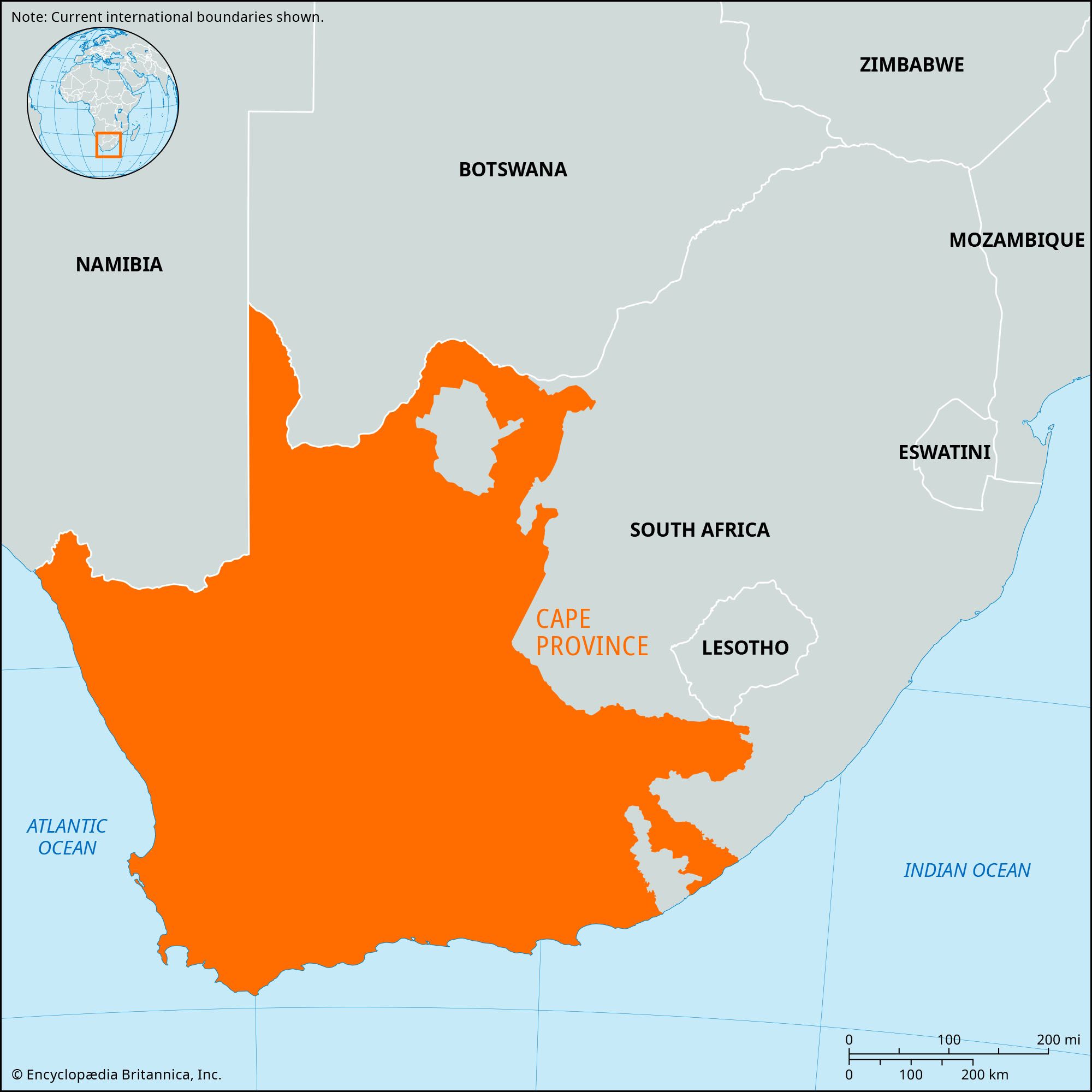
The Cape Province, initially known as the Cape Colony, was a former province of South Africa occupying the country's southern extremity. Before the establishment of the Union of South Africa in 1910, the area was known as the Cape Colony.
The British seized the Cape settlement from the Dutch in 1795 to keep it out of Revolutionary France's hands. Although the British returned the cape to the Dutch in 1803, they occupied it again in 1806. In 1814, the Dutch permanently ceded the Cape settlement to Britain, which then ruled the area as the Colony of the Cape of Good Hope, known as the Cape Colony.
In 1910, the Cape Colony joined the Union of South Africa as the Cape of Good Hope province, or Cape Province. In 1994, the Cape Province was split into three new provinces: Western Cape, Eastern Cape, and Northern Cape, with a portion joining the new North-West province.
5 Britannica SourcesCreated from Britannica articles using AI. AI can make mistakes, so verify using Britannica articles. -
Where was the Cape Province located?
The Cape Province, initially known as the Cape Colony, was located in the southern extremity of the African continent. It encompassed all of southern and western South Africa and was the largest of the four traditional provinces, covering more than half the country's total area.
The province contained the black states of Ciskei, Transkei, and Bophuthatswana within its boundaries, though these were politically distinct. The Cape of Good Hope promontory, located approximately 30 miles (48 km) south of Cape Town, gave its name to the entire province. In 1910, the Cape Colony became the Cape of Good Hope province with the formation of the Union of South Africa. In 1994, the Cape Province was split into three new provinces: Western Cape, Eastern Cape, and Northern Cape, with a portion joining North-West province.
3 Britannica SourcesCreated from Britannica articles using AI. AI can make mistakes, so verify using Britannica articles. -
What was the capital city of the Cape Province?
The capital city of the Cape Province, also known as the Cape Colony, was Cape Town. Established by the Dutch East India Company in 1652, Cape Town was intended to supply fresh food and water to Dutch trading ships. It is now the legislative capital of South Africa and the capital of Western Cape province.
3 Britannica SourcesCreated from Britannica articles using AI. AI can make mistakes, so verify using Britannica articles. -
How did the Cape Province become part of South Africa?
The Cape Province, initially known as the Cape Colony, became part of South Africa in 1910 with the formation of the Union of South Africa. This unification was established through the South Africa Act of 1909, which unified the British colonies of the Cape Colony, Natal, Transvaal, and Orange River. The Cape Colony then became the Cape of Good Hope province, also known as the Cape Province. In the Union, the Cape Province was soon surpassed economically and in population by the heavily industrialized Transvaal.
In 1994, the Cape Province was split into three new provinces: Western Cape, Eastern Cape, and Northern Cape, with a portion joining the new North-West province.
4 Britannica SourcesCreated from Britannica articles using AI. AI can make mistakes, so verify using Britannica articles. -
Why was the Cape Province important in South African history?
The Cape Province, initially known as the Cape Colony, held significant importance in South African history due to its early capitalist development and strategic location. Established by the British in 1806, it was the first area in South Africa to develop capitalist infrastructure because of its older colonial history and sea links to the British Empire.
The Cape's economy, while initially focused on wine and wool, diversified into copper mining and other ventures. The discovery of diamonds in Griqualand West (now the Northern Cape province) in 1867 spurred economic growth, attracting British immigrants and foreign capital, and leading to railway expansion.
The province played a crucial role in the series of Cape Frontier Wars with the Xhosa people, gradually annexing their territories. Despite its economic and political advancements, the Cape Province later faced economic challenges and the erosion of voting rights for non-white South Africans.
4 Britannica SourcesCreated from Britannica articles using AI. AI can make mistakes, so verify using Britannica articles. -
What happened to the Cape Province after 1994?
In 1994, the Cape Province was dissolved and split into three new provinces: Western Cape, Eastern Cape, and Northern Cape, with a portion joining the new North-West province. This reorganization occurred when the administrative creations of the apartheid system, Transkei and Ciskei, were dissolved and reincorporated back into South Africa.
The four original provinces of South Africa (Cape of Good Hope, Orange Free State, Transvaal, and Natal) and the four former independent homelands (Transkei, Bophuthatswana, Venda, and Ciskei) were reorganized into nine provinces.
4 Britannica SourcesCreated from Britannica articles using AI. AI can make mistakes, so verify using Britannica articles.
Cape Province, former province of South Africa, occupying the southern extremity of the African continent. Prior to the establishment of the Union of South Africa in 1910, the area was known as the Cape Colony. Cape Province comprised all of southern and western South Africa. It was the largest of the four traditional provinces and contained more than half the country’s total area. Located within the province’s boundaries, but politically distinct from it, were the black states of Ciskei and parts of two others, Transkei and Bophuthatswana. The name Cape of Good Hope, while specifically referring to the promontory about 30 miles (48 km) south of Cape Town (see Cape of Good Hope), officially applied to the whole province.
The interior of what would become the Cape Colony had long been inhabited by the San and Khoekhoe peoples. Some Xhosa and Zulu had also settled on the eastern seaboard by the 17th century. The Portuguese navigator Bartolomeu Dias reached the southern tip of Africa in 1488 and named it the Cape of Good Hope (Portuguese: Cabo da Boa Esperança). The first European settlement in southern Africa was established in 1652 by the Dutch East India Company at Table Bay, 30 miles (48 km) north of the cape. The settlement at Table Bay became Cape Town, whose purpose was to supply fresh food and water to Dutch trading ships rounding the Cape of Good Hope on their voyages to and from the Dutch East Indies (now Indonesia). Because the Dutch East India Company’s early farming ventures at Table Bay proved inadequate for this purpose, lands were assigned to independent Dutch settlers beginning in 1657. To supplement their labour, slaves were imported, at first from West Africa and later in larger numbers from Madagascar, Ceylon (now Sri Lanka), and the Dutch East Indies. As the amount of livestock obtainable from the nomadic Khoekhoe—called Hottentots (now pejorative) by the Dutch—to supply ships also proved insufficient, the company itself began to raise livestock and later encouraged the settlers to do so.
The cape’s early Dutch-speaking settlers gradually evolved a distinct variant of that language known as Afrikaans, and they themselves became known as Afrikaners, or Boers. By 1700 Afrikaner grain, wine, and fruit farms were scattered along the eastern foot of Table Mountain (which overlooks Table Bay) as well as along the western foot of the small mountain ranges 30–40 miles (50–65 km) to the east. The Khoekhoe offered no resistance to this encroachment and withdrew before the colonists or accepted service with them as shepherds, guides, and interpreters; in the smallpox epidemic of 1713 thousands of them died. The surviving Khoekhoe fled, and by 1730 no remnants remained within 250 miles (400 km) of Table Bay. At the same time, interbreeding between the whites, Khoekhoe, and slaves produced the ethnically mixed Cape Coloured people.



The growing volume of shipping around the cape and the consequent demand for livestock provided the incentive for the spread of colonial sheep farmers northeastward beyond the Roggeveldberg and Hantamsberg and eastward through the plateau region of the Karoo until, by 1779, they were in contact with Bantu-speaking Xhosa peoples along the Great Fish River.
Great Britain seized the Cape settlement from the Dutch in 1795 in order to keep it out of the hands of Holland’s ally, Revolutionary France. The British returned the cape to the Dutch in 1803 but occupied it again in 1806, and, at the Congress of Vienna in 1814, the Dutch permanently ceded the Cape settlement to Britain, which thenceforth ruled the area as the Colony of the Cape of Good Hope, which simply became known as the Cape Colony. In the meantime, the earliest of a long-running series of Cape Frontier Wars (1779–1879) had broken out between the Afrikaners and the Xhosa peoples. The British introduction in 1820 of some 3,500 English-speaking settlers between the Afrikaner settlers and the Xhosa failed to establish an effective buffer settlement, but it did solidify British control over the colony. The British abolished slavery in 1834 in an effort to redress some of the worst inequities between blacks and whites in the colony. The Afrikaners resented this policy and feared Britain’s attempts to Anglicize the Cape Colony at their expense. The result was the Great Trek of the late 1830s, in which about 13,000 Afrikaners left the colony, eventually to found the Boer republics of the Transvaal and the Orange Free State.
In 1853 Britain granted the Cape Colony the right to elect a bicameral legislature, though that body still had little control over the British-appointed governor-general. The voting franchise was based on property and income qualifications rather than on skin colour. The Cape Colony was granted full internal self-government in 1872, with a cabinet responsible to the legislature.
The Cape Colony repeatedly defeated the Xhosa people in the Cape Frontier Wars and gradually annexed their territories. These annexations had by 1894 advanced the frontier of the Cape Colony eastward to the Mtamvuna River, the southwestern border of the colony of Natal. All the tribal territories east of the Great Kei River were reduced to the status of tribal reserves under British colonial administration.
The trusted destination for professionals, college students, and lifelong learners.
SUBSCRIBE


The gradual northward diffusion of Afrikaner pastoralists across the interior plateau of the Upper Karoo had meanwhile led to the discovery in 1867 of diamonds in Griqualand West (now in central Northern Cape province). This in turn stimulated a rush of British immigrants, an influx of foreign capital, and the extension of railroads northward from Cape Town and other coastal cities far into the interior; in 1873–84 the small Cape Town–Wellington railway was extended more than 600 miles (1,000 km) inland to Kimberley. The discovery of diamonds also prompted Britain to annex Griqualand West in 1871, despite conflicting claims by the Orange Free State, and to hand it over to the Cape Colony. As prime minister of the Cape Colony from 1890 to 1896, Cecil Rhodes tried to cement British-Afrikaner cooperation in a possible union of southern Africa’s four territories, but this was opposed by the Transvaal and the Orange Free State, which lost their independence in the South African War (1899–1902) against Britain. In 1910 the Cape Colony joined them in the new Union of South Africa as the Cape of Good Hope province, or Cape Province.
In the union, the Cape Province was soon outstripped economically by the heavily industrialized Transvaal, which also surpassed it in population. Nor was the Cape Province’s comparatively liberal voting franchise copied by the other provinces, which continued to deny any voting rights whatsoever to nonwhite South Africans. Indeed, the Cape withdrew voting rights from Africans in 1936 and from Coloureds in 1956.
The black states of Transkei and Ciskei within the province were declared “independent” by the South African government in 1976 and 1981, respectively. These administrative creations of the apartheid system were dissolved in 1994, however, and were reincorporated back into South Africa. At that time the Cape Province was split up into three new provinces—Western Cape, Eastern Cape, and Northern Cape—with part also joining the new North-West province.