

- Formerly:
- Old Calabar

Calabar
-
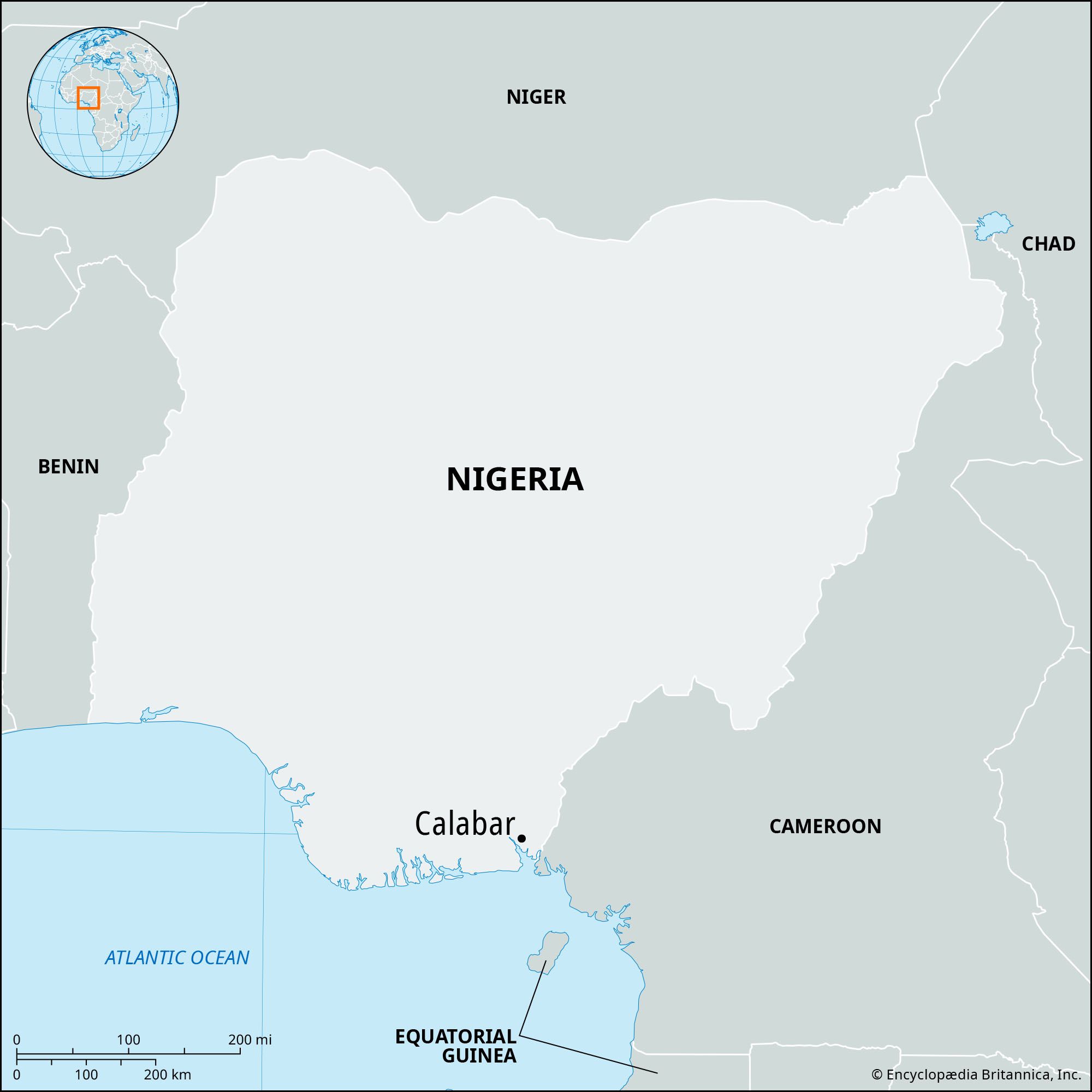
Where is Calabar located in Nigeria?
Calabar is a town and port located in southern Nigeria. It serves as the capital of Cross River state. The town lies along the Calabar River, approximately 5 miles (8 km) upstream from the river's entrance into the Cross River estuary.
The name Old Calabar was given to the African inhabitants of that part of the Gulf of Guinea coast by 15th-century Portuguese navigators.
1 Britannica SourceCreated from Britannica articles using AI. AI can make mistakes, so verify using Britannica articles. -
What is Calabar known for?
Calabar is a town and port in southern Nigeria, the capital of Cross River state. In the 17th century, the Efik people settled there, and it became a trade center between Europeans and Africans. Calabar was known for trading items such as fish, cassava, bananas, palm oil, and palm kernels for European manufactured goods and as a major slave-trading depot. After the slave trade declined, its economy relied on palm oil and kernels. Today, the port exports oil, natural gas, palm produce, timber, rubber, cocoa, and piassava fibre. Calabar has also been an educational center since 1846.
2 Britannica SourcesCreated from Britannica articles using AI. AI can make mistakes, so verify using Britannica articles. -
Which river is important to Calabar's geography?
Calabar is situated along the Calabar River, approximately 8 kilometers upstream from where the Calabar River meets the Cross River estuary. The Cross River itself rises in the western highlands of Cameroon and flows for 489 kilometers before reaching the Bight of Biafra, and it serves as an important waterway for the transport of goods such as palm oil, timber, and rubber to the port of Calabar.
3 Britannica SourcesCreated from Britannica articles using AI. AI can make mistakes, so verify using Britannica articles. -
How has Calabar's history as a port city influenced its development?
Calabar's history as a port city has significantly shaped its development. In the 17th century, it emerged as a trade center between Europeans and inland Africans, dealing in goods like fish, cassava, and palm oil, while also becoming a major slave-trading depot. By the mid-19th century, the economy shifted to palm oil and kernels after the decline of the slave trade.
After 1884, Old Calabar became the capital of the Oil Rivers Protectorate and Southern Nigeria, remaining an important port for ivory, timber, beeswax, and palm produce. The construction of roads to other regions further contributed to Calabar’s importance as a port. Today, Calabar continues to export products such as oil, natural gas, and timber.
1 Britannica SourceCreated from Britannica articles using AI. AI can make mistakes, so verify using Britannica articles. -
What are some tourist attractions or landmarks found in Calabar?
Calabar, the capital of Cross River state in southern Nigeria, is rich in history and culture. Settled in the early 17th century by the Efik people, it became a trade center between Europeans and inland Africans, dealing in goods like fish, cassava, and palm oil.
Historical highlights include Duke Town and other Efik settlements like Creek Town and Henshaw Town, once united by the Ekpe secret society. Calabar served as a key administrative center for British protectorates until the early 20th century and remains an important port for exporting oil, natural gas, and timber.
The town is also an educational hub, home to the University of Calabar and several other colleges.
1 Britannica SourceCreated from Britannica articles using AI. AI can make mistakes, so verify using Britannica articles.
Calabar, town and port, capital of Cross River state, southern Nigeria. It lies along the Calabar River, 5 miles (8 km) upstream from that river’s entrance into the Cross River estuary. Settled in the early 17th century by the Efik branch of the Ibibio people, the town became a centre for trade between Europeans on the coast and Africans farther inland. Fish, cassava, bananas, palm oil, and palm kernels were traded at Calabar for European manufactured goods, and the town also served as a major slave-trading depot. Duke Town and the other Efik settlements near Calabar—Creek Town, Henshaw Town, and Obutong (Old Town)—were forcibly united into the loosely knit state of Old Calabar by the Ekpe secret society, which was controlled by the towns’ merchant houses.
By the mid-19th century, after the waning of the slave trade, Old Calabar’s economy had become based on the export of palm oil and palm kernels. After the chiefs of Duke Town accepted British protection in 1884, the town, which was called Old Calabar until 1904, served as capital of the Oil Rivers Protectorate (1885–93), the Niger Coast Protectorate (1893–1900), and Southern Nigeria (1900–06) until the British administrative headquarters were moved to Lagos. It remained an important port (shipping ivory, timber, and beeswax, as well as palm produce) until it was eclipsed by Port Harcourt, terminus (1916) of the railroad, 90 miles (145 km) west.
The name Old Calabar (as distinguished from the port and river named New Calabar, 120 miles [193 km] west) was originally given by 15th-century Portuguese navigators to the African inhabitants of that part of the Gulf of Guinea coast. This region was the main source of the Calabar bean, a poisonous bean that, when ingested, markedly affects the nervous system.




The completion of roads from Calabar to Arochukwu, Ikom, and Mamfe (in Cameroon) and the Calabar–Itu–Expene highway (which provides easy access to the rest of Nigeria) contributed to Calabar’s initial importance as a port. The port still exports some products, including oil, natural gas, palm produce, timber, rubber, cocoa, and piassava fibre. The town has a sawmill; rubber-, food-, and oil-palm-processing plants; and a cement factory. Wood carving is a traditional art of the Efik, and the town’s artisans sculpt ebony artifacts for the tourist market in Lagos.
Calabar has long been an educational centre. Its first church school, established by Hope Waddell of the Free Church of Scotland in 1846, helped influence the Ekpe secret society to pass a law (1850) prohibiting human sacrifice. The University of Calabar (1975), a college of technology, a teacher-training college, and numerous secondary schools are located in Calabar. Pop. (2016 est.) urban agglom., 895,000.