


- French:
- Bruges


Brugge
News •
-
Where is Brugge located?
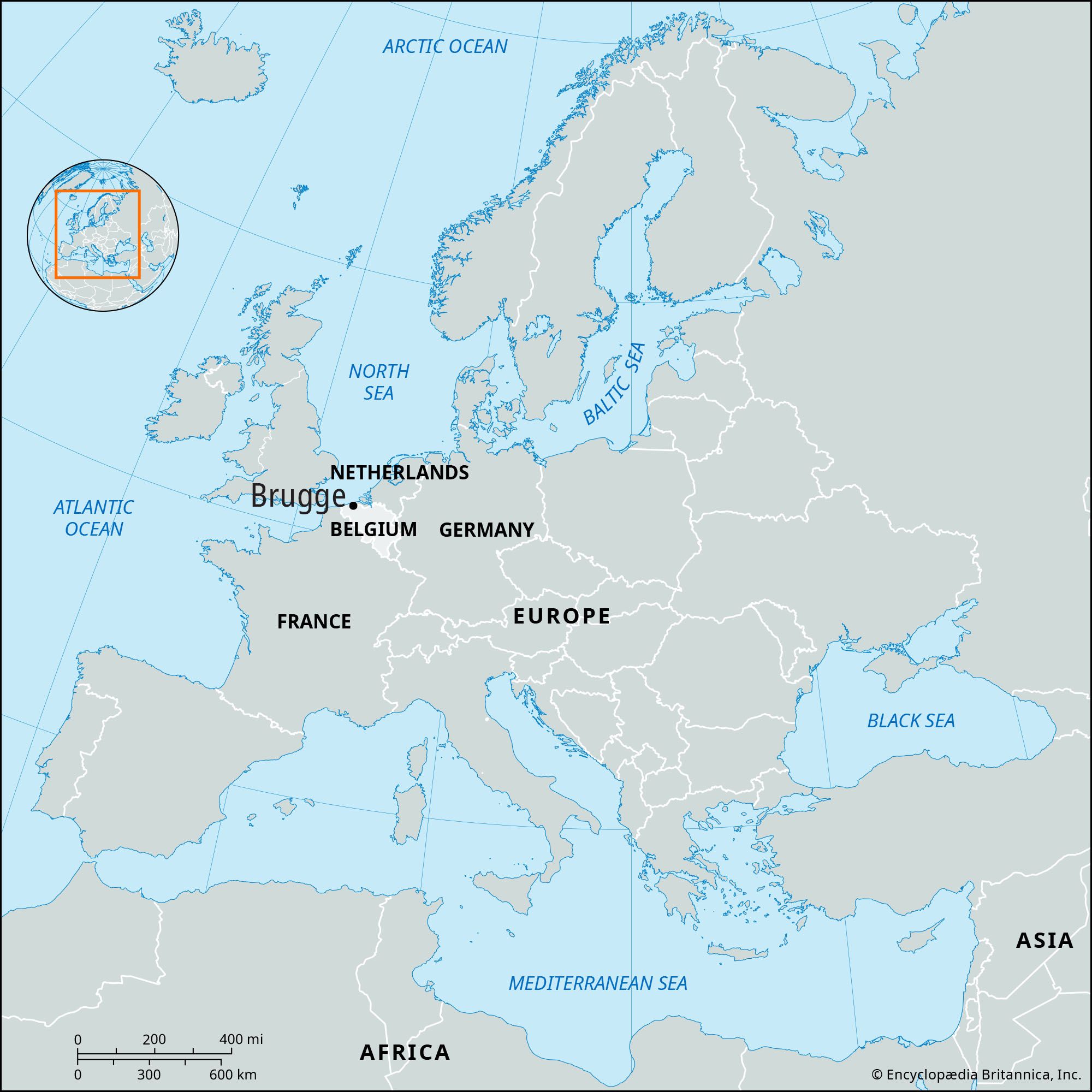
Brugge is a city in the Flanders Region of northwestern Belgium, approximately 10 miles (16 km) south of Zeebrugge, its port on the North Sea. Brugge is known for its intricate network of canals, which has earned it the nickname "Venice of the North". The city is a rail and canal junction that depends largely on tourism, but it also has a relatively new industrial area in the north that produces ships, electronic equipment, dies, yeast, and industrial glass.
3 Britannica SourcesCreated from Britannica articles using AI. AI can make mistakes, so verify using Britannica articles. -
What is Brugge known for?
Brugge, located in the Flanders Region of Belgium, was originally a landing place on the Zwijn estuary. Its network of canals has earned it the nickname “Venice of the North”.
Brugge is known for its medieval remains, such as the Old Market Hall and Town Hall. The city is also known for the Procession of the Holy Blood, a tradition parading what is said to be the coagulated blood of Christ through the city.
4 Britannica SourcesCreated from Britannica articles using AI. AI can make mistakes, so verify using Britannica articles. -
Why is Brugge called the 'Venice of the North'?
Brugge is called the "Venice of the North" because of its intricate network of canals. These waterways, initially a landing place on the Zwijn estuary where the Reie River flowed, have long been a defining feature of the city. The canals not only contribute to Brugge's picturesque charm but also played a vital role in its historical significance as a trade center.
The construction of the Brugge-Zeebrugge Canal between 1896 and 1907 further solidified Brugge's connection to the sea, restoring its status as an ocean port. This canal, along with the city's medieval remains and unique atmosphere, makes Brugge a popular destination for tourism and pageantry.
4 Britannica SourcesCreated from Britannica articles using AI. AI can make mistakes, so verify using Britannica articles. -
What historical features can you find in Brugge?
Brugge, also known as Bruges, has many historical features. Originally a landing place in the 7th century, the first counts of Flanders constructed their castle there in the 9th century.
By the 13th century, Brugge held a monopoly on English wool and was a leading emporium for the Hanseatic League. Medieval remains include the old Market Hall (13th–15th century), with a 47-bell carillon in the belfry, and the Town Hall (1376–1420). The Chapel of the Holy Blood (14th–16th century) contains the Chapel of St. Basil (1150) and a gold casket that is said to hold drops of Christ’s blood. The Bruges Concert Hall was completed in time for Brugge’s year as Capital of European Culture in 2002.
3 Britannica SourcesCreated from Britannica articles using AI. AI can make mistakes, so verify using Britannica articles. -
How has Brugge's history influenced its architecture?
Brugge's history has significantly shaped its architecture. The city's medieval remains include the Old Market Hall (13th–15th century) with its famous belfry, and the Town Hall (1376–1420). As a prominent trade center in the 13th and 14th centuries, Brugge's architecture reflected its economic power and independence. The Gothic style persisted, influencing classical architecture and giving it a unique hybrid quality. The city's religious structures, such as the Cathedral of St. Salvator (12th–16th century) and the Church of Notre Dame, showcase its historical importance as a religious center. Today, the medieval atmosphere of Brugge contributes to its appeal as a UNESCO World Heritage Site.
4 Britannica SourcesCreated from Britannica articles using AI. AI can make mistakes, so verify using Britannica articles.
Brugge, city, Flanders Region, northwestern Belgium, about 10 miles (16 km) south of Zeebrugge, its port on the North Sea. Originally a landing place on the Zwijn estuary, into which the Reie River flowed, it was mentioned in the 7th century as the Municipium Brugense (a name derived from a Roman bridge over the Reie). Brugge’s intricate network of canals has led many to describe the city as the Venice of the North. After it was evangelized by St. Eloi, bishop of Noyon-Tournai, the first counts of Flanders built their castle there (9th century) against Norman invaders. By the 13th century the town held a monopoly on English wool, was a leading emporium for the Hanseatic League, and, with the other “members from Flanders” (Ghent and Ypres), virtually governed the entire province. After maintaining its independence despite an attack by France in 1302, it reached its commercial zenith in the 14th century. At that time it was one of the largest and most important cities in northern Europe. As the Zwijn estuary silted up in the 15th century, the city began to decline as a trade centre but remained brilliant and powerful as the court of the dukes of Burgundy (counts of Flanders from 1384) and as the artistic centre of the Flemish school of painting, until the religious and political struggles of the 16th century completed its eclipse.

It remained a sleepy medieval town until the construction of the port of Zeebrugge and the cutting of a connecting canal (opened 1907) revived trade and stimulated industry and tourism. It was occupied by the Germans in World Wars I and II; the harbour of Zeebrugge was raided by the British in 1918, and blockships were sunk in the canal to deny the use of the port to German submarines.
As a rail and canal junction, Brugge depends largely on tourism, but a relatively new industrial area in the north produces ships, electronic equipment, dies, yeast, and industrial glass. Spinning, weaving, and lace making are traditional.





Medieval remains in the city include the old Market Hall (13th–15th century), with a famous 47-bell carillon in the belfry, and the Town Hall (1376–1420). The Chapel of the Holy Blood (14th–16th century) contains the Chapel of St. Basil (1150) and a gold casket that is reputed to hold a few drops of Christ’s blood brought from the Holy Land in 1150. Other notable churches include the Cathedral of St. Salvator (12th–16th century); the Church of Notre Dame, containing the tombs of Mary of Burgundy and her father, Charles the Bold; and the Church of Jerusalem (1428), a replica of the Church of the Holy Sepulchre. Notable among numerous museums with collections of Flemish art and history are the Memling Museum in the 12th-century Hospital of St. John, the Groeninge Museum, and the 15th-century Gruuthuse mansion. The béguinage (a retreat for secular nuns; 1245) is one of the finest in Belgium. The medieval atmosphere of Brugge lends itself to pageantry, a notable example of which is the Procession of Holy Blood (on Ascension Day). Pop. (2007 est.) mun., 116,982.