


Britannica AI Icon
Adding us as a Preferred Source tells Google you trust our content, so our articles show up more often in your Google Search, Discover feed, and AI Overviews.
verifiedCite
While every effort has been made to follow citation style rules, there may be some discrepancies. Please refer to the appropriate style manual or other sources if you have any questions.
Select Citation Style
Feedback
Corrections? Updates? Omissions? Let us know if you have suggestions to improve this article (requires login).
Thank you for your feedback

Our editors will review what you’ve submitted and determine whether to revise the article.

External Websites
Britannica Websites
Articles from Britannica Encyclopedias for elementary and high school students.

Basseterre

national capital, Saint Kitts and Nevis

News •

England Lions overcome West Indies ‘A’ to claim T20 series • Nov. 4, 2026, 1:10 AM ET (The Gleaner)

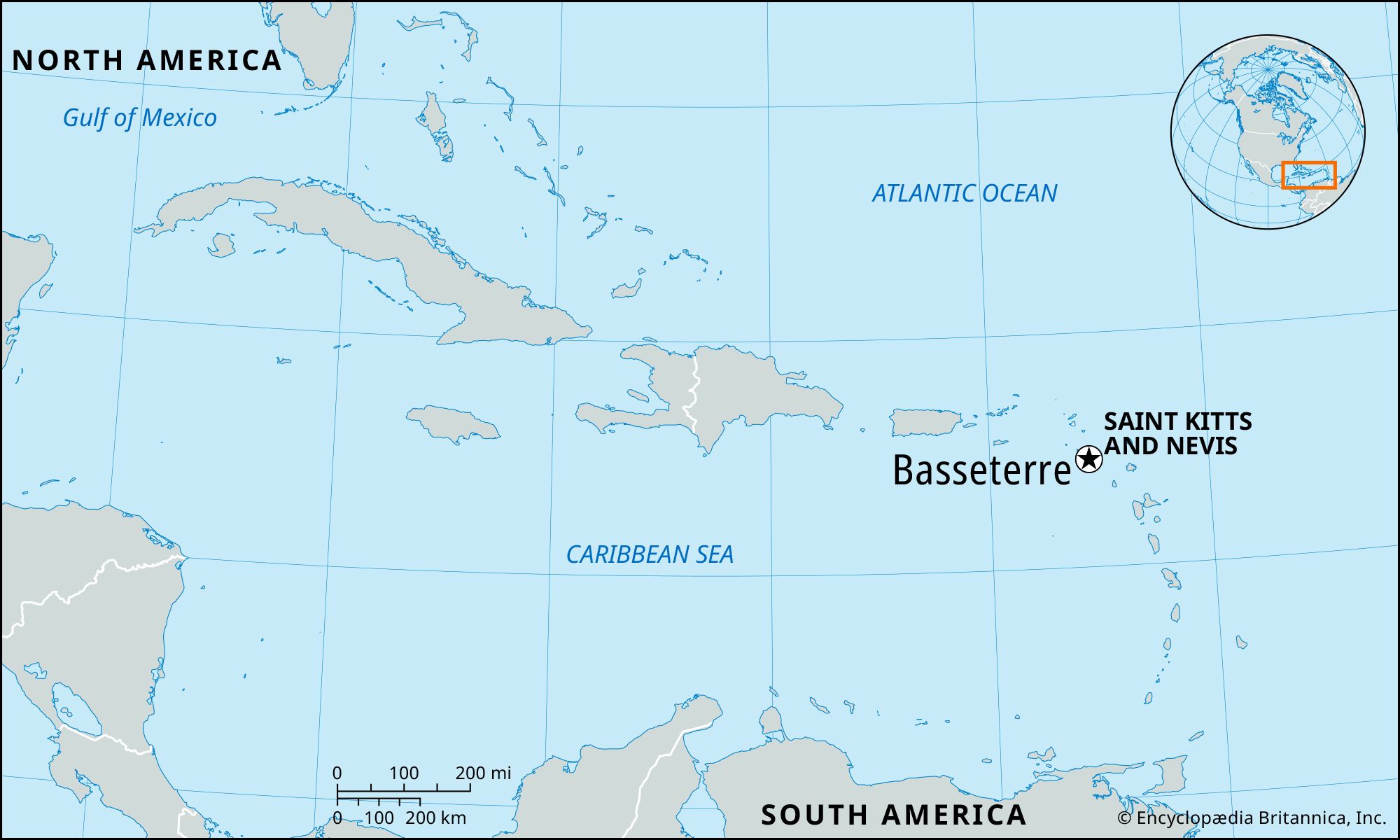
Basseterre, chief town of St. Kitts (St. Christopher) island and capital of St. Kitts and Nevis, a parliamentary federated state located in the eastern Caribbean. It lies on the island’s southwestern coast, 60 miles (100 km) west of St. John’s, Antigua. Founded in 1627 and rebuilt after being destroyed by fire (1867), it is St. Kitts’s chief port and serves as a depot distributing merchandise to neighboring islands. Sugar refining is the chief industry, and there is trade in sugar, molasses, cotton, salt, and fruit. Places of interest include St. George’s Church, Government House, Independence Square, the Circus (a thoroughfare modeled on London’s Piccadilly Circus), and a botanical garden. Robert L. Bradshaw International Airport provides links with the Caribbean and other areas. Brimstone Hill Fortress National Park (a British fortress built by slave labor in the 17th–18th century), designated a UNESCO World Heritage site in 1999, is 10 miles (16 km) northwest of the town. Pop. (2001 prelim.) 13,220.


The Editors of Encyclopaedia BritannicaThis article was most recently revised and updated by Michael Levy.
Discover the fascinating events that shaped the world, straight from our editors.
By clicking “Sign Up”, you consent to the Britannica Privacy Policy and Terms of Use.
