


Avenida 9 de Julio
Quick Summary

Avenida 9 de Julio is a major avenue in Buenos Aires, Argentina, renowned as one of the widest avenues globally. Named after Argentina's national day of independence, July 9th, it was conceived as part of a grand urban renewal project in the early 20th century, inspired by Paris's boulevards.12
The avenue cuts through the city center and features an obelisk at its intersection with Avenida Corrientes. This obelisk commemorates significant events in Buenos Aires's history, including its founding and the establishment of the Federal District. The construction of Avenida 9 de Julio in the 1930s transformed the urban landscape, creating a broad thoroughfare that remains a vital artery for the city's traffic.12
Ask Britannica AI about this topic
Britannica doesn't have a full article on this topic, so we've curated a list of our relevant coverage.
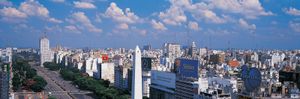 Buenos AiresCity center
Intersecting Avenida de Mayo is Avenida 9 de Julio (July 9 is Argentina’s national day of independence), called the “widest avenue in the world.” An obelisk, inaugurated in 1936, marks the intersection of Avenida 9 de Julio and Avenida Corrientes (four blocks from Plaza de Mayo). Four significant events in…
Read MoreIntersecting Avenida de Mayo is Avenida 9 de Julio (July 9 is Argentina’s national day of independence), called the “widest avenue in the world.” An obelisk, inaugurated in 1936, marks the intersection of Avenida 9 de Julio and Avenida Corrientes (four blocks from Plaza de Mayo). Four significant events in…
Read More- Buenos AiresThe independent capital
Named 9 de Julio (July 9) after the official national day of independence, that block-wide swath was cut through the city in the 1930s and opened officially in October 1937.
Read MoreNamed 9 de Julio (July 9) after the official national day of independence, that block-wide swath was cut through the city in the 1930s and opened officially in October 1937.
Read More