
- Also spelled:
- Adjara, Adzhariya, or Adžarija

Ajaria
-
What is Ajaria?
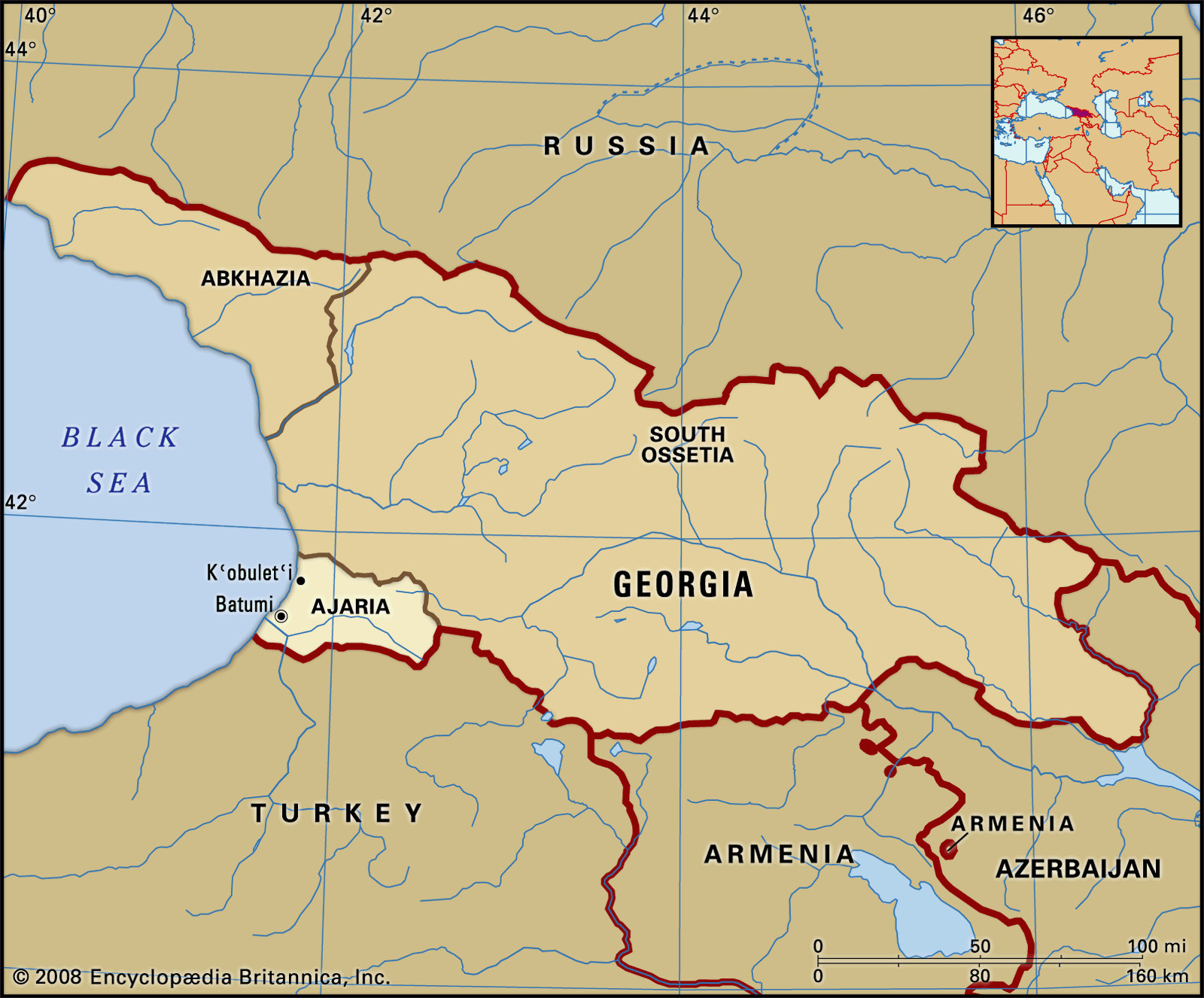
Ajaria, also known as Adzharia, is an autonomous republic in the southwestern corner of Georgia, bordering the Black Sea and Turkey. The capital and largest city is Batumi.
Geographically, Ajaria is mostly mountainous, with the exception of a narrow coastal strip. The Ajaristskali River valley lies between the Ajar-Imeretinsky and Shavshetsky ranges.
From the 17th century until 1878, Ajaria was under Turkish rule. It was then annexed by Russia and attached to Georgia. After a period as an autonomous republic of the U.S.S.R., it became part of independent Georgia in 1991 and was officially designated an autonomous republic in 2000.
2 Britannica SourcesCreated from Britannica articles using AI. AI can make mistakes, so verify using Britannica articles. -
Where is Ajaria located?
Ajaria is an autonomous republic in Georgia, situated in the country's southwestern corner, adjacent to the Black Sea and the Turkish border. The capital and largest city is Batumi. The area is largely mountainous except for a narrow strip of coast. The population includes Georgians, Russians, Armenians, and the Ajars, who are Georgians that converted to Islam under Turkish rule and represent a distinctive cultural segment of the Georgian homeland.
2 Britannica SourcesCreated from Britannica articles using AI. AI can make mistakes, so verify using Britannica articles. -
Why is Ajaria called an autonomous republic?
Ajaria is called an autonomous republic because it is a self-governing region within the country of Georgia. Following a constitutional amendment passed by the Georgian parliament in April 2000, Ajaria was officially designated as an autonomous republic. From 1922 to 1991, it was an autonomous republic of the U.S.S.R. before becoming part of the newly independent country of Georgia.
2 Britannica SourcesCreated from Britannica articles using AI. AI can make mistakes, so verify using Britannica articles. -
What is the capital and main city of Ajaria?
Ajaria, an autonomous republic in Georgia, is located in the country's southwestern corner, near the Black Sea and the Turkish border. Batumi serves as both the capital and largest city of Ajaria. It is situated on the Black Sea coast, approximately 9.5 miles (15 km) north of the Turkish border and has a history that dates back to the 1st millennium BCE. The city experiences the highest rainfall in Georgia, averaging 62 inches (1,600 mm) annually.
3 Britannica SourcesCreated from Britannica articles using AI. AI can make mistakes, so verify using Britannica articles. -
What are some important features of Ajaria's geography and culture?
Ajaria, an autonomous republic in Georgia, is characterized by its diverse geography and unique culture. The region is largely mountainous, except for a narrow strip of coastal lowlands. Two major ranges, the Ajar-Imeretinsky and Shavshetsky, rise from the Black Sea coast, with the Ajaristskali River valley nestled between them.
The coastal area has a humid subtropical climate that supports the cultivation of subtropical crops such as tea and citrus fruits. Ajaria's population includes Georgians, Russians, Armenians, and the Ajars, who represent a distinct cultural segment influenced by Turkish rule. This blend of cultures contributes to Ajaria's unique identity within Georgia.
1 Britannica SourceCreated from Britannica articles using AI. AI can make mistakes, so verify using Britannica articles. -
How has Ajaria's history influenced its relationship with the rest of Georgia?
Ajaria's history has significantly shaped its relationship with Georgia. From the 17th century until 1878, Ajaria was under Turkish rule. It was then annexed by Russia and attached to Georgia. Between 1922 and 1991, it was an autonomous republic of the U.S.S.R., later becoming part of independent Georgia.
From 1991 to 2004, Aslan Abashidze, a pro-Russian leader, governed the region. After a constitutional amendment in 2000, Ajaria was officially designated as an autonomous republic. However, relations between Ajaria and the central Georgian government worsened, especially after the 2004 election of Mikheil Saakashvili. Abashidze's refusal to recognize Saakashvili's authority led to acts such as the destruction of bridges and dismantling of rail lines.
1 Britannica SourceCreated from Britannica articles using AI. AI can make mistakes, so verify using Britannica articles.
Ajaria, autonomous republic in Georgia, in the southwestern corner of that country, adjacent to the Black Sea and the Turkish frontier. It is largely mountainous with the exception of a narrow coastal strip. Batumi is the capital and largest city. Area 1,112 square miles (2,880 square km). Pop. (2014) 333,953; (2017 est.) 339,000.
Geography
Two east-west ranges, the Ajar-Imeretinsky in the north and the Shavshetsky in the south, rise from the Black Sea coastal lowlands to more than 9,200 feet (2,800 metres). Between the ranges lies the Ajaristskali River valley, which is closed at the eastern end by a third range, the Arsiyan Mountains. The coastal lowland area, which widens somewhat to the south of Batumi and again in the north around Kobuleti, has a humid subtropical climate with average January temperatures ranging from 41 to 46 °F (5 to 8 °C) and average August temperatures ranging from 70 to 73 °F (21 to 23 °C). The climate becomes more severe in the foothills and mountains as elevation increases; above 6,000 feet (1,800 metres) it is cold, and snow lies on the summits for six months. The highest rainfall in Georgia occurs at Batumi, where an average 62 inches (1,600 mm) are recorded annually. Subtropical vegetation prevails in the lowland areas, and coniferous forests, scrub, and alpine meadows predominate on the mountain slopes.
The population includes Georgians, Russians, Armenians, and the Ajars themselves, a Georgian population Islamicized under Turkish rule. Although the Ajars are not a nationality distinct from other Georgians, they do represent a distinctive cultural segment of the Georgian homeland. Of the total population, less than one-half is urban and two-thirds live in the coastal lowlands and foothills.



Subtropical crops, which form the basis of the republic’s economy, include tea, citrus fruits, and avocados, tung trees (for oil), eucalyptus trees (camphor oil), and bamboo. Tobacco is grown in the higher areas, in which livestock raising is also important. Industrial development is concentrated around Batumi, the terminus of a pipeline from Baku on the Caspian Sea. Industrial activity includes oil refining, shipping and shipbuilding, food processing, light manufacturing, and the production of wine, plywood, furniture, and chemical pharmaceuticals. The republic is linked with the rest of Georgia by a road over the Goderdzi Pass in the Arsiyan Mountains and by the Transcaucasian Railway, which runs north along the coast from Batumi, then eastward. Ajaria has air services from Batumi to Tbilisi, Georgia; Moscow; and other cities.
History
Ajaria was under Turkish rule from the 17th century until 1878, when it was annexed by Russia and attached to Georgia. From 1922 to 1991 it was an autonomous republic of the U.S.S.R.; following the dissolution of the U.S.S.R., it became part of the newly independent country of Georgia. From 1991 to 2004, the region was under the leadership of Aslan Abashidze, a pro-Russian ruler from a distinguished family of Ajar descent. Following a constitutional amendment passed by the Georgian parliament in April 2000, Ajaria was officially designated an autonomous republic. Relations between Ajaria and the central Georgian government—already somewhat contentious—worsened following the 2004 election of Georgian Pres. Mikheil Saakashvili, whose authority Abashidze refused to recognize. In May 2004 Abashidze ordered the destruction of two bridges linking Ajaria with the rest of Georgia, as well as the dismantling of rail lines—moves he argued were acts of self-defense against a Georgian invasion. Within days of an ultimatum issued by Saakashvili calling for Abashidze to return to Georgia’s constitutional framework, as well as in the wake of broad demonstrations against the Ajar leader, Abashidze resigned his position and departed for Russia, and Ajaria was quickly placed under central authority.