


- Arabic:
- عدن (ʿAdan)


Aden
News •
-
Where is Aden located?
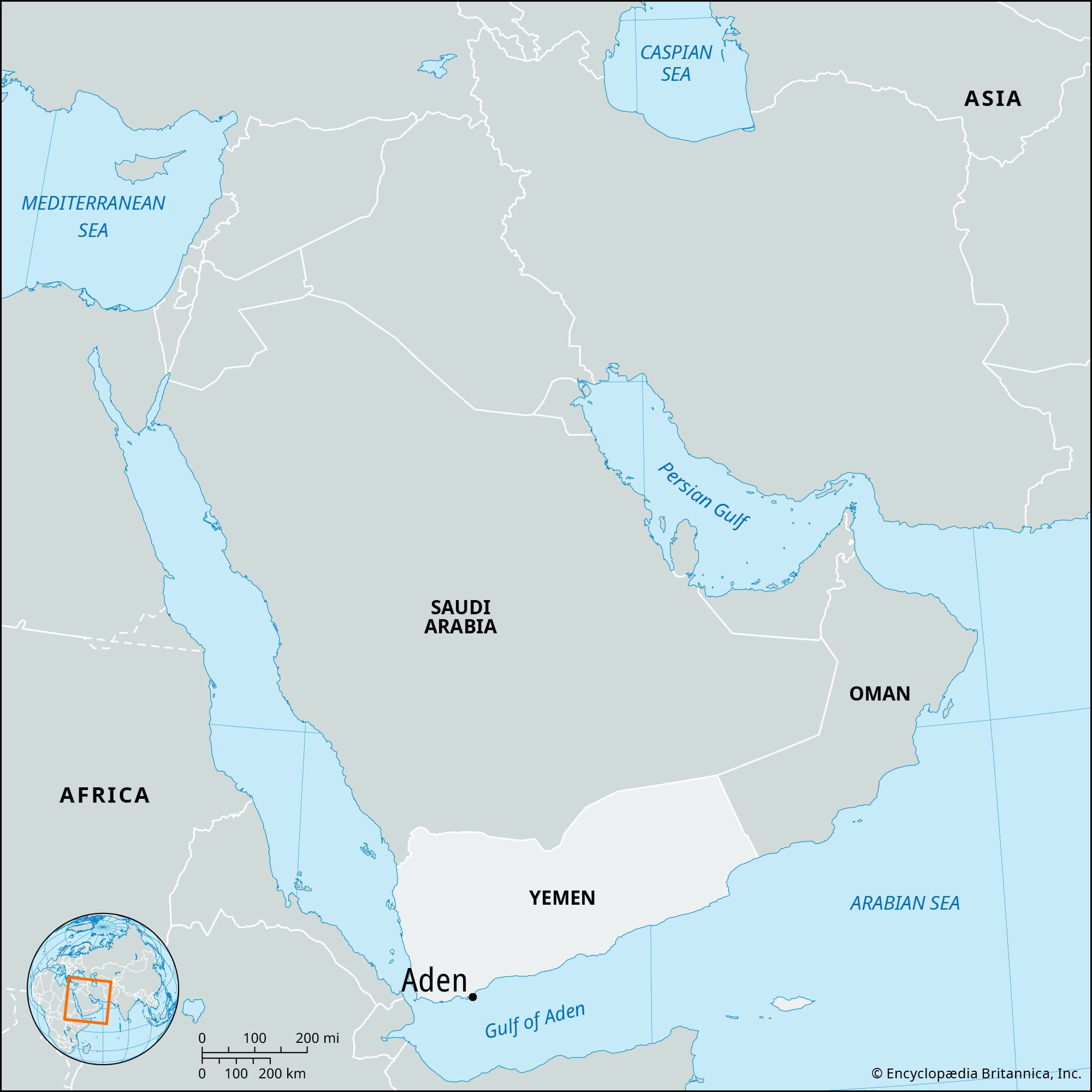
Aden is a city in Yemen, situated on the north coast of the Gulf of Aden. It lies on a peninsula that encloses the eastern side of Al-Tawāhī Harbour; Little Aden is the peninsula that encloses the harbor's western side. Sanaa is the national capital of unified Yemen, while Aden is the main economic hub.
Yemen is bounded on its south side by the Gulf of Aden and the Arabian Sea and to the west by the Red Sea.
3 Britannica SourcesCreated from Britannica articles using AI. AI can make mistakes, so verify using Britannica articles. -
What country is Aden part of?
Aden is a city in Yemen, situated on the north coast of the Gulf of Aden. Aden was under Yemeni, Ethiopian, or Arab control and later captured by the British in 1839. In 1937, it became a British crown colony but achieved independence on November 30, 1967, as part of the NLF-ruled People’s Republic of Southern Yemen. In 1990, North and South Yemen united, with Sanaa as the capital, though Aden remained a vital economic center. When Houthi rebels captured Sanaa in 2015, Yemen moved its government to Aden.
3 Britannica SourcesCreated from Britannica articles using AI. AI can make mistakes, so verify using Britannica articles. -
Why is Aden important as a port city?
Aden's significance as a port city stems from its strategic location and historical role in trade. It is situated on the Gulf of Aden, giving it a prime position on Red Sea trade routes. The British recognized its importance and seized it in 1839, developing it into a crucial coaling station and a preeminent global port. The construction of the Suez Canal in 1869 further boosted Aden's importance by revitalizing Red Sea trade. Although Aden was a free port until 1970, it still remains Yemen’s main economic hub.
2 Britannica SourcesCreated from Britannica articles using AI. AI can make mistakes, so verify using Britannica articles. -
What is the historical significance of Aden?
Aden's historical significance stems from its strategic location on the Gulf of Aden. It is mentioned in the Old Testament as a trading partner of Tyre. Aden served as a key point on the spice road of western Arabia for about a thousand years until the 3rd century CE. The British captured Aden in 1839 and Aden became a vital coaling station, earning the nickname "Coalhole of the East". Aden was a British crown colony in 1937. In 1967, Aden achieved independence as part of the People's Republic of Southern Yemen and became its capital in 1968. Though the capital of Yemen moved to Sanaa after unification in 1990, Aden remains Yemen’s main economic center.
2 Britannica SourcesCreated from Britannica articles using AI. AI can make mistakes, so verify using Britannica articles. -
How did foreign powers influence Aden in the past?
Aden's history reveals significant foreign influence. The British captured Aden in 1839, recognizing its strategic importance for communications with India and turning it into a vital coaling station. By the early 20th century, clashes between the British and Ottomans intensified along the undemarcated border, leading to a treaty that both Yemens later regarded as foreign interference. Despite Yemeni claims to Aden and the protectorate states, the British maintained control over the south, consolidating their position by incorporating Hadramawt into their protectorate system. These foreign interventions profoundly shaped Aden's trajectory, impacting its political landscape and future alliances.
2 Britannica SourcesCreated from Britannica articles using AI. AI can make mistakes, so verify using Britannica articles. -
What role does Aden play in Yemen's current politics and economy?
Aden is a port city in Yemen that serves as the country’s main economic hub. After Houthi rebels captured Sanaa in 2015, Yemen moved its government to Aden.
Aden has a long history as a strategic trade location. In 1839, the British took Aden and the island of Socotra, using it as a coaling station. Aden became a British crown colony in 1937. In 1967, Aden achieved independence as part of the NLF-ruled People’s Republic of Southern Yemen and became the national capital in 1968. In 1990, North and South Yemen merged, and Sanaa became the capital, though Aden remained the main economic center.
3 Britannica SourcesCreated from Britannica articles using AI. AI can make mistakes, so verify using Britannica articles.
Aden, city of Yemen. It is situated along the north coast of the Gulf of Aden and lies on a peninsula enclosing the eastern side of Al-Tawāhī Harbor. The peninsula enclosing the western side of the harbor is called Little Aden.
Aden has its earliest recorded mention in the Hebrew Bible’s Book of Ezekiel, where it is named alongside Canneh as one of the places with which Tyre had trading connections. Canneh and Aden were the two principal termini of the spice road of western Arabia, which was in use for about a millennium until the 3rd century ce. Later Aden continued to function as a trading center under Yemeni, Ethiopian, or Arab control. The height of trade activity in Aden began with the advent of Ayyubid rule in the 12th century and lasted until the fall of the Tahirid dynasty in the 16th century. In the 16th century the Ottomans established themselves as rulers there, and Aden’s sea trade declined as global trade routes began to bypass Ottoman control.
British interest in Aden as a strategic base dates from Napoleon’s conquest of Egypt, a conquest that was regarded as a menace to Britain’s communications with India. About 1800 the British established a garrison at Aden, and in 1802 they signed a treaty with the harbor’s ruler, the sultan of Laḥij. When steam navigation was introduced some years later, it became necessary to have a coaling station on the Red Sea route to India. Aden, which the British had captured in 1839 from the sultan, was chosen as the most suitable location and later became so heavily used as a coal-bunkering facility that it was nicknamed the “Coalhole of the East.” Certain mainland areas were purchased by the British between 1868 and 1888, and in 1937 Aden became a British crown colony. In 1953 an oil refinery was built at Little Aden, on the western side of the bay.




Aden became partially self-governing in 1962 and was incorporated in the Federation of South Arabia (comprising the former Aden Protectorate territories) in 1963. When the federation was promised independence from Britain by 1968, however, Aden became the focus of a struggle between two rival nationalist organizations, the Egyptian-supported Front for the Liberation of Occupied South Yemen (FLOSY) and the Marxist-oriented National Liberation Front (NLF), for eventual control of the country. It was as a part of the NLF-ruled People’s Republic of Southern Yemen that Aden achieved its independence on November 30, 1967, and became the national capital in 1968 of what was known as South Yemen, or Yemen (Aden). In 1990 North Yemen and South Yemen merged into the single country of Yemen, and Sanaa became the national capital of unified Yemen; Aden remained the country’s main economic hub. When Houthi rebels captured Sanaa in 2015, the internationally recognized government moved its headquarters to Aden.
The contemporary city of Aden consists of three sections: Crater, the old commercial quarter; Al-Tawāhī, the business section; and Maʿallāʾ, the main harbor area. Its economy is based almost entirely on its functions as a commercial centre for nearby states and as a refueling stop for ships. The city has some small industries, including light manufacturing, evaporation of seawater to obtain marine salt, and boatbuilding. Aden was a free port, with no customs duties, until 1970, when duties were imposed. There is an international airport at Khawr Maksar, a former Royal Air Force (RAF) base just north of Aden. The University of Aden was opened in 1970. Pop. (2004) 588,938; (2025 est.) 1,100,000.