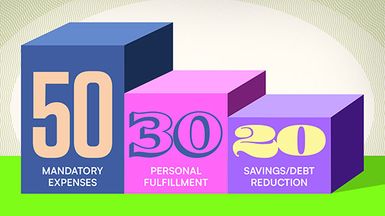
The 50-30-20 rule is a simple guideline for building a budget.
Photo illustration Encyclopædia Britannica, Inc.
The 50-30-20 rule is a common way to allocate the spending categories in your personal or household budget. The rule targets 50% of your after-tax income toward necessities, 30% toward things you don’t need—but make life a little nicer—and the final 20% toward paying down debt and/or adding to your savings.
The 50-30-20 rule isn’t meant to be a budgetary precision law, but rather a general guideline to help get you thinking about how to allocate those paychecks.
Key Points
- The 50-30-20 rule is a simple guideline (not a hard-and-fast rule) for building a budget.
- The plan allocates 50% of your income to necessities, 30% toward entertainment and “fun,” and 20% toward savings and debt reduction.
- It’s more important to understand your personal budget realities than to hit the 50-30-20 rule with precision.
Building a 50-30-20 budget
Making a monthly budget is the first step in directing your income toward your short-, medium-, and long-term goals, and the 50-30-20 rule is the first step in making a budget.
Start with your monthly post-tax income, based on recent paychecks. That’s the pie you’ll be slicing up for your 50-30-20 budget.
Mandatory expenses: The 50%
Once you know your income, look at the list of bills that you absolutely, positively need to pay each month:
These are your bare necessities. Add it all up, and if it’s half of your take-home pay or less, then you’re already on track for a 50-30-20 budget.
If it’s more than half of your income, ask yourself where you could cut back. Do you need that car for your job, or is it just for weekend cruising? How much are you paying to park it? Are you budget conscious when grocery shopping? And some of those beverages you consume should probably be in the next category.
Creature comforts: The 30%
Assuming your necessities take up half of your post-tax income, then it’s time to look at how you spend the rest. Bank and credit card statements can help you see where your “discretionary” dollars are going each month:
- Entertainment (including cable and streaming services)
- Restaurant meals
- Travel
- Shopping
- Self-care
Look back over several months to get a sense of how much you’re spending on average and how it compares with your income. If it’s more than 30%, go through the list to see which of these enjoyments you’ll miss the least, and make some cuts for the months to come.
Paying down debt and building wealth: The 20%
The last 20%—debt repayment and savings—requires some discipline. It’s tempting, particularly if you’re just starting out, to put off saving until later and limit debt payments to the required minimum each month. But consider: credit cards and student debt typically have high interest rates. High-interest debt can be a massive impediment toward meeting your financial goals.
If your debt is manageable, and that 20% is earmarked for savings, think about what you’re saving for. Many experts recommend having six months of expenses saved in an easily accessible emergency fund, usually a savings account. But if you’re saving for longer-term goals like retirement, you may want to consider an individual retirement account (IRA). If your employer offers a 401(k) plan, contribute as much as you can, particularly if the company matches a portion of your contributions.
After taxes, Ben makes $5,000 a month. If he maintains a 50-30-20 budget, then his monthly expenses might look something like this:
50% Necessities| Mortgage and homeowner dues | $1,350 |
| Car payments/insurance/fuel | $300 |
| Gas bill | $150 |
| Electric bill | $125 |
| Phone and Internet bill | $125 |
| Groceries | $450 |
| Total = $2,500, or 50% |
30% Personal Enjoyment| Cable TV and streaming | $175 |
| Shopping | $400 |
| Movies and sporting events | $250 |
| Eating out | $675 |
| Total = $1,500, or 30% |
20% Savings| Emergency fund | $650 |
| Roth IRA | $350 |
| Total = $1,000, or 20% |
When you’re just starting out, it might be impossible to hit those numbers in the short term. For example, a modest apartment in a big city can easily consume 50% of an entry-level salary. And down the road, life changes—such as the birth of a child or a career change—might interrupt your 50-30-20 targeting.
It’s a yardstick, not a hard-and-fast mandate. If you suffer a setback, just make it a point to return to 50-30-20 as soon as you can.
By the same token, when the budget is flush, feel free to raise the savings rate above 20%. Someday, your future self will thank you.
Whether you use AI or a spreadsheet, the 50-30-20 rule offers a solid starting point for budgeting your money.
Encyclopædia Britannica, Inc.