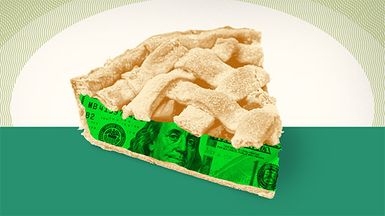
Any way you slice it, profit margins tell the story.
© Evrymmnt/stock.adobe.com, © nata777_7/stock.adobe.com; Photo illustration Encyclopædia Britannica, Inc
The first rule of business is that it can’t succeed unless it can bring in enough revenue to cover all of its costs. That’s why business owners and investors focus on profits and profit margins, which look at profit as a percentage of the revenue—or sales—that the company has brought in.
Data from a company’s income statement can be sliced and diced many ways, but executives and analysts tend to focus on gross margin, operating margin, and net margin.
- Gross margin: The percentage of sales that is kept in the business after the costs of goods sold (the direct costs for producing the goods) are deducted.
- Operating margin: The percentage of sales that is kept by the company after operating expenses are paid.
- Net margin: The percentage of sales that is kept by the company after all expenses are paid, including interest, taxes, and other nonoperating expenses.
Profit margins don’t capture everything happening in a business, but they offer a quick summation that can lead to deeper questions. Taken together, these three profit margins can help you get a first read on a business’s health.
Key Points
- Gross margin is the amount of money the company has for operations after covering the costs of the goods and services sold.
- Operating margin shows what’s left over after all the business costs are covered.
- Net margin is what’s left over for the business owners after taxes and interest expenses are paid.
Gross margin: What’s being brought in from sales?
Every business has some item or service it offers to the public in exchange for money. Clothing, electronics, gardening supplies, eye exams, tax preparation—you name it, and someone is selling it. Everything that’s for sale—whether goods or services—has associated costs: inventory, warehousing and retail space, and workers to perform the service.
It’s not always easy to get customers to part with their money. But a business can’t be successful unless it can get consumers to pay enough to cover the costs of whatever is being sold. Accountants collectively call these the cost of goods sold, or COGS.
- What gross margin is: It’s the percentage of revenue remaining after subtracting the direct costs of producing goods or services.
- How to calculate it: Start with gross profit, which is total revenue, and subtract COGS. As a percentage of revenue, gross margin = [(revenue – COGS)/revenue] x 100
- What it means: Whether the market allows the company to charge high enough prices to cover the costs of sales.
When analyzing gross margin, keep in mind that it reflects changes in the numerator (revenue) and/or the denominator (cost of goods sold). An analyst will want to see which one (or both) may be driving any change in gross margin. Revenue is driven by supply and demand.
The costs of goods and services vary with a company’s product mix, the costs of getting goods and services delivered to the customer, and the costs being charged for inventory, labor, and supplies. A detailed look at gross margin offers clues about the company’s profit potential and its management capabilities.
Operating margin: Covering the costs of doing business
Unlike gross margin, which looks at costs directly associated with sales, operating margin also considers expenses unrelated to sales that a company has to pay to run the business—those that can’t be tied to particular products, services, or customers. Examples include the costs of having headquarters and other company facilities; the accounting, legal, and human resources teams; and the company’s information technology infrastructure. These expenses are usually known as selling, general, and administrative (SG&A) expenses. Although SG&A costs are often dismissed as overhead, they are important to long-term viability.
EBIT vs EBITDA: The earnings deep dive
- What operating margin is: It’s the percentage of revenue remaining after operating expenses such as SG&A costs are deducted from gross margin.
- How to calculate it: Start with operating profit, which is gross profit minus SG&A. As a percentage of revenue, operating margin = [(revenue – COGS – SG&A)/revenue] x 100
- What it means: Whether the company has enough money to support its operations and invest in future growth.
In the short run, a company can have a negative operating margin as long as its gross margin is positive. In the long run, operating costs must be covered because most are essential to staying in business. It’s difficult to run a viable business without lawyers, accountants, and other essential functions.
Net margin: What’s the bottom line?
Net profit margin, often called the bottom line, accounts for all expenses. In addition to COGS and SG&A, net margin includes the effects of taxes, interest payments, and one-time costs. The rest is what the business’s owners earned for their investment in the company.
- What net margin is: It’s the percentage earned from sales after all costs are deducted.
- How to calculate it: Start with net profit, which is operating profit less interest, taxes, and other expenses. As a percentage of revenue, net margin = [(revenue – COGS – SG&A – interest – taxes – other expenses)/revenue] x 100
- What it means: How much money the company earned for shareholders.
If the operating margin is positive, the net margin should be, too. If not, the culprits are usually related to interest expenses and one-time charges—known in corporate lingo as nonrecurring charges. Nonrecurring items include merger and acquisition (M&A) costs, write-down of goodwill associated with a previous acquisition, fines and legal settlements, and costs associated with restructuring the business.
The bottom line for a company is the percentage of revenue that represents its net profit margin—what’s left over after all the business costs are covered. Net margin is an important measure of a company’s success, but it’s the gross margin and operating margin that give clues about how the company got there.
This article was most recently revised and updated by Ann C. LogueThis article was most recently revised and updated by Doug Ashburn