Debbie Carlson is a veteran financial journalist who writes about many personal finance and financial industry topics such as retirement, consumer spending, sustainable and ESG investing, commodity markets, exchanged-traded funds, mutual funds and much more, in an easy-to-understand way. Debbie writes for many high-level and top-tier media organizations and has contributed to Barron's, Chicago Tribune, The Guardian, MarketWatch, The Wall Street Journal, and U.S. News & World Report, among other publications. She holds a BA in Journalism from Eastern Illinois University.
Doug is a Chartered Alternative Investment Analyst who spent more than 20 years as a derivatives market maker and asset manager before “reincarnating” as a financial media professional a decade ago.
Before joining Britannica, Doug spent nearly six years managing content marketing projects for a dozen clients, including The Ticker Tape, TD Ameritrade’s market news and financial education site for retail investors. He has been a CAIA charter holder since 2006, and also held a Series 3 license during his years as a derivatives specialist.
Doug previously served as Regional Director for the Chicago region of PRMIA, the Professional Risk Managers’ International Association, and he also served as editor of Intelligent Risk, PRMIA’s quarterly member newsletter. He holds a BS from the University of Illinois at Urbana-Champaign and an MBA from Illinois Institute of Technology, Stuart School of Business.
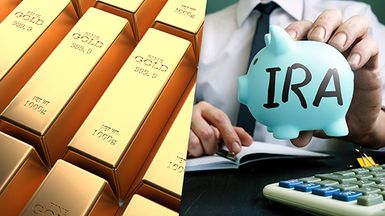
A gold IRA is a type of self-directed individual retirement account that holds physical gold and certain other IRS-approved precious metals instead of traditional investments like stocks or bonds. The metal must meet strict purity standards and be stored by an approved custodian at an IRS-approved depository rather than held directly by the account owner.
What rules apply to gold IRAs?
Gold IRAs follow the same contribution limits, required minimum distributions, and early-withdrawal penalties as other IRAs, but they also come with additional restrictions. Only specific coins and bars qualify, the gold must be held in approved storage, and physical gold is treated as a collectible for tax purposes, which can affect how gains are taxed outside a retirement account.
What are the risks of investing in a gold IRA?
Gold IRAs involve market risk, since gold prices can be volatile, and practical risk, because accessing the metal takes time and involves custodians and depositories. They also tend to carry higher ongoing costs than traditional IRAs, including account, storage, and insurance fees, and the gold itself does not generate income.
Open full sized image
Your nest egg could include gold, but know the rules.
Gold and other precious metals can help you diversify your retirement holdings.
Gold IRAs have strict rules that you must follow in order to comply with IRS rules.
ETFs and mining stocks offer other ways to get precious metals exposure in a retirement portfolio.
And if you like the idea of gold and precious metals in your retirement portfolio, but decide a gold IRA isn’t for you, there are other ways to get exposure.
How gold IRAs work
Gold IRAs were created by the Securities and Exchange Commission (SEC) specifically to hold precious metals. Gold IRAs fall under the larger category of self-directed IRAs. In addition to gold, a SDIRA can hold certain silver, platinum, and palladium products. They follow many of the same rules and regulations as traditional IRAs:
Gold IRA owners who make qualified withdrawals from a gold IRA are also subject to capital gains tax. Note that physical gold may be taxed at a higher rate than other long-held assets; the IRS taxes gold at the so-called “collectible rate,” which can be as high as 28%.
What are the risks of a gold IRA?
Like any other asset, gold prices fluctuate, and because gold has no inherent yield, all appreciation comes from the price paid for the metal. Gold IRAs are easy to open, but the trick is to fund them properly and follow IRS rules exactly. Consider all of these factors before investing in a gold IRA:
Logistics. You’re on your own to find an account custodian, gold dealer, and IRS-approved depository to hold the gold. None of these entities are fiduciaries, and they cannot vouch for each other.
Costs and fees. Working with a custodian and an approved depository involves ongoing costs, including annual account, storage, and insurance fees.
Purity. Only certain types of gold bars and coins meet IRS purity standards. Each metal has specific purity standards, but most fall in the 99% or higher range.
No direct possession. You can never touch the gold before it is deposited. If you take direct possession, it’s considered a prohibited transaction and the account loses its tax-sheltered status.
There’s no way to immediately access your gold. It takes time to ship the gold to the vault, and time for you to receive your gold as a qualified distribution. If a zombie apocalypse is headed your way, you can’t just grab your gold and run for the hills.
How much is an Olympic gold medal really worth? Explore the metals behind the medals.
Encyclopædia Britannica, Inc.
Other ways to invest in precious metals
Holding physical gold in a self-directed IRA isn’t the only way to own gold as a retirement asset. There are less complex, quicker, and cheaper ways to get exposure to the price of gold in a traditional or Roth IRA:
Physically backed gold ETFs. These exchange-traded funds (ETFs) reflect the price of gold bullion, less expenses. Like all ETFs, they trade throughout the day and are available on various trading platforms. The largest of the physically backed gold ETFs (by assets under management) is the SPDR Gold Trust (GLD). The trust owns the gold bars; they are held by a custodian in a vault. The annual cost to own the GLD ETF is 0.40%, or $4 a year for every $1,000 invested.
Gold mining funds. Investors can own both ETFs and mutual funds that invest in gold miners. Share prices for gold mining equities are affected by the price of gold and the performance of the individual company. Examples of gold mining ETFs include VanEck Gold Miners ETF (GDX) and Gabelli Gold Fund (GOLDX). Some gold mutual funds, such as First Eagle Gold Fund (SGGDX), own physical bullion to diversify their equity holdings.
Individual gold mining stocks. Investors who would prefer to choose specific gold mining companies can purchase equities. A couple of the largest gold mining companies are Barrick Gold (GOLD) and Newmont (NEM).
The bottom line
If you’d like to own physical gold as a retirement asset, a gold IRA might be a good vehicle, but you should understand that it takes time and effort to set up the account and conduct due diligence on potential custodians and dealers. It will also take time to sell the gold and receive it as a distribution.
ETFs, mutual funds, and mining stocks are alternatives to owning physical gold and can be held with less hassle.
But if you definitely want a physical gold IRA, ensure it meets IRS rules. When searching for a custodian and/or a gold dealer, ensure that they are members of the Better Business Bureau or industry-specific organizations, such as the Retirement Industry Trust Association or the Association of Trust Organizations (for trust custodians), or the Professional Numismatists Guild or Accredited Precious Metals Dealers (for gold dealers).
Is gold a good candidate for your retirement portfolio? That depends on your risk tolerance, financial plan, time horizon, and your overall asset allocation plan. For example, are you aiming for maximum growth, or are you looking for your portfolio to hold its value over time?
Gold may be volatile in the short run, but the yellow metal is often seen as a longer-term store of value. In a 2012 research paper, Campbell Harvey and Claude Erb presented historical evidence that the wage of a Roman centurion as measured in gold was approximately the same as a U.S. Army captain’s pay. Two millennia of boom and bust, war and peace, the rise and fall of civilizations, and gold has essentially held its relative value.
For an investor interested in precious metals as a diversifier and alternative investment, gold can play a small part in an overall portfolio. And if you’re not sure, consider starting with a small allocation. Among those who do include alternatives in a portfolio, many limit commodities such as gold to about 5% or 10% of their total asset base.
This article is intended for educational purposes only and not as an endorsement of a particular financial strategy, company, or fund. Encyclopædia Britannica, Inc., does not provide legal, tax, or investment advice. Please consult your legal or tax advisor before proceeding.
This article was most recently revised and updated by Debbie CarlsonThis article was most recently revised and updated by Doug Ashburn