Doug is a Chartered Alternative Investment Analyst who spent more than 20 years as a derivatives market maker and asset manager before “reincarnating” as a financial media professional a decade ago.
Before joining Britannica, Doug spent nearly six years managing content marketing projects for a dozen clients, including The Ticker Tape, TD Ameritrade’s market news and financial education site for retail investors. He has been a CAIA charter holder since 2006, and also held a Series 3 license during his years as a derivatives specialist.
Doug previously served as Regional Director for the Chicago region of PRMIA, the Professional Risk Managers’ International Association, and he also served as editor of Intelligent Risk, PRMIA’s quarterly member newsletter. He holds a BS from the University of Illinois at Urbana-Champaign and an MBA from Illinois Institute of Technology, Stuart School of Business.
Encyclopaedia Britannica's editors oversee subject areas in which they have extensive knowledge, whether from years of experience gained by working on that content or via study for an advanced degree. They write new content and verify and edit content received from contributors.

In options trading, extrinsic valueâalso called time valueâis the current market value of uncertainty in the option between now and the optionâs expiration. If an option is in the money, the extrinsic value is the amount of the premium over and above its intrinsic value. If an option is currently out of the money, its premium is entirely made up of extrinsic value.
For example, if stock XYZ is trading for $60 per share, and a call option at the 55-strike is trading for $6.25, that option would have $5 of intrinsic value (because the stock is trading exactly $5 above the strike price) and $1.25 of extrinsic value. If a call option at the 65-strike (which is out of the money) is trading for $0.40, it would have $0.40 of extrinsic value.
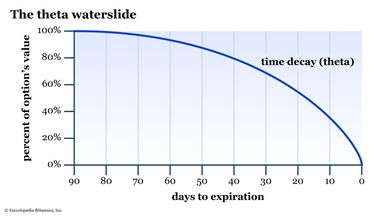
A rise in an optionâs implied volatility (as measured by the variable vega) will raise its extrinsic value. As time passes, all else equal, an optionâs value will erode (as measured by the variable theta, also known as âtime decayâ).
When an option expires, it has zero extrinsic value.
This article was most recently revised and updated by Doug Ashburn